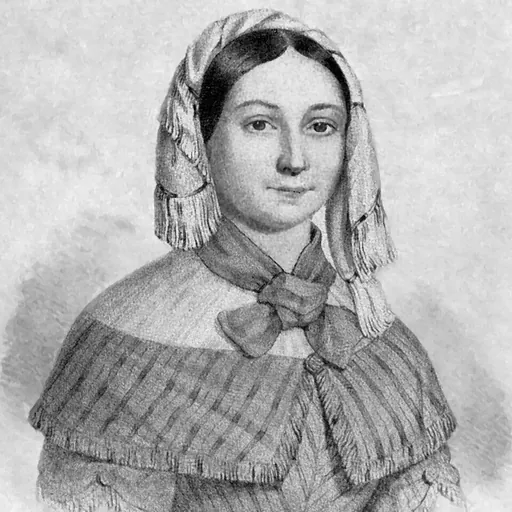
About Emilie Flygare-Carlén
Lived 1807 – 1892 (aged 84). Emilie Flygare-Carlén was a Swedish author, writer and novelist.
Emilie Flygare-Carlén (; August 8, 1807 – February 5, 1892) was a Swedish novelist.
Biography Emilie Smith was born in Strömstad and grew up in the archipelago of Bohuslän. Her father, Rutger Smith, was a retired sea captain who had settled down as a small merchant, and she often accompanied him on the voyages he made along the coast. She thus came in frequent contact with the seafaring folk, fishermen, and smugglers who were to populate her later stories. At the age of twenty, she married a local physician, Axel Flygare, and went with him to live in the province of Småland. She was widowed in 1833, returned to her old home, and decided to devote herself to literature.
She moved to Stockholm some years later, and in 1841 she married a lawyer, publicist and poet of that city, Johan Gabriel Carlén (1814–1875). Her house became a meeting place for Stockholm men of letters, and for the next twelve years she produced one or two novels annually. The premature death of her son Edvard Flygare (1829–1853), who had already published three books, showing great promise, was followed by six years of silence, after which she resumed her writing until 1884.
She founded charitable endowments in aid of students and of teachers, and of fishermen and their widows. She is best known by the hyphenated name Flygare-Carlén. She died in Stockholm. Her daughter, Rosa Carlén (1836–1883), was also a popular novelist.
Publications Her first novel, Valdemar Klein, was published in 1838. In that and several later novels, such as Rosen på Tistelön (1842; Eng. trans. The Rose of Tistelön, 1842), Pål Värning, Enslingen på Johannisskäret (1846; Eng. trans. The Hermit, 4 vols., 1853), Jungfrutornet, and Ett köpmanshus i skärgården (1859; The Merchant's House on the Cliffs), she wrote about life in the archipelago and the sea, while the stories of novels such as Fosterbröderna, Fideikommisset, Ett år, En nyckfull kvinna, Kamrer Lassman, and Vindskuporna take place in the middle or upper classes.
Her novels were collected into 31 volumes (Stockholm, 1869–1875). In 1878, she published an autobiography, Minnen af svenskt författarlif 1840–1860 (Reminiscences of Swedish Literary Life). She was translated into Danish, Norwegian, German, Russian, French, English, Italian, Portuguese, Dutch, Hungarian and Czech, and was the most widely read Swedish novelist of her time.
In 2007, Valancourt Books released a new scholarly English edition of The Magic Goblet (Kyrkoinvigningen i Hammarby, 1841), edited by Amy H. Sturgis.
Don’t just read it —
keep it.
Full-length biographies made to live with: read them, listen on the way to work, watch them tonight.
- E-book
- Audio
- Video
Instant download · yours to keep · every purchase keeps this site free
Important facts
People in Emilie Flygare-Carlén's life
Named in this biography and alive at the same time
Related people
Same field, nearest in time



Contemporaries
People whose lives overlapped Emilie Flygare-Carlén's






Frequently asked questions
Who was Emilie Flygare-Carlén?
Swedish novelist (1807-1892)
When was Emilie Flygare-Carlén born?
Emilie Flygare-Carlén was born on 8 August 1807 in Strömstad.
When did Emilie Flygare-Carlén die?
Emilie Flygare-Carlén died on 5 February 1892 in Stockholm City.
What was Emilie Flygare-Carlén's occupation?
Emilie Flygare-Carlén was an author, writer and novelist.
What nationality was Emilie Flygare-Carlén?
Emilie Flygare-Carlén was Swedish.
Sources & further reading
· Wikipedia: Emilie Flygare-Carlén
· DBpedia: Emilie Flygare-Carlén
Cite this page
APA: Biography.guide. (2026). Emilie Flygare-Carlén. https://biography.guide/emilie-flygare-carlen/
MLA: "Emilie Flygare-Carlén." Biography.guide, https://biography.guide/emilie-flygare-carlen/.
Chicago: "Emilie Flygare-Carlén." Biography.guide. https://biography.guide/emilie-flygare-carlen/.
Data last updated: 2026-09-22 · Spot an error? Report a correction.
Portrait: Wikimedia Commons · author & licence
Page generated 2026-09-27 05:02 UTC