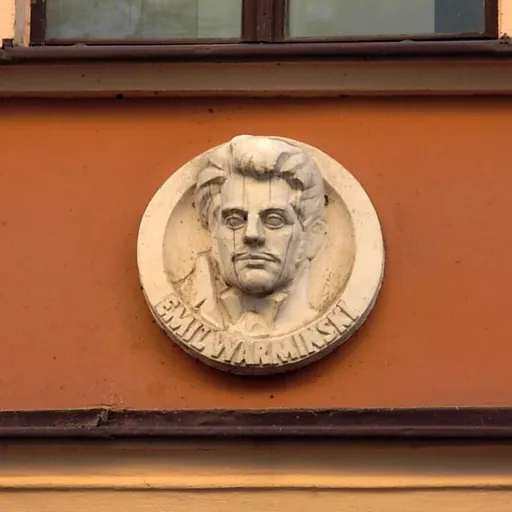
About Emil Warmiński
Lived 1881 – 1909 (aged 28). Emil Warmiński was a physician and activism, known for Bydgoszcz.
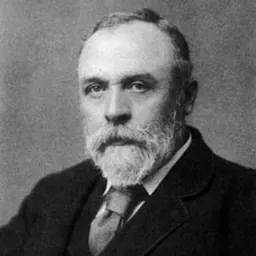
Emil Warmiński (15 March 1881 – 9 June 1909) was a Polish physician, social and national activist and founder of the Polish House in Bydgoszcz.
Biography Youth
Emil Warmiński was born on 15 March 1881 in a tenement at 6 Plac Poznański in Bromberg, then part of the German Empire. He was the son of Otto Ferdynand, a court secretary, and Małgorzata née Siudzińska, from Szubin. He had three sisters, Maria, Helena and Stanisława.
He decided to join the Sokół Polish Gymnastic Society and began to work for Polish organizations in exile. In 1904, he completed his studies in the city of Freiburg im Breisgau. The same university conferred on him the title of Doctor of Medicine, for his presentation of a thesis dealing with typhoid fever. the "Halka" Singing Society as a board member; the Society of Polish-Catholic Workers ; the Industrial Association of Bydgoszcz , created by Teofil Magdziński in 1872. Furthermore, he assisted to the establishment of: the Merchants' Society , becoming one of its member in 1909; the Merchant Youth Society ; the Nadnotecki Association of Doctors , created as a form of reaction against germanization.
During the period of Polish strikes caused by the ban on the use of the Polish language during religion classes (1907), Emil founded a library and a reading room for children. Later, he contributed to set up a reading room for women, which soon became the largest and most active institution of this type in the Province of Posen. In 1907, with the accumulated funds of his building company established four years ago while in studies in Germany, he purchased a building at 6 Gamm straße, today's 11 Doktora Emila Warmińskiego street. There Warmiński organized the first Polish House in the city, operating as a center of cultural and social life of Polish society under Prussian rule. It soon became the corner stone of the national Polish revival of Bydgoszcz. Unfortunately, the building was destroyed in August 1919, just before the city re-joined the newly re-created state of Poland.
"Invited to numerous rallies in Bydgoszcz, Gniezno, Inowrocław, Toruń and other nearby villages, Warmiński delivered passionate speeches in defense of the endangered Polish peoples", as wrote his wife Halina in her diary. Emil Warmiński was buried in the family vault in the Starofarny cemetery at 15 Grunwaldzka street. Following his death, the editorial office of the "Dziennik Bydgoski" recalled the figure and merits of the honorable doctor of "Polish hearts and souls". Przemysław Maria Longinus (1908–1939), who became an accomplished tennisman, four-time Polish tennis representative at the Davis Cup and winner of two national championship (in 1930 in mixed double with Jadwiga Jędrzejowska, in 1932 in double with Ignacy Tłoczyński). In addition, he took part in the ice hockey league with the AZS Poznań, winning the Polish championship in 1934. In 1938, he became the coach of the national hockey team. Like his father, he was an activist in several associations. He joined the far-right National Radical Camp . After his sporting career, he became a journalist, writing about the political achievements of Germany and warning against the dangers of Nazi Germany in 1938–1939. Mobilized in September 1939 as a second lieutenant in the reserve, he died on 26 September 1939 during the Siege of Warsaw (1939). Przemysław Warmiński was buried in the Avenue of the Distinguished at the Powązki Cemetery. He was since the 1880s a member of the Historical Society for the Nadnotecki District in Bydgoszcz and actively participated in the work of professional and medical organizations. He often lectured doctors traveling to meetings about the benefit of balneotherapy in stations in Italy and North Africa. A wealthy man and a passionate traveler, he undertook distant journeys, as far as Africa. This plaque stood until the demolition of the building in February 2019: however, the commemorative plaque will be positioned back on the plot at the end of the building works.
In 1959, another commemorative plaque was set on the wall of High School Nr.1 on Plac Wolności, where Emil Warmiński studied.
On 30 December 1959 the name Emil Warmiński was given to a hospital in Bydgoszcz, at 19 Szpitalna street.
In 1980, a medallion-shaped sgraffiti of Emil Warmiński, designed by Witold Wasik, was set up on the front elevation at 2 Jezuicka Street, housing inter alia, the Library of the History Department of Kazimierz Wielki University and the Department of Culture of the City Hall. This medallion is part of a series comprising four other scientists and artists associated with Bydgoszcz and the region: Jan Kasprowicz, Jan Śniadecki, Jędrzej Śniadecki and Leon Wyczółkowski.
On 12 December 1986 the name Emil Warmiński was given to the Bydgoszcz Medical Schools at 10 Swarzewska.
Emil's busts can be found in the city hospital (since 1975) and in the hall of the Secondary School N.8 (since 1986).
In 2017, the namesake of Emil Warmiński has been assigned by plebiscite of Bydgoszcz inhabitants to one of the 18 new tramways purchased by the city.
Don’t just read it —
keep it.
Full-length biographies made to live with: read them, listen on the way to work, watch them tonight.
- E-book
- Audio
- Video
Instant download · yours to keep · every purchase keeps this site free
Important facts
People in Emil Warmiński's life
Named in this biography and alive at the same time
Related people
Same field, nearest in time



Contemporaries
People whose lives overlapped Emil Warmiński's


Frequently asked questions
Who was Emil Warmiński?
Polish physician
When was Emil Warmiński born?
Emil Warmiński was born on 15 March 1881 in Bydgoszcz.
When did Emil Warmiński die?
Emil Warmiński died on 9 June 1909 in Poznań.
What was Emil Warmiński's occupation?
Emil Warmiński was a physician and activism.
What was Emil Warmiński known for?
Emil Warmiński was known for Bydgoszcz.
Sources & further reading
Cite this page
APA: Biography.guide. (2026). Emil Warmiński. https://biography.guide/emil-warminski/
MLA: "Emil Warmiński." Biography.guide, https://biography.guide/emil-warminski/.
Chicago: "Emil Warmiński." Biography.guide. https://biography.guide/emil-warminski/.
Data last updated: 2026-09-24 · Spot an error? Report a correction.
Portrait: Wikimedia Commons · author & licence
Page generated 2026-09-27 05:09 UTC