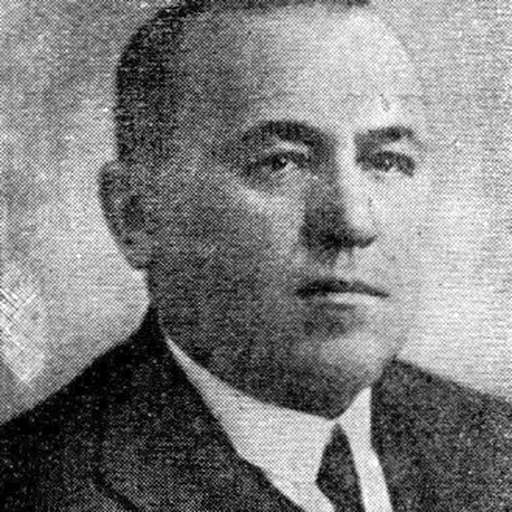
About Emil Hațieganu
Lived 1878 – 1959 (aged 80). Emil Hațieganu was an Austrian and Romanian jurist.
Emil Hațieganu (December 9, 1878—May 13, 1959) was a Romanian politician and jurist, a prominent member of the Romanian National Party (PNR) and of its successor, the National Peasants' Party (PNȚ); he was physician Iuliu Hațieganu's brother. Before his arrest, he was an honorary member of the Romanian Academy.
He was born in Tritenii de Jos, Transylvania (inside the Kingdom of Hungary in Austria-Hungary at the time, now in Cluj County, Romania), the son of , a Greek Catholic priest. He attended gymnasium and high school in Blaj and Cluj, and then studied Law at Franz Joseph University in Cluj, graduating in 1901. Afterwards, he practiced Law and was a judge in Huedin, Ileanda, and Cluj.
Hațieganu later became a professor at the University of Cluj, and served as its rector in 1929–1930. Following World War I and the Aster Revolution in Hungary, he was present with PNR leaders at the Alba Iulia assembly that called for the union of Transylvania with Romania, and served on the Directory Council designated by the participants.
A Minister of Labour and Social Security in the Iuliu Maniu cabinets in Bucharest, he was kept in the Gheorghe Mironescu government (that brought about the return of Carol II as King of Romania). Hațieganu also held the office of Minister of State for Transylvania. In 1940, he became noted for his vocal protest against the cession of Northern Transylvania to Hungary (the signing of the Second Vienna Award).
In front of mounting Communist influence, Hațieganu approached Iuliu Maniu with a proposal to establish direct contacts with the Western Allies by having Ion Mihalache evade the country (July 1947); the attempt, known as the Tămădău Affair, eventually led to the prosecution of the PNȚ leadership during a show trial and to an official ban on all party activities.
Arrested in Sibiu by the authorities of Communist Romania, he was investigated by the notorious Securitate officer . He was incarcerated at Cluj, Sighet, Jilava, Văcărești, and Ocnele Mari. In 1951, the term of his imprisonment in the infamous Sighet Prison was increased by another 60 months. He was released on June 15, 1955, and died in Cluj four years later.
Don’t just read it —
keep it.
Full-length biographies made to live with: read them, listen on the way to work, watch them tonight.
- E-book
- Audio
- Video
Instant download · yours to keep · every purchase keeps this site free
Important facts
People in Emil Hațieganu's life
Named in this biography and alive at the same time



Related people
Same field, nearest in time


Contemporaries
People whose lives overlapped Emil Hațieganu's




Frequently asked questions
Who was Emil Hațieganu?
Romanian politician (1878–1959)
When was Emil Hațieganu born?
Emil Hațieganu was born on 9 December 1878 in Tritenii de Sus.
When did Emil Hațieganu die?
Emil Hațieganu died on 13 May 1959 in Cluj-Napoca.
What was Emil Hațieganu's occupation?
Emil Hațieganu was a jurist.
What nationality was Emil Hațieganu?
Emil Hațieganu was Austrian and Romanian.
Sources & further reading
Cite this page
APA: Biography.guide. (2026). Emil Hațieganu. https://biography.guide/emil-hatieganu/
MLA: "Emil Hațieganu." Biography.guide, https://biography.guide/emil-hatieganu/.
Chicago: "Emil Hațieganu." Biography.guide. https://biography.guide/emil-hatieganu/.
Data last updated: 2026-09-21 · Spot an error? Report a correction.
Portrait: Wikimedia Commons · author & licence
Page generated 2026-09-27 05:00 UTC