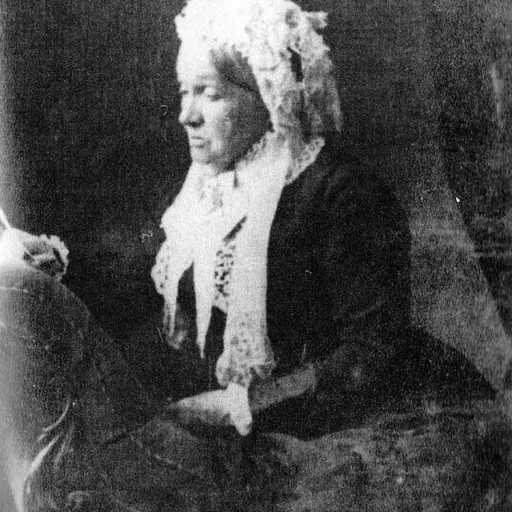
Elizabeth Throsby
Australian survivor of the 1809 Boyd massacre
About Elizabeth Throsby
Lived 1807 – 1891 (aged 83).
Elizabeth Isabella Throsby (née Broughton; 4 February 180714 January 1891) was an Australian survivor of the 1809 Boyd massacre.
Born on Norfolk Island, Throsby was two years old when she and her mother left Sydney on the Boyd, bound for England via New Zealand. During the voyage, a dispute broke out between the ship's English captain and a Māori passenger, the son of a Māori chief who was returning to his home at Whangaroa Harbour. Once there, his tribe learned of the captain's ill-treatment of him, and sought revenge by murdering and cannibalising most of the 70 passengers and crew, including Throsby's mother. Throsby and three other survivors were rescued a few weeks later by merchant and explorer Alexander Berry, who took them to Lima, Peru. Throsby remained there for 10 months. Berry then took her to Rio de Janeiro where they arrived a full two years after Betsy had been rescued. He transferred her to a whaling vessel that was bound for Sydney where she was reunited with her father.
She went on to marry in her late teenage years and raise a large family at Throsby Park south of Sydney, where she remained for the rest of her life.
Birth and family Elizabeth Broughton was born on 4 February 1807 on Norfolk Island—then a satellite penal station of New South Wales and now an external territory of Australia—as the youngest of five children to Englishman William Broughton and his common-law wife, London-born convict Ann Glossop, of Welsh descent. Born in Chatham, Kent in 1768, William travelled to New South Wales in 1787 aboard the First Fleet convict transport Charlotte, as a free servant of John White, the colony's first Surgeon-General. Upon arrival in Botany Bay, Sydney on 20 January 1788, Broughton and White commissioned a convict on the ship, Thomas Barrett, to strike each of them a medallion to commemorate the voyage. Broughton supplied Barrett with the metal and engraving tools, as well as the ship's coordinates for recording.
In 1792, while working as a store-keeper in Parramatta, Broughton met Glossop, who had been transported to the colony that year aboard the Pitt. They moved to Norfolk Island in 1800 when he became its acting deputy-commissary. In the wake of the Rum Rebellion of 1808, they returned to Sydney, where Broughton replaced Bligh loyalist John Palmer as commissary of New South Wales.
Boyd massacre and rescue
The Boyd, a convict transport captained by John Thompson, arrived in Sydney from Ireland in August 1809, and two months later was chartered by ex-convict Simeon Lord to take seal skins to England. On the way, the Boyd was to call at New Zealand to complete the cargo with kauri spars, and also drop off several young Māori at Whangaroa Harbour, among them Te Ara, the son of a Ngāti Uru chief. Among the passengers bound for England were the emancipated Glossop and two-year-old Elizabeth, possibly to visit her siblings who had been sent there for their education.
The Boyd reached Whangaroa in December and Te Ara's tribe soon learned of his punishment. This only deepened their desire for "utu", for they had grown suspicious of Europeans since another ship's visit in 1808 resulted in a deadly outbreak of disease among Māori, which they believed to be a curse. Then, as night fell, Māori assaulted the Boyd, murdering and later cannibalising most of the 70 remaining passengers and crew, including Glossop. Elizabeth was one of only four passengers to survive the massacre. ) possession and found to be "greatly emaciated", dressed only in a linen shirt and with white feathers ornamenting her hair "in the fashion of New Zealand".
Richard Read portrait
William Broughton had Richard Read paint a portrait of Elizabeth as a gift for the family who had cared for her in Lima. Read was an English-born artist who was transported as a convict to New South Wales for 14 years for possessing forged banknotes. Within two months of his arrival in Sydney in October 1813, he was granted a ticket of leave, and went on to establish Australia's first drawing school, in Pitt Street, in 1814, the year he painted Elizabeth's portrait. and is one of the earliest extant portraits of an Australian-born European.
The portrait was rediscovered in England in the early 1950s by art collector Rex Nan Kivell, who found inside the back of the frame a letter from Broughton to Elizabeth's adopted family in Lima, thanking them for "nobly distinguishing themselves by their humanity in their protection and benevolent treatment of the child". Also during Elizabeth's absence, and after the death of Glossop, Broughton married and had children with widow Elizabeth Charlotte. In 1814, the murder of a Gandangara boy by a soldier on Lachlan Vale triggered a series of reprisals that culminated in a massacre of at least 14 Aboriginal Australians on and around Broughton's land. Broughton subsequently drew the ire of colonists who sought peaceful race relations in the area, including Charles Throsby, a vocal champion of Aboriginal people since meeting them while exploring the Southern Tablelands. The Broughtons and Throsbys reconciled in 1824 when Elizabeth, aged 17, married Charles Throsby's nephew, also named Charles Throsby. Elizabeth moved to Moss Vale to live with her husband at Throsby Park, granted to Charles Throsby after his retirement as surgeon of the Coal River penal colony.
The Throsbys managed to weather the depression of the 1840s, and in 1845, Throsby Jr. funded the construction of Christ Church in Bong Bong, near Moss Vale. After a few months of ill-health, Elizabeth died at Throsby Park on 14 January 1891, aged 83, and was buried in the cemetery next to the church. Her funeral service had fifty vehicles in the cortege and was conducted by three clergymen with mourners from throughout New South Wales in attendance.
Don’t just read it —
keep it.
Full-length biographies made to live with: read them, listen on the way to work, watch them tonight.
- E-book
- Audio
- Video
Instant download · yours to keep · every purchase keeps this site free
Important facts
People in Elizabeth Throsby's life
Named in this biography and alive at the same time





Contemporaries
People whose lives overlapped Elizabeth Throsby's





Frequently asked questions
Who was Elizabeth Throsby?
Australian survivor of the 1809 Boyd massacre
When was Elizabeth Throsby born?
Elizabeth Throsby was born on 4 February 1807 in Norfolk Island.
When did Elizabeth Throsby die?
Elizabeth Throsby died on 14 January 1891 in Moss Vale, New South Wales.
Sources & further reading
· Wikipedia: Elizabeth Throsby
Cite this page
APA: Biography.guide. (2026). Elizabeth Throsby. https://biography.guide/elizabeth-throsby/
MLA: "Elizabeth Throsby." Biography.guide, https://biography.guide/elizabeth-throsby/.
Chicago: "Elizabeth Throsby." Biography.guide. https://biography.guide/elizabeth-throsby/.
Data last updated: 2026-09-24 · Spot an error? Report a correction.
Portrait: Wikimedia Commons · author & licence
Page generated 2026-09-27 05:08 UTC