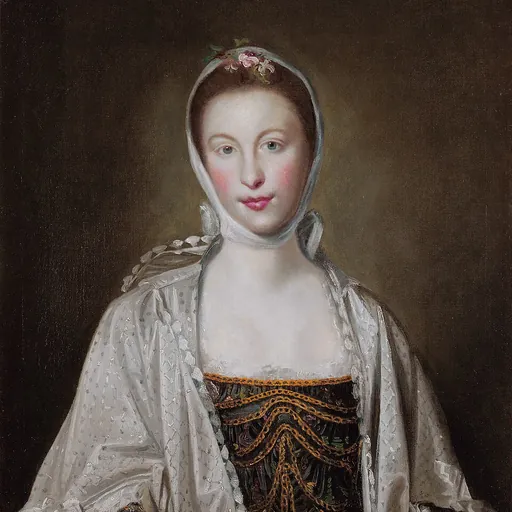
About Elizabeth Rawdon, Countess of Moira
Lived 1731 – 1808 (aged 77). Elizabeth Rawdon, Countess of Moira was a politician.
Elizabeth Rawdon, Countess of Moira in the Peerage of Ireland (23 March 1731 – 11 April 1808) was a political hostess, literary patron and antiquarian. She was born at Donington Park, Leicestershire, England and died at Moira, County Down, Ireland. and 15th Baroness Hungerford, inheriting the titles on the death of her brother Francis Hastings, 10th Earl of Huntingdon.
She was the third wife of John Rawdon, 1st Earl of Moira, in Dublin an opposition peer in the Ascendancy Parliament, and on his County Down estate an "improving landlord". She preferred Moira House in Dublin, the Irish capital, where, having established her liberal credentials as a critic of the American War, she hosted the Whig opposition and the literary avant garde. Among her guests were Henry Grattan, leader of the Patriot party in the Irish Commons; Charles James Fox, his English counterpart; the radical MP William Todd Jones for whom voters had defied their landlord, the Moiras’ county neighbour, the Marquess of Hertford;
A bluestocking set was her salon’s most distinctive feature. It included Charlotte Brooke whose pioneering collection of Irish-language poetry acknowledged Lady Moira's assistance,
In 1797, both King and Battier subscribed to the United Irish test. Their patroness, however, had been clear as to enlightenment limits of her politics. In a dinner invitation to Wolfe Tone and Thomas Russell both, in 1792, fresh from their role in establishing the Belfast and Dublin societies of United Irishmen, Lady Moira wrote: As for making a democrat of me that, you must be persuaded, is a fruitless hope: for, to keep my Manche and Clarence arms, it is more probable I should turn Amazon and, having the blood of Hugh Capet in my veins, am, from nature, a firm aristocrat ... I am not a convertible, but a rational being. (Tone considered himself a friend of the family. Lady Moira's son Francis was godfather to Tone's fourth child, named in his honour Francis Rawdon Tone).
In the years before the French Revolution gave new currency to ideas of citizenship and universal rights, she had been content to pursue less contentious interests. In 1782 she investigated the remains of a bog body discovered on the husband's land and published her findings in 1785 in the periodical Archaeologia. It was the first documented scientific investigation of a such a find.
Lord Moira died in 1793. The now dowager countess supported her son Francis, the 2nd Earl Moira, in urging a conciliatory policy. In 1797, he sought to present the King with affidavits supplied by William Sampson detailing atrocities committed by the military as they sought to break up and disarm the United Irishmen and their Defender allies. His mother played her part, sending testimonies from their tenants to the Lord Lieutenant, Lord Camden, the brother of her equally alarmed county neighbour Lady Londonderry. She compared the actions of government troops to Robespierre's reign of terror, and suggested they undermined the deference to rank in a people already driven to extremes by material distress.
When, on the eve of the 1798 Rebellion, Lord Edward Fitzgerald (who in America had been aide-de-camp to her son Francis), died of wounds received resisting arrest, Lady Moira sheltered and attended his pregnant wife, Pamela Fitzgerald, in Moira House.
In the North, the issue was decided at the Battle of Ballynahinch, fought principally on the Moiras’ Monalto demesne. She assisted tenants who suffered at the hands of the troops, and, not only then, but also in 1803 when Thomas Russell attempted to again raise the United Irish standard in the county, was suspected by government agents of helping rebels and their sympathisers escape summary justice. She understood her protest against the government's martial-law regime as arising from a sense, not only of natural justice, but also of "feudal" duty. An Aristocrat of the genuine Breed no currish Cross in my Race, I loved the People & thought it my duty to protect & serve them, I shou'd [sic] not, nor do I chuse [sic] to be tyrannized by the mob having never had the least inclination to practice tyranny over those who were subject to my influence, I am loyal & national - but I sigh when I behold those who never had a Great Grandfather, to whom the Noble Feudal feelings of grateful attachment to a faithful Follower & the Indulgence of the power to protect & Serve are unknown - talking of the People pretending to despise & govern them, & pretending to Airs of Consequence & the Exertion of Force, devoid of Prudence. In the aftermath of the rebellion, Lady Moira and her daughter Selina were convinced that there was a policy of deliberately inflaming sectarian tensions in order to thwart further pressure for change and to promote the government's policy of union with Great Britain. As Earl Moira, Francis voted in the Irish House of Lords against the Act of Union but, sitting as Baron Rawdon of Rawdon, withdrew his opposition in the British Lords in the belief that catholic relief would follow. When it did not, he opposed bills imposing Irish martial law and suspending habeas corpus. He also continued her patronage of Thomas Moore.
Don’t just read it —
keep it.
Full-length biographies made to live with: read them, listen on the way to work, watch them tonight.
- E-book
- Audio
- Video
Instant download · yours to keep · every purchase keeps this site free
Important facts
Family & relationships
People in Elizabeth Rawdon, Countess of Moira's life
Named in this biography and alive at the same time



Related people
Same field, nearest in time




Contemporaries
People whose lives overlapped Elizabeth Rawdon, Countess of Moira's






Frequently asked questions
Who was Elizabeth Rawdon, Countess of Moira?
British noblewoman
When was Elizabeth Rawdon, Countess of Moira born?
Elizabeth Rawdon, Countess of Moira was born on 23 March 1731 in Donington Hall.
When did Elizabeth Rawdon, Countess of Moira die?
Elizabeth Rawdon, Countess of Moira died on 11 April 1808 in Moira.
What was Elizabeth Rawdon, Countess of Moira's occupation?
Elizabeth Rawdon, Countess of Moira was a politician.
Sources & further reading
· Wikipedia: Elizabeth Rawdon, Countess of Moira
· DBpedia: Elizabeth Rawdon, Countess of Moira
Cite this page
APA: Biography.guide. (2026). Elizabeth Rawdon, Countess of Moira. https://biography.guide/elizabeth-rawdon-countess-of-moira/
MLA: "Elizabeth Rawdon, Countess of Moira." Biography.guide, https://biography.guide/elizabeth-rawdon-countess-of-moira/.
Chicago: "Elizabeth Rawdon, Countess of Moira." Biography.guide. https://biography.guide/elizabeth-rawdon-countess-of-moira/.
Data last updated: 2026-09-22 · Spot an error? Report a correction.
Portrait: Wikimedia Commons · author & licence
Page generated 2026-09-27 05:01 UTC