Elizabeth Needham
English procuress and brothel-keeper
About Elizabeth Needham
Lived 1700 – 1731. Elizabeth Needham was a madam and brothel owner.
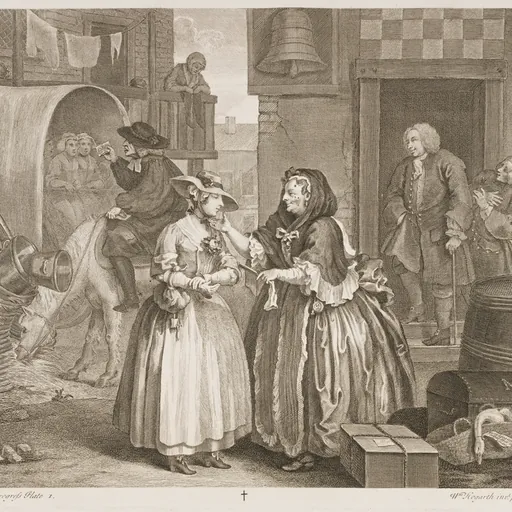
Elizabeth Needham (died 3 May 1731), also known as Mother Needham, was an English procuress and brothel-keeper of 18th-century London, who has been identified as the bawd greeting Moll Hackabout in the first plate of William Hogarth's series of satirical etchings A Harlot's Progress. Although Needham was notorious in London at the time, little is recorded of her life, and no genuine portraits of her survive.
Her house was the most exclusive in London and her customers came from the highest strata of fashionable society. She eventually ran afoul of the moral reformers of the day and died as a result of the severe treatment she received after being sentenced to stand in the pillory.
Character Nothing is known of Needham's early life, but by the time she was middle-aged she was renowned in London as the keeper of a brothel in Park Place, St. James. Her house was regarded as the most exclusive in London, superior to those of Covent Garden, even to that of the other notorious bawd of the time, Mother Wisebourne. She was said to still be attractive in middle-age. Hogarth described her as a "handsome old Procuress ... well dressed in silk", but mentions "patches on her face" and in his picture her face is seen to be pock-marked. although Mother Bird was also the name of another brothel-keeper who was committed to Newgate Prison with Needham in 1724. As depicted in Hogarth's picture, she particularly targeted girls and women fresh from the country. The essayist Richard Steele found her pitching to a newly arrived girl when he went to meet a wagon bringing him items from the countryside. He described her as "artful", and it seems that she was friendly and engaging with her potential employees, revealing her vicious character only when they were under her roof. In The Dunciad, Alexander Pope warns not to "... lard your words with Mother Needham's style".
Pope mentions her once more at the end of The Dunciad (1728), making reference to her foul mouth, and again, alongside other notorious madams of the day, in the last verses of his Coronation Epistle, which were suppressed in editions of the poem from 1769 until 1954: For Want of you, we spend our random Wit on The first we find with Needham, Brooks, or Briton.
Henry Fielding refers to her in his Pasquin (1736) and used Hogarth's representation of her as the model for Mother Punchbowl in The Covent Garden Tragedy (1732). Mary Davys's bawd in the Accomplish'd Rake of 1727 is called "Mother N-d-m" and targets young girls fresh from the countryside, just as Needham did.
Customers Chief among her customers were Francis Charteris and his cousin the Duke of Wharton—Charteris is lounging in the doorway behind Needham in Hogarth's picture. Charteris, already known as the "Rape-Master General", was convicted and sentenced to death as a result of the Bond rape, although he was later pardoned. Needham's name was not mentioned during the legal proceedings. The connection with Sally Salisbury only served to heighten the reputation of Needham's house. Needham may have introduced Charteris to Sally Salisbury around 1708. Salisbury was the pre-eminent prostitute of the day and was kept by Charteris for a short time as mistress at the beginning of her career. When her previous bawd, Mother Wisebourne, died in 1719, she became a member of Needham's household and brought with her a clientele from the highest ranks of society. Salisbury brought further fame to Needham's house by involving another of her girls in the theft of the Earl of Cardigan's clothes. The two women accompanied him to Newmarket where he became drunk, and after putting him to bed at an inn they stole his clothes and jewellery and returned to London. The Earl treated the matter as a joke.
Some idea of the reputation of Needham's house can be gathered from one of Joe Miller's Jests, which involves her asking her landlord to wait for his money until Parliament and the Convocation sit, at which point she will be able to pay him ten times over, and by a satirical premature obituary, which appeared in the London Journal. The obituary describes a will in which she distributes appropriate gifts to her famous clients: "a picture of Sodom and Gomorrah to indorsing D―n; an ounce of Mercuris Dulcis to Beau C―e, of St. Martin's Lane; her estate to the Duke of Wharton; her library to Ned C―; and a receipt to cure a clap to little Quibus". the first time Needham was raided was in 1724: quote|text=Yesterday morning the celebrated Mother Needham and Mother Bird, two eminent conservators of the Game of the Kingdom, were committed to Newgate; their houses being disturb'd the night before by the Constables, who disengaged the Gentlemen and Ladies to a great number, and carried them to the Round-House. This being the first time Mrs Needham ever received publick correction, since her being at the head of venal affairs in this town, 'tis thought will be the ruin of her household. Daily Journal, Tuesday 21 July 1724. Needham's punishment is not recorded, but it appears that she was still incarcerated in September when her house burned down, killing one of the inhabitants, Captain Barbute, a French officer. In 1728, several of her girls were arrested, but she appears to have escaped punishment. The Grub Street Journal, the satirical journal allied with Alexander Pope and others of Hogarth's friends, sardonically reported that the populace "acted very ungratefully, considering how much she had done to oblige them". There were other madams ready to step into her shoes, but it was not until Mother Douglas took over the King's Head in Covent Garden in 1741 that a brothel reappeared with a reputation to match that of Needham.
Don’t just read it —
keep it.
Full-length biographies made to live with: read them, listen on the way to work, watch them tonight.
- E-book
- Audio
- Video
Instant download · yours to keep · every purchase keeps this site free
Important facts
People in Elizabeth Needham's life
Named in this biography and alive at the same time




Related people
Same field, nearest in time




Contemporaries
People whose lives overlapped Elizabeth Needham's


Frequently asked questions
Who was Elizabeth Needham?
English procuress and brothel-keeper
When was Elizabeth Needham born?
Elizabeth Needham was born in 1700.
When did Elizabeth Needham die?
Elizabeth Needham died on 3 May 1731.
What was Elizabeth Needham's occupation?
Elizabeth Needham was a madam and brothel owner.
Sources & further reading
· Wikipedia: Elizabeth Needham
Cite this page
APA: Biography.guide. (2026). Elizabeth Needham. https://biography.guide/elizabeth-needham/
MLA: "Elizabeth Needham." Biography.guide, https://biography.guide/elizabeth-needham/.
Chicago: "Elizabeth Needham." Biography.guide. https://biography.guide/elizabeth-needham/.
Data last updated: 2026-09-21 · Spot an error? Report a correction.
Portrait: Wikimedia Commons · author & licence
Page generated 2026-09-27 04:59 UTC