
Elizabeth Howe
One of the accused in the Salem witch trials
About Elizabeth Howe
Lived 1635 – 1692 (aged 56–57).
Elizabeth Howe (; – July 19, 1692) was one of the accused in the Salem witch trials. She was found guilty and executed on July 19, 1692.
Early life Elizabeth Jackson was born around 1637 near Rowley, Yorkshire, the daughter of William and Joanne Jackson. Elizabeth married James Howe II in 1658 in Ipswich, Massachusetts. The couple lived in Topsfield, Massachusetts and had six children: James Howe III (born 1659) Elizabeth Howe Jr. (born 1661) Mary Howe (born 1664) Deborah Howe (born 1667) John Howe (born 1671) Abigail Howe (born 1673)
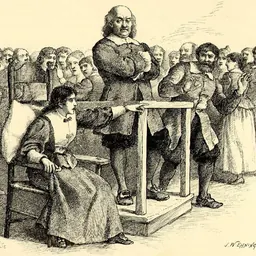
Topsfield was a Puritan community. They were a deeply pious society, with an extreme religious focus not only as a community but also on an individual basis. They believed firmly in the devil, and felt that he was not only an enemy to mankind, but to the Puritans specifically. "The devil, as envisioned by the people of Salem, was a short, black man with cloven feet who stood about as high as a walking stick". The fight against the devil was viewed as an individual religious responsibility. In their testimony against Howe, on June 1, 1692, they quoted their daughter as saying, "I could never afflict a dog as Good Howe afflicts me." At first the parents did not believe their daughter's accusations. They took the child to several doctors who told them she was "under an evil hand". Mercy Lewis was a major contributor of spectral evidence in the examination of Elizabeth Howe. She threw herself to the floor in a fit as soon as Howe entered the meeting house. Her name not only appeared on the arrest warrant served to Elizabeth Howe but appeared in one of two indictments.
Abigail Williams was 11 at the time of Elizabeth Howe's trial in 1692. She was one of the most well-known "afflicted" girls in the Salem witch trials. Her name appeared on the arrest warrant for Elizabeth Howe. Mary Warren was 21 when the trials began. She was employed as a servant in the house of John Proctor of Salem Village. Warren participated in some of the "afflicted girls" accusations before confessing that the other girls were lying. However, they turned on her and Warren herself was eventually tried for being a witch. She escaped conviction by changing sides again, accusing her employer and his wife of "certain deeds, although she hesitated to call them a witch and a wizard".
Warrant for arrest On May 28, 1692, a warrant was released for the arrest of Elizabeth Howe by John Hathorne and Jonathan Corwin. She was to be apprehended and taken to the home of Lieutenant Nathaniel Ingersolls. She stood charged with "Sundry Acts of Witch-craft done or [committed] on the [bodies] of Mary Walcott, Abigail Williams, and others of Salem Village." She was apprehended by Ephraim Wildes, constable of Tops-field, on May 29, 1692. While Elizabeth Howe was imprisoned in these conditions she was able to rely on the support of her family. Her daughters, and occasionally her blind husband, would take turns in making regular trips to Boston. Starkey said they would bring her "country butter, clean linen, and comfort".
Such was the case of Elizabeth Howe's trial which began on May 31, 1692. defined by The Witches of Early America as "the supernatural phenomena thought to occur when a vision or 'spectre' of an accused witch appeared to a witness".
Anger followed by mischief is one form of evidence that was brought against Elizabeth Howe. The Perley (sometimes spelled Pearly) family, who had also accused her of afflicting their ten-year-old daughter, blamed the sudden illness of the family's cow upon her. Convicted witches were hanged on Gallows Hill.
In 1709, many were encouraged to join in a petition with Phillip English; they began with approximately twenty-one accused witches and children of the accused; although, later many others added their sentiments. Among these were the daughters of Elizabeth Howe. They requested that their good names be restored and also wanted financial compensation for their losses during the trials. It was not until 1711 that a sum of approximately £598 was distributed among the survivors.
Don’t just read it —
keep it.
Full-length biographies made to live with: read them, listen on the way to work, watch them tonight.
- E-book
- Audio
- Video
Instant download · yours to keep · every purchase keeps this site free
Important facts
People in Elizabeth Howe's life
Named in this biography and alive at the same time


Contemporaries
People whose lives overlapped Elizabeth Howe's






Frequently asked questions
Who was Elizabeth Howe?
One of the accused in the Salem witch trials
When was Elizabeth Howe born?
Elizabeth Howe was born in 1635 in Yorkshire.
When did Elizabeth Howe die?
Elizabeth Howe died on 19 July 1692 in Salem.
What was Elizabeth Howe known for?
Elizabeth Howe was known for Salem witch trials.
Sources & further reading
Cite this page
APA: Biography.guide. (2026). Elizabeth Howe. https://biography.guide/elizabeth-howe/
MLA: "Elizabeth Howe." Biography.guide, https://biography.guide/elizabeth-howe/.
Chicago: "Elizabeth Howe." Biography.guide. https://biography.guide/elizabeth-howe/.
Data last updated: 2026-09-20 · Spot an error? Report a correction.
Page generated 2026-09-27 05:00 UTC