
About John Proctor
Lived 1632 – 1692 (aged 60). John Proctor was a farmer.
John Proctor (9 October 1631 – 19 August 1692) was a landowner in the Massachusetts Bay Colony. He and his wife Elizabeth were tried and convicted of witchcraft as part of the Salem Witch Trials, whereupon he was hanged.
Early life Proctor was born in Suffolk, England, When he was just three years old, his parents brought their family to America. They sailed from London on 12 April 1635 on a ship called the Susan and Ellen. Martha (1655–1658), Benjamin Proctor was the only surviving child from this marriage. Proctor married Elizabeth Thorndike (1641–1672), daughter of John Thorndike, founder of Ipswich, Massachusetts. Mary (1667–1668); and daughter of Nathaniel Felton and Mary Skelton.
In 1666, Proctor moved to Salem daughter of William and Sarah (Burt) Bassett of Lynn, Massachusetts. They had seven children: William (1674/5 If customers in the tavern had insufficient funds, Elizabeth insisted they pay with pawned goods.
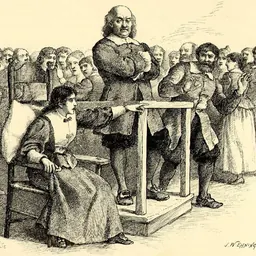
Accusations and trial Initial accusations were aimed at Proctor's third wife, Elizabeth (Bassett). When he began to defend her and vocally express his disbelief in the accusers, fingers were then pointed at him as well. Although Abigail Williams was John Proctor's chief accuser, he was also named by Mary Walcott, who stated he tried to choke her, and by his former servant Mary Warren on 21 April. Warren told magistrates that Proctor had beaten her for putting up a prayer bill before forcing her to touch the Devil's Book. Further allegations of an increasingly salacious nature followed. Proctor continued to challenge the veracity of spectral evidence and the validity of the Court of Oyer and Terminer, which led to a petition signed by 32 neighbors in his favor. The signatories stated that Proctor had lived a "Christian life in his family and was ever ready to help such as they stood in need".
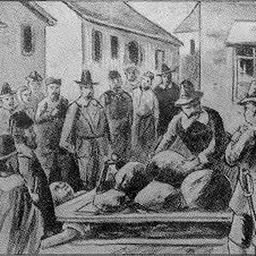
The Proctors were tried on 5 August 1692, found guilty, and sentenced to death by hanging. While Proctor and his wife were still in jail, the sheriff seized all of their household belongings. The cattle were sold cheaply, slaughtered, or shipped to the West Indies. The beer barrels at the tavern were emptied. Their children were left with no means of support. Proctor was hanged on 19 August 1692. Elizabeth, who was then pregnant, was given a reprieve until she gave birth, which came after the trials ended.
Accusations against other Proctor family members
In 1692, one hundred and forty-one complaints were filed. Of those, twelve were against relatives or extended members of the Proctor family. John Proctor, Elizabeth Proctor, and Rebecca Nurse were convicted, and John and Rebecca were executed.
John Proctor, husband of Elizabeth Bassett aka Elizabeth Proctor and the father of Benjamin, William, and Sarah Proctor. Elizabeth Bassett Proctor, third wife of John Proctor and mother of William Proctor. Benjamin Proctor, son of John Proctor and his first wife Martha. William Proctor, son of John Proctor and his third wife, Elizabeth. Mary Bassett DeRich, the sister of Elizabeth Proctor.
Extended family: Thomas Farrar Sr., father-in-law of Elizabeth (Hood) Farrar, sister of Sarah Hood aka Sarah Bassett Elizabeth Hutchinson, wife of Isaac Hart whose daughter, Deborah Hart, was married to Benjamin Proctor, brother of John Proctor. Elizabeth Proctor, daughter of John Proctor and Elizabeth Thorndike Proctor, married Thomas Very in 1681. His sister, Elizabeth Very was the second wife of John Nurse, the eldest son of Francis and Rebecca (née Towne) Nurse. Rebecca Nurse, sister of Mary Eastey and Sarah Cloyce. Mary Eastey, sister of Rebecca Nurse and Sarah Cloyce. Sarah Cloyce, sister of Rebecca Nurse and Mary Eastey. Esther Elwell (née Dutch), aka Hester Elwell, was wed to Samuel Elwell, brother of Thomas Elwell; sister-in-law to Sarah Bassett Elwell, another of Elizabeth Bassett Proctor's sisters.
Family Tree:
Related accuser One other family member was drawn into the Trials, joining the accusers: 16-year-old John DeRich, the son of the imprisoned Mary Bassett DeRich and her husband, Michel DeRich, who had recently died. John testified against George and Sarah Jacobs, Giles Corey, and Sarah Pease.
Aftermath
In June 1696, Elizabeth filed an appeal to contest her husband's will. She testified in court that "in that sad time of darkness before my said husband was executed it is evident somebody had contrived a will and brought it to him to sign, wherein his whole estate is disposed of." The will had already been probated and assets distributed and she stated that her step-children "will not suffer me to have one penny of the estate, neither upon the account of my husband's contract with me before marriage nor yet upon the account of the dower which, as I humbly conceive, doth belong or ought to belong to me by law, for they say that I am dead in the law".
On 22 September 1696, Elizabeth remarried to Daniel Richards.
On 2 March 1703, twenty-one spouses and children of those condemned, as well as three women who were convicted but not executed, including Elizabeth, filed petitions before any action was taken on Elizabeth's appeal for reversal of attainder. They requested that "something may be publicly done to take off infamy from the names". Two more petitions were filed in June 1703. These included requests from eleven ministers to reconsider the convictions and restore the good names of the citizens. The Massachusetts House of Representatives finally passed a bill disallowing spectral evidence. However, they only gave a reversal of attainder for those who had filed petitions.
In 1705, another petition was filed requesting a more equitable settlement for those wrongly accused. In May 1709, 22 people who had been convicted of witchcraft, or whose parents had been convicted of witchcraft, presented the General Court with a petition to take action on the 1705 proposal demanding both a reversal of attainder and compensation for financial losses. In May 1710, the legislature appointed a committee to hear the petitions. After many delays, on 17 October 1711, the General Court passed a bill reversing the judgment against the people listed in the 1709 petition and Governor Joseph Dudley signed the bill into law. There were still an additional seven people who had been convicted but had not signed the petition. There was no reversal of attainder for them. The bill read as follows:
The 22 people in the 1709 petition were awarded the sum of £578-12-0 to be divided among the survivors and relatives of those accused. However, reversal of attainder and monies were only awarded to the accused and their heirs who had asked for it. £150 were awarded to "John Proctor and wife, but Elizabeth's name was not specifically mentioned. Thorndike Proctor received money for his family's suffering. His older brother Benjamin objected as he had been the one responsible for taking care of his siblings during this time. The court took no action, leaving it up to the family to determine how to divide the funds. Most of the accounts were settled within a year. The award to the Proctor family was $1500, much more money from the Massachusetts General Court than most families of accused witches, a possible indicator of the wealth of the families involved.
Thorndike Proctor purchased the Groton Farm from the Downing family of London, England, following the hanging of his father. The farm was renamed Downing Farm. Thorndike subsequently sold nearly half of Downing Farm to his half-brother Benjamin. Eight generations of Proctors resided on the Downing farm, until 1851.
By 1957, not all the condemned had been exonerated. Descendants of those falsely accused demanded the General Court clear the names of their family members. In 1957, an act was passed pronouncing the innocence of those accused, however, it only listed Ann Pudeator by name and the others as "certain other persons", still not including all names of those convicted. They also included a resolution prohibiting further lawsuits based on old court proceedings.
In 1992, the Danvers Tercentennial Committee persuaded the Massachusetts House of Representatives to issue a resolution honoring "the courage and steadfastness of these condemned persons who adhered to truth when the legal, clerical, and political institutions failed them". While the document did list the names of all those not previously granted reversal of attainder, it only noted that these individuals were "worthy of remembrance and commemoration".
After concerted efforts by a Salem schoolteacher named Paula Keene, and Representatives J. Michael Ruane and Paul Tirone et al, a proclamation of innocence for all the victims was finally signed by Governor Jane Swift on 31 October 2001. More than 300 years after the witch trials, all of its victims were finally exonerated of their supposed guilt.
In popular culture
In The Crucible by Arthur Miller, a 1953 fictionalized version of the trials portrayed as a theatrical play, John Proctor is cast as the main character whose story is centered around his powerful and unrivaled position in the society and consequential wrongfully convicted fate. However, the storyline of the play diverges from his actual history in numerous ways.
In the 1957 screen adaptation of Miller's piece, Proctor was depicted by Yves Montand. In the 1996 film based on the play, Proctor was played by Daniel Day-Lewis.
A re-examination of some issues in The Crucible takes place in the play John Proctor Is the Villain.
Don’t just read it —
keep it.
Full-length biographies made to live with: read them, listen on the way to work, watch them tonight.
- E-book
- Audio
- Video
Instant download · yours to keep · every purchase keeps this site free
Important facts
Family & relationships
People in John Proctor's life
Named in this biography and alive at the same time





Related people
Same field, nearest in time


Contemporaries
People whose lives overlapped John Proctor's





Frequently asked questions
Who was John Proctor?
Convicted of witchcraft during the Salem Witch Trials
When was John Proctor born?
John Proctor was born on 30 March 1632 in England.
When did John Proctor die?
John Proctor died on 19 August 1692 in Salem.
What was John Proctor's occupation?
John Proctor was a farmer.
Sources & further reading
· DBpedia: John Proctor (Salem witch trials)
Cite this page
APA: Biography.guide. (2026). John Proctor. https://biography.guide/john-proctor-farmer/
MLA: "John Proctor." Biography.guide, https://biography.guide/john-proctor-farmer/.
Chicago: "John Proctor." Biography.guide. https://biography.guide/john-proctor-farmer/.
Data last updated: 2026-09-20 · Spot an error? Report a correction.
Page generated 2026-09-27 05:04 UTC