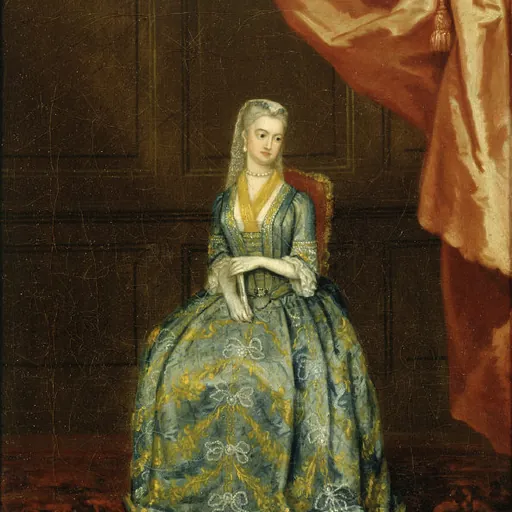
About Elizabeth Germain
Lived 1680 – 1769 (aged 88–89). Elizabeth Germain was a courtier, antiquarian and art collector.
Lady Elizabeth Germain (1680 – 16 December 1769) was a wealthy English aristocrat and courtier, a philanthropist and collector of antiquities, who corresponded with literary and political figures.
Life Lady Elizabeth "Betty" Germain, née Berkeley, was the second daughter of Charles Berkeley, 2nd Earl of Berkeley and his wife Elizabeth, daughter of Baptist Noel, 3rd Viscount Campden. In 1738, Sarah Churchill, Duchess of Marlborough wrote of her that "notwithstanding the great pride of the Berkeley family she married an innkeeper's son," and maliciously adds in explanation that "she was very ugly, without a portion, and in her youth had an unlucky accident with one of her father's servants." The so-called innkeeper's son was Sir John Germain, 1st Baronet (1650–1718), who was rumored to be the illegitimate son of William II, Prince of Orange and accordingly half-brother of King William III. Lady Betty met Germain at the Hot Wells, Bristol, and they were shortly thereafter married in October 1706. He was a recent widower, having first married Mary Mordaunt, Baroness Mordaunt, only child and heiress of the 2nd Earl of Peterborough, after her first husband, Henry Howard, 7th Duke of Norfolk had divorced her in 1700 over her love affair with Germain. Betty was thirty years younger than her husband, but her good sense made their union happy.
They had three children, two boys and a girl, all of whom died young, and in acknowledgment of her devotion in nursing them, Germain left her the estate of Drayton in Northamptonshire, and the vast property which he had inherited from his first wife, who had died childless. On his deathbed, he expressed the wish that she would marry a young man and have children to succeed to her wealth, but hoped that otherwise her fortune might pass to a younger son of Lionel Sackville, 1st Duke of Dorset, who had married Elizabeth, daughter of Lieutenant-general Walter Philip Colyear, Germain's friend and colleague in the Dutch service. Though almost persuaded in later years to marry Lord Sidney Beauclerk, a handsome and worthless fortune-hunter, she remained a widow for more than fifty years, and fulfilled her husband's wishes by leaving the estate of Drayton, with £20,000 in money and half the residue of her wealth, to the politician Lord George Sackville, the Duke's second son, who in turn assumed the name of Germain.
Lady Betty passed most of her widowhood in her own apartments at Knole, near Sevenoaks in west Kent, the seat of her friends the Duke and Duchess of Dorset, or at her London town house in St. James's Square where she entertained politicians regardless of party or faction. She only occasionally visited Drayton House, which she retained in much the condition her husband left it. Originally built in the 14th century and expanded over the centuries, Drayton had been lavishly remodelled in the early 18th century following Baroness Mordaunt's marriage to Germain. After her death, he continued to devote considerable attention to the estate, including his formal Dutch gardens, which Lady Betty maintained as they had been in his lifetime.
She died at her town house on 16 December 1769. Her elder sister married Thomas Chamber of Ilanworth, Middlesex, and had two daughters, who, as their parents died young, were brought up entirely under Lady Betty's guardianship. The elder niece, Mary, married Vere Beauclerk, 1st Baron Vere. The younger, Anne, became the wife of Richard Grenville-Temple, 2nd Earl Temple, a close political associate of his brother-in-law, William Pitt (the Elder), 1st Earl of Chatham. Most of the balance of Lady Betty's estate was left to Lady Vere, She left £120,000 in the funds. Her spirited letter to Swift defending her friend Henrietta Howard, Countess of Suffolk (George II's mistress and Betty's future sister-in-law) against Swift's harsh censure is especially singled out as doing her "great honour". Though their correspondence appears to have ceased in 1737, she retained him in her affections, and a portrait of Swift still hangs in her rooms at Knole. she was credited with having written a satire on Alexander Pope.
A brass plaque commemorating her is found at St Peter's Church, Lowick, near to Sir John Germain's tomb.
Don’t just read it —
keep it.
Full-length biographies made to live with: read them, listen on the way to work, watch them tonight.
- E-book
- Audio
- Video
Instant download · yours to keep · every purchase keeps this site free
Important facts
People in Elizabeth Germain's life
Named in this biography and alive at the same time

Related people
Same field, nearest in time



Contemporaries
People whose lives overlapped Elizabeth Germain's





Frequently asked questions
Who was Elizabeth Germain?
British antiquarian
When was Elizabeth Germain born?
Elizabeth Germain was born in 1680.
When did Elizabeth Germain die?
Elizabeth Germain died in 1769.
What was Elizabeth Germain's occupation?
Elizabeth Germain was a courtier, antiquarian and art collector.
Sources & further reading
· Wikipedia: Elizabeth Germain
· DBpedia: Lady Elizabeth Germain
Cite this page
APA: Biography.guide. (2026). Elizabeth Germain. https://biography.guide/elizabeth-germain/
MLA: "Elizabeth Germain." Biography.guide, https://biography.guide/elizabeth-germain/.
Chicago: "Elizabeth Germain." Biography.guide. https://biography.guide/elizabeth-germain/.
Data last updated: 2026-09-24 · Spot an error? Report a correction.
Portrait: Wikimedia Commons · author & licence
Page generated 2026-09-27 05:08 UTC