
About Elijah ben Solomon Abraham ha-Kohen
Lived 1650 – 1729 (aged 78–79). Elijah ben Solomon Abraham ha-Kohen was a Turkish rabbi.
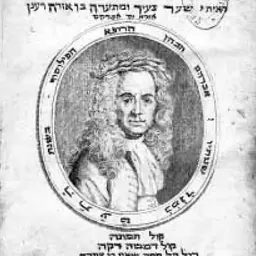
Rabbi Eliyahu ben Solomon Abraham ha-Kohen ha-Itamari (1640–1729) was a Dayan, almoner and preacher. He was born in Smyrna, where he was educated by R. Benjamin Melamed (he records the eulogy in Midrash Eliyahu), a leading Rabbi of İzmir (Smyrna), and became a homiletic preacher. R. Eliyahu's opposition to Sabbatai Zevi and his associates earned him much grief at home. He apparently cared for orphans as his writings display an extremely detailed knowledge of the physical and psychological suffering of the poor. A prolific writer, he is best remembered for his ethical work Shevet Mussar (Rod of Admonition), which has seen numerous editions and been translated into many languages. The first edition of Shevet Mussar was issued in Constantinople in 1712.
Works
Eliyahu produced over 30 works, of which the principal, according to (Orient, Lit. p. 579), are as follows: Midrash Eliyahu, eleven funeral sermons and a commentary on the Talmudic sayings relative to the Book of Esther (Constantinople, 1693) Midrash ha-Itamari, homilies (ib. 1695) Midrash Talpiyyot, glosses and comments taken from 300 works and containing 926 (the numerical value of the word "Talpiyyot") paragraphs in alphabetical order: only the first part, from "alef" to "kaf," was published (Amsterdam, 1698) Me'il Ẓedaḳah, a treatise on charity (ib. 1704) Shebeṭ Musar, an ethical and moral treatise composed of 52 chapters, each intended to be studied weekly throughout the year. First published in 1712, the book quickly gained widespread popularity across Jewish communities. Its accessible style and deep spiritual insights led to numerous reprints and translations into several languages, including Ladino, making it a cornerstone of Sephardic ethical literature. The work offers guidance on personal conduct, repentance, and spiritual growth, and remains influential in both traditional and modern Jewish thought. It was taken for the most part from the Or Ḳadmon of Moses Ḥagis, the Tokaḥot of the Spanish poets, the Orḥot Ḥayyim, and the Roḳeaḥ of Eleazar of Worms (Constantinople, 1712) Megalleh Ẓefunot, commentary on the Chumash (Porizk, 1785) She'elot u-Teshubot, responsa (Sudilkov, 1796) Minḥat Eliyahu, sermons (Salonica, 1824) Semukim le-'Ad, homiletic treatise on the parashiyyot (ib. 1826) We-Lo 'Od Ella, a treatise on the Talmudic and Midrashic passages beginning with these words (Smyrna, 1853) Ezor Eliyahu, a commentary to Pirkei Avot (Jerusalem, 1981) Agadat Eliyahu a commentary on the aggadic passages of the Jerusalem Talmud of Zeraim and Moed (Smyrna, 1755)
Elijah's other works are not yet published (as of 1906). They include: a commentary to the Psalms Ezor Eliyahu, a commentary to the Pesaḥ Haggadah Ṭa'ame ha-Miẓwot, a treatise on the 613 commandments Sheloshah Mahadurot, a commentary to the Pentateuch Shiṭṭah, on the Abodah Zarah a commentary to the difficult passages in the Ta'anit a commentary to the Hafṭarot Ḥiddushim Nifradim, Yado ha-Kol, comprising commentaries to the Song of Songs, Book of Ruth, and Book of Esther, each under a different title mystical glosses to the Song of Songs and Esther a commentary to Lamentations commentaries to Pirḳe Rabbi Eliezer, Otiyyot de-Rabbi Aḳiba, Kallah, Semaḥot, Derek Ereẓ Rabbah and Derek Ereẓ Zuṭa, Tanna debe Eliyahu, and Tiḳḳune ha-'Aberot one treatise and three sermons on repentance a commentary to various prayers
Jewish Encyclopedia bibliography Azulai, Shem ha-Gedolim, i. 22; Michael, Heimann Joseph, (1891) Or ha-Ḥayyim, Frankfort-on-the-Main (in Hebrew), No. 407: Jellinek, B. H. i. 16, Preface; Steinschneider, Cat. Bodl. col. 932; Fürst, Bibl. Jud. i. 238; Friedenstein, 'Ir Gibborim.
Don’t just read it —
keep it.
Full-length biographies made to live with: read them, listen on the way to work, watch them tonight.
- E-book
- Audio
- Video
Instant download · yours to keep · every purchase keeps this site free
Important facts
People in Elijah ben Solomon Abraham ha-Kohen's life
Named in this biography and alive at the same time
Related people
Same field, nearest in time


Contemporaries
People whose lives overlapped Elijah ben Solomon Abraham ha-Kohen's





Frequently asked questions
Who was Elijah ben Solomon Abraham ha-Kohen?
Ottoman rabbi
When was Elijah ben Solomon Abraham ha-Kohen born?
Elijah ben Solomon Abraham ha-Kohen was born in 1650 in İzmir.
When did Elijah ben Solomon Abraham ha-Kohen die?
Elijah ben Solomon Abraham ha-Kohen died in 1729 in İzmir.
What was Elijah ben Solomon Abraham ha-Kohen's occupation?
Elijah ben Solomon Abraham ha-Kohen was a rabbi.
What nationality was Elijah ben Solomon Abraham ha-Kohen?
Elijah ben Solomon Abraham ha-Kohen was Turkish.
Sources & further reading
· Wikipedia: Elijah ben Solomon Abraham ha-Kohen
· DBpedia: Elijah ben Solomon Abraham ha-Kohen
Cite this page
APA: Biography.guide. (2026). Elijah ben Solomon Abraham ha-Kohen. https://biography.guide/elijah-ben-solomon-abraham-ha-kohen/
MLA: "Elijah ben Solomon Abraham ha-Kohen." Biography.guide, https://biography.guide/elijah-ben-solomon-abraham-ha-kohen/.
Chicago: "Elijah ben Solomon Abraham ha-Kohen." Biography.guide. https://biography.guide/elijah-ben-solomon-abraham-ha-kohen/.
Data last updated: 2026-09-20 · Spot an error? Report a correction.
Page generated 2026-09-27 05:22 UTC