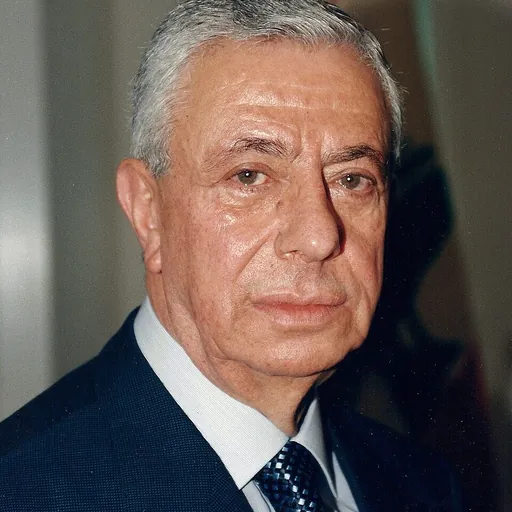
About Elias Hrawi
Lived 1926 – 2006 (aged 79). Elias Hrawi was a Lebanese politician, lawyer and entrepreneur.
Elias Hrawi (; 4 September 1926 – 7 July 2006) was a Lebanese politician who served as the 10th president of Lebanon from 1989 to 1998.
Early life and education Hrawi was born on 4 September 1926 in Hawch Al Umara, Zahlé, to a wealthy landowning Maronite family in the Bekaa Valley. He was the son of Khalil Hrawi and Helena Harb. He obtained a diploma in commerce at the Sagesse Institute in 1947. A successful businessman, Hrawi started a vegetable-export business, dealing with major Swiss companies. He also headed the Beqaa sugarbeet cooperative. When his export business was destroyed by the 1975–1990 civil war, he switched his business to oil import.
Career The scion of a politically prominent family, Hrawi followed his brothers Georges and Joseph when he was elected to the National Assembly in 1972. From 1980 to 1982, he served in the cabinet as minister of public works under President Elias Sarkis and Prime Minister Shafik Wazzan.
President of Lebanon Hrawi was elected at the Park Hotel in Chtoura by 47 out of 53 members of parliament on 24 November 1989 Five MPs cast blank ballots in the election. On 13 October 1990, with support from the Syrian army, he forced General Aoun, who was heading a rival administration, to surrender to begin the reconstruction of Lebanon. On 22 May 1991, he signed the treaty of fraternity, co-ordination and co-operation with Syria, in which Lebanon promised not to allow its territory to be used against Syria's interests. In 1992, Hrawi appointed Rafik Hariri as prime minister. Hrawi attended the meetings of the cabinet during his term to control the executive branch of the country.
Lebanese people had distinct opinions about Hrawi's term. Some appreciate his decisiveness in acting against the feuding militias, ending the civil war that had been tearing the country apart for fifteen years and reuniting the major political parties of Lebanon. His supporters viewed him as a pragmatic political figure, and respected him for his long-held conviction that national loyalty should take precedence over sectarian interests, and for promoting peaceful coexistence among Lebanon's religious factions. Conversely, Hrawi's attempt to pass a law legitimizing civil marriage failed due to the fierce opposition from religious authorities. It is argued that it occurred after Hrawi went to Damascus and agreed on a plan by which he would be succeeded later by Emile Lahoud.
Personal life Hrawi married twice. His elder sons have a firm dealing with the import of petroleum. His eldest son ran for general elections in 1992 but lost in the seat in Zahle.
Death Hrawi died of cancer at the American University of Beirut Medical Center in Beirut on 7 July 2006, aged 79.
Don’t just read it —
keep it.
Full-length biographies made to live with: read them, listen on the way to work, watch them tonight.
- E-book
- Audio
- Video
Instant download · yours to keep · every purchase keeps this site free
Important facts
People in Elias Hrawi's life
Named in this biography and alive at the same time

Related people
Same field, nearest in time






Contemporaries
People whose lives overlapped Elias Hrawi's


Frequently asked questions
Who was Elias Hrawi?
10th President of Lebanon (1926-2006)
When was Elias Hrawi born?
Elias Hrawi was born on 4 September 1926 in Zahlé.
When did Elias Hrawi die?
Elias Hrawi died on 7 July 2006 in Beirut.
What was Elias Hrawi's occupation?
Elias Hrawi was a politician, lawyer and entrepreneur.
What nationality was Elias Hrawi?
Elias Hrawi was Lebanese.
Sources & further reading
Cite this page
APA: Biography.guide. (2026). Elias Hrawi. https://biography.guide/elias-hrawi/
MLA: "Elias Hrawi." Biography.guide, https://biography.guide/elias-hrawi/.
Chicago: "Elias Hrawi." Biography.guide. https://biography.guide/elias-hrawi/.
Data last updated: 2026-09-20 · Spot an error? Report a correction.
Portrait: Wikimedia Commons · author & licence
Page generated 2026-09-27 04:58 UTC