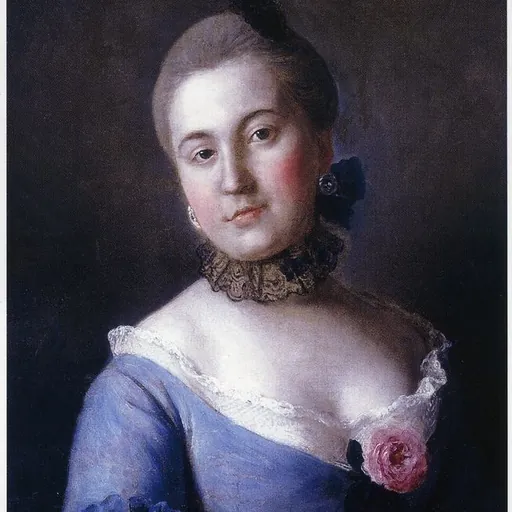
Elena Kurakina
Favorite of Peter III
About Elena Kurakina
Lived 1735 – 1768 (aged 33). Elena Kurakina was a Russian.
Princess Elena Stepanovna Kurakina, , née Apraksina, ) (September 5, 1735 – October 29, 1768) was the daughter of Field Marshal Stepan Apraksin, the wife of Senator Boris–Leonty Kurakin, one of the favorites of Emperor Peter III.
Biography She came from an untitled branch of the Apraksins. The eldest daughter of Field Marshal Stepan Apraksin (1702–1760) from his marriage to Agrafena Soimonova (1719–1771). From childhood she was accustomed to court life; Grand Duchess Ekaterina Alekseevna recalled:
On February 6, 1751, 15–year–old Elena Stepanovna married the chamberlain, senator Prince Boris–Leonty Kurakin. Due to her husband's official duties and her own inclination towards social life, Elena Stepanovna lived in Saint Petersburg in the winter, and preferred to spend the summer at the Saint Petersburg dacha on the Neva or at the Eldigino Estate near Moscow.
In her "Notes", Catherine II noted (when describing the events of 1756) the open connection of Elena Kurakina with the General Feldzeugmeister Count Pyotr Shuvalov. According to Catherine, on Kurakina's part, the main role in this relationship was played by calculation, not love: Elena used Shuvalov to support her father's reputation at court, especially during the investigation of him. Also, these relationships helped the Grand Duchess Ekaterina Alekseevna herself during clashes with enemies, as a result of which, upon accession to the throne, Ekaterina always treated Kurakina favorably.
At the same time, Elena Stepanovna was conducting a love affair with Shuvalov's adjutant, then little–known Grigory Orlov. The romantic story about how Count Shuvalov discovered this connection, accidentally taking the lovers by surprise, created a lot of noise in Saint Petersburg and, as it is believed, first drew the attention of Catherine II to Grigory Orlov.
Soon after the accession of Peter III to the throne, Elena Stepanovna attracted the attention of the monarch. Prince Mikhail Shcherbatov in his pamphlet "On the Damage to Morals in Russia" described Kurakina's behavior as follows:
Also, according to Shcherbatov with reference to the words of Dmitry Volkov, Peter III's secretary, Kurakina was unwittingly responsible for the appearance of the manifesto "On the Freedom of the Nobility", hastily composed by Volkov during their meeting to hide it from the "official" favourite Elizaveta Vorontsova, who was announced that the sovereign is busy with Volkov "reasoning the improvement of the state".
In the Satirical Catalog at the Court of Catherine II, a book entitled "Mille et Une Faveurs" was attributed to Princess Kurakina.
Her husband, Boris–Leonty Kurakin, died in 1764 at the age of 30, leaving his wife and children with many debts. Their guardians were appointed: Counts Peter and Nikita Panin, Count Fyodor Apraksin and Alexander Talyzin. The guardians, especially Count Pyotr Panin, were able to bring the Kurakins' huge, but extremely debt–ridden fortune into exemplary order.
Elena Stepanovna survived her husband by only 4 years and died in 1768 at the age of 33. She was buried in the Lazarev Cemetery of the Alexander Nevsky Lavra, leaving behind "dear children, four sons", as was written on the marble tomb by Ivan Martos, erected to her by her sons. The sculpture depicted a bowed woman sobbing at the grave of a deceased princess. At the foot, the sons of the deceased are hugging and crying.
Family In her marriage to Boris–Leonty Kurakin, Elena Stepanovna had seven sons and two daughters, five of whom died in infancy. Alexander Borisovich (1752–1818), Vice–Chancellor of the Russian Empire, Ambassador to Vienna and Paris (1808–1812); Agrafena Borisovna (died in childhood); Alexandra Borisovna (died in childhood); Stepan Borisovich (1754–1805), Major General, Active Privy Councilor; Ivan Borisovich (June 13, 1755 – May 27, 1756); Nikolay Borisovich (1756 – August 2, 1758); Alexey Borisovich (1759–1829), Prosecutor General, Minister of Internal Affairs, Active Privy Councillor of the 1st Class; Ivan Borisovich (1761–1827); Dmitry Borisovich (1763–1764).
Don’t just read it —
keep it.
Full-length biographies made to live with: read them, listen on the way to work, watch them tonight.
- E-book
- Audio
- Video
Instant download · yours to keep · every purchase keeps this site free
Important facts
People in Elena Kurakina's life
Named in this biography and alive at the same time



Contemporaries
People whose lives overlapped Elena Kurakina's



Frequently asked questions
Who was Elena Kurakina?
favorite of Peter III (1735-1768)
When was Elena Kurakina born?
Elena Kurakina was born on 5 September 1735.
When did Elena Kurakina die?
Elena Kurakina died on 29 October 1768.
What nationality was Elena Kurakina?
Elena Kurakina was Russian.
Sources & further reading
Cite this page
APA: Biography.guide. (2026). Elena Kurakina. https://biography.guide/elena-kurakina/
MLA: "Elena Kurakina." Biography.guide, https://biography.guide/elena-kurakina/.
Chicago: "Elena Kurakina." Biography.guide. https://biography.guide/elena-kurakina/.
Data last updated: 2026-09-23 · Spot an error? Report a correction.
Portrait: Wikimedia Commons · author & licence
Page generated 2026-09-27 05:06 UTC