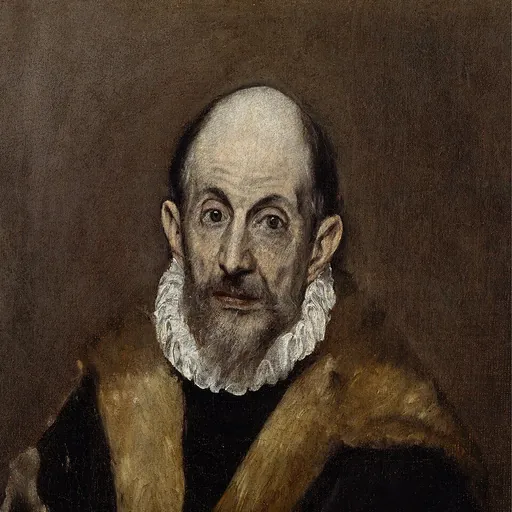
About El Greco
Lived 1541 – 1614 (aged 72). El Greco was an Italian and Greek painter, sculptor, architect, architectural drafter and printmaker.
Doménikos Theotokópoulos (, ; 1 October 1541 7 April 1614), most widely known as El Greco (; "The Greek"), was a Greek painter, sculptor and architect of the Spanish Renaissance, regarded as one of the greatest artists of all time. El Greco was a nickname, and the artist normally signed his paintings with his full birth name in Greek letters often adding the word , which means "Cretan" in Ancient Greek.
El Greco was born in the Kingdom of Candia (modern Crete), which was at that time part of the Republic of Venice, and the center of Post-Byzantine art. He trained and became a master within that tradition before traveling at age 26 to Venice, as other Greek artists had done. In 1570, he moved to Rome, where he opened a workshop and executed a series of works. During his stay in Italy, El Greco enriched his style with elements of Mannerism and of the Venetian Renaissance taken from a number of great artists of the time, notably Tintoretto and Titian. In 1577, he moved to Toledo, Spain, where he lived and worked until his death. In Toledo, El Greco received several major commissions and produced his best-known paintings, such as View of Toledo and Opening of the Fifth Seal.
El Greco's dramatic and expressionistic style was met with puzzlement by his contemporaries but found appreciation by the 20th century. El Greco is regarded as a precursor of both Expressionism and Cubism, while his personality and works were a source of inspiration for poets and writers such as Rainer Maria Rilke and Nikos Kazantzakis. El Greco has been characterized by modern scholars as an artist so individual that he belongs to no conventional school. He is best known for tortuously elongated figures and often fantastic or phantasmagorical pigmentation, marrying Byzantine traditions with those of Western painting.
Although mostly ignored by his contemporaries, El Greco is considered one of the greatest painters in the history of art. Art critics have resolutely placed him among the best artists of all time, citing his originality, his power of expression, and his innovative use of form and colour. His works are seen as transcending and surpassing the artistic traditions from which they emerged and as having had a profound effect on generations of later artists, including Francisco Goya, Diego Velázquez, Eugène Delacroix, Édouard Manet, Salvador Dalí and Pablo Picasso, amongst many others.
Life
Early years and family The Dormition of the Virgin (before 1567, tempera and gold on panel, , Holy Cathedral of the Dormition of the Virgin, Hermoupolis, Syros) was probably created near the end of the artist's Cretan period. The painting combines post-Byzantine and Italian mannerist stylistic and iconographic elements. Born in 1541, in either the village of Fodele or Candia (the Venetian name of Chandax, present day Heraklion) on Crete, El Greco was descended from a prosperous urban family, which had probably been driven out of Chania to Candia after an uprising against the Catholic Venetians between 1526 and 1528. El Greco's father, Geṓrgios Theotokópoulos (; 1556), was a merchant and tax collector. Almost nothing is known about his mother or his first wife, except that they were also Greek. His second wife was a Spaniard.
El Greco received his initial training as an icon painter of the Cretan school, a leading center of post-Byzantine art. In addition to painting, he probably studied the classics of ancient Greece, and perhaps the Latin classics also; he left a "working library" of 130 volumes at his death, including the Bible in Greek and an annotated Vasari book. Candia was a center for artistic activity where Eastern and Western cultures co-existed harmoniously, where around two hundred painters were active during the 16th century, and had organized a painters' guild, based on the Italian model. In 1563, at the age of twenty-two, El Greco was described in a document as a "master" ("maestro Domenigo"), meaning he was already a master of the guild and presumably operating his own workshop. Three years later, in June 1566, as a witness to a contract, he signed his name in Greek as (; "Master Ménegos Theotokópoulos, painter"). Knowledge of El Greco's years in Italy is limited. He lived in Venice until 1570 and, according to a letter written by his much older friend, the greatest miniaturist of the age, Giulio Clovio, was a "disciple" of Titian, who was by then in his eighties but still vigorous. This may mean he worked in Titian's large studio, or not. Clovio characterized El Greco as "a rare talent in painting".
In 1570, El Greco moved to Rome, where he executed a series of works strongly marked by his Venetian apprenticeship. In Rome, on the recommendation of Giulio Clovio, El Greco was received as a guest at the Palazzo Farnese, which Cardinal Alessandro Farnese had made a center of the artistic and intellectual life of the city. There he came into contact with the intellectual elite of the city, including the Roman scholar Fulvio Orsini, whose collection would later include seven paintings by the artist (View of Mt. Sinai and a portrait of Clovio are among them).
Unlike other Cretan artists who had moved to Venice, El Greco substantially altered his style and sought to distinguish himself by inventing new and unusual interpretations of traditional religious subject matter. His works painted in Italy were influenced by the Venetian Renaissance style of the period, with agile, elongated figures reminiscent of Tintoretto and a chromatic framework that connects him to Titian. As a result of his stay in Rome, his works were enriched with elements such as violent perspective vanishing points or strange attitudes struck by the figures with their repeated twisting and turning and tempestuous gestures, all elements of Mannerism. He singled out Correggio and Parmigianino for particular praise, but he did not hesitate to dismiss Michelangelo's Last Judgment in the Sistine Chapel; he extended an offer to Pope Pius V to paint over the whole work in accord with the new and stricter Catholic thinking. When he was later asked what he thought about Michelangelo, El Greco replied that "he was a good man, but he did not know how to paint". However, despite El Greco's criticism, Michelangelo's influence can be seen in later El Greco works such as the Allegory of the Holy League. By painting portraits of Michelangelo, Titian, Clovio and, presumably, Raphael in one of his works (The Purification of the Temple), El Greco not only expressed his gratitude but also advanced the claim to rival these masters. As his own commentaries indicate, El Greco viewed Titian, Michelangelo and Raphael as models to emulate. On 6 July 1572, El Greco officially complained about this event. A few months later, on 18 September 1572, he paid his dues to the Guild of Saint Luke in Rome as a miniature painter. At the end of that year, El Greco opened his own workshop and hired as assistants the painters Lattanzio Bonastri de Lucignano and Francisco Preboste. At the time, Toledo was the religious capital of Spain and a populous city (Toledo must have been one of the largest cities in Europe during this period.) In 1571 the population of the city was 62,000. In Rome, El Greco had earned the respect of some intellectuals, but was also facing the hostility of certain art critics. During the 1570s the huge monastery-palace of El Escorial was still under construction and Philip II of Spain was experiencing difficulties in finding good artists for the many large paintings required to decorate it. Titian was dead, and Tintoretto, Veronese and Anthonis Mor all refused to come to Spain. Philip had to rely on the lesser talent of Juan Fernández de Navarrete, of whose gravedad y decoro ("seriousness and decorum") the king approved. When Fernández died in 1579, the moment was ideal for El Greco to move to Toledo.
Through Clovio and Orsini, El Greco met Benito Arias Montano, a Spanish humanist and agent of Philip; Pedro Chacón, a clergyman; and Luis de Castilla, son of Diego de Castilla, the dean of the Cathedral of Toledo. El Greco's friendship with Castilla would secure his first large commissions in Toledo. He arrived in Toledo by July 1577, and signed contracts for a group of paintings that was to adorn the church of Santo Domingo el Antiguo in Toledo and for . By September 1579 he had completed nine paintings for Santo Domingo, including The Trinity and The Assumption of the Virgin. These works would establish the painter's reputation in Toledo. Indeed, he did manage to secure two important commissions from the monarch: Allegory of the Holy League and Martyrdom of St. Maurice. However, the king did not like these works and placed the St Maurice altarpiece in the chapter-house rather than the intended chapel. He gave no further commissions to El Greco. The exact reasons for the king's dissatisfaction remain unclear. Some scholars have suggested that Philip did not like the inclusion of living persons in a religious scene; Philip took a close interest in his artistic commissions, and had very decided tastes; a long sought-after sculpted Crucifixion by Benvenuto Cellini also failed to please when it arrived, and was likewise exiled to a less prominent place. Philip's next experiment, with Federico Zuccari was even less successful. In any case, Philip's dissatisfaction ended any hopes of royal patronage El Greco may have had. According to Hortensio Félix Paravicino, a 17th-century Spanish preacher and poet, "Crete gave him life and the painter's craft, Toledo a better homeland, where through Death he began to achieve eternal life." In 1585, he appears to have hired an assistant, Italian painter Francisco Preboste, and to have established a workshop capable of producing altar frames and statues as well as paintings. On 12 March 1586 he obtained the commission for The Burial of the Count of Orgaz, now his best-known work.
The decade 1597 to 1607 was a period of intense activity for El Greco. During these years he received several major commissions, and his workshop created pictorial and sculptural ensembles for a variety of religious institutions. Among his major commissions of this period were three altars for the Chapel of San José in Toledo (1597–1599); three paintings (1596–1600) for the Colegio de Doña María de Aragon, an Augustinian monastery in Madrid, and the high altar, four lateral altars, and the painting St. Ildefonso for the Capilla Mayor of the Hospital de la Caridad (Hospital of Charity) at Illescas (1603–1605).
Between 1607 and 1608 El Greco was involved in a protracted legal dispute with the authorities of the Hospital of Charity at Illescas concerning payment for his work, which included painting, sculpture and architecture; this and other legal disputes contributed to the economic difficulties he experienced towards the end of his life. In 1608, he received his last major commission at the Hospital of Saint John the Baptist in Toledo. It was in these apartments, which also served as his workshop, that he spent the rest of his life, painting and studying. He lived in considerable style, sometimes employing musicians to play whilst he dined. It is not confirmed whether he lived with his Spanish female companion, Jerónima de Las Cuevas , whom he probably never married. She was the mother of his only son, Jorge Manuel, born in 1578, who also became a painter, assisted his father, and continued to repeat his compositions for many years after he inherited the studio. (Doña Jerónima de Las Cuevas appears to have outlived El Greco, and, although the master acknowledged both her and his son, he never married her.) That fact has puzzled researchers, because he mentioned her in various documents, including his last testament. Most analysts assume that El Greco had married unhappily in his youth and therefore could not legalize another attachment. He was buried in the Church of Santo Domingo el Antiguo, aged 72.
Art
Technique and style The primacy of imagination and intuition over the subjective character of creation was a fundamental principle of El Greco's style.
Art historian Max Dvořák was the first scholar to connect El Greco's art with Mannerism and Antinaturalism. Modern scholars characterize El Greco's theory as "typically Mannerist" and pinpoint its sources in the Neoplatonism of the Renaissance. Jonathan Brown believes that El Greco created a sophisticated form of art; according to Nicholas Penny "once in Spain, El Greco was able to create a style of his own—one that disavowed most of the descriptive ambitions of painting".
View of Toledo (, oil on canvas, , Metropolitan Museum of Art, New York) is one of the two surviving landscapes of Toledo painted by El Greco. Detail from St. Andrew and St. Francis (1595, oil on canvas, , Madrid), showing the artist's signature in Greek.
In his mature works El Greco demonstrated a characteristic tendency to dramatize rather than to describe. The anatomy of the human body becomes even more otherworldly in El Greco's mature works; for The Immaculate Conception (El Greco, Toledo) El Greco asked to lengthen the altarpiece itself by another "because in this way the form will be perfect and not reduced, which is the worst thing that can happen to a figure". A significant innovation of El Greco's mature works is the interweaving between form and space; a reciprocal relationship is developed between the two which completely unifies the painting surface. This interweaving would re-emerge three centuries later in the works of Cézanne and Picasso. Fernando Marias and Agustín Bustamante García, the scholars who transcribed El Greco's handwritten notes, connect the power that the painter gives to light with the ideas underlying Christian Neo-Platonism.
Modern scholarly research emphasizes the importance of Toledo for the complete development of El Greco's mature style and stresses the painter's ability to adjust his style in accordance with his surroundings. Harold Wethey asserts that "although Greek by descent and Italian by artistic preparation, the artist became so immersed in the religious environment of Spain that he became the most vital visual representative of Spanish mysticism". He believes that in El Greco's mature works "the devotional intensity of mood reflects the religious spirit of Roman Catholic Spain in the period of the Counter-Reformation". His portraits are fewer in number than his religious paintings, but are of equally high quality. Wethey says that "by such simple means, the artist created a memorable characterization that places him in the highest rank as a portraitist, along with Titian and Rembrandt". He painted with the usual pigments of his period such as azurite, lead-tin-yellow, vermilion, madder lake, ochres and red lead, but he seldom used the expensive natural ultramarine.
Suggested Byzantine affinities Since the beginning of the 20th century, scholars have debated whether El Greco's style had Byzantine origins. Certain art historians had asserted that El Greco's roots were firmly in the Byzantine tradition, and that his most individual characteristics derive directly from the art of his ancestors, while others had argued that Byzantine art could not be related to El Greco's later work.
The discovery of the Dormition of the Virgin on Syros, an authentic and signed work from the painter's Cretan period, and the extensive archival research in the early 1960s, contributed to the rekindling and reassessment of these theories. Although following many conventions of the Byzantine icon, aspects of the style certainly show Venetian influence, and the composition, showing the death of Mary, combines the different doctrines of the Orthodox Dormition of the Virgin and the Catholic Assumption of the Virgin. Significant scholarly works of the second half of the 20th century devoted to El Greco reappraise many of the interpretations of his work, including his supposed Byzantinism. Based on the notes written in El Greco's own hand, on his unique style, and on the fact that El Greco signed his name in Greek characters, they see an organic continuity between Byzantine painting and his art. According to Marina Lambraki-Plaka "far from the influence of Italy, in a neutral place which was intellectually similar to his birthplace, Candia, the Byzantine elements of his education emerged and played a catalytic role in the new conception of the image which is presented to us in his mature work". In making this judgement, Lambraki-Plaka disagrees with Oxford University professors Cyril Mango and Elizabeth Jeffreys, who assert that "despite claims to the contrary, the only Byzantine element of his famous paintings was his signature in Greek lettering". Nikos Hadjinikolaou states that from 1570 El Greco's painting is "neither Byzantine nor post-Byzantine but Western European. The works he produced in Italy belong to the history of the Italian art, and those he produced in Spain to the history of Spanish art".
The English art historian David Davies seeks the roots of El Greco's style in the intellectual sources of his Greek-Christian education and in the world of his recollections from the liturgical and ceremonial aspect of the Orthodox Church. Davies believes that the religious climate of the Counter-Reformation and the aesthetics of Mannerism acted as catalysts to activate his individual technique. He asserts that the philosophies of Platonism and ancient Neo-Platonism, the works of Plotinus and Pseudo-Dionysius the Areopagite, the texts of the Church fathers and the liturgy offer the keys to the understanding of El Greco's style. Summarizing the ensuing scholarly debate on this issue, José Álvarez Lopera, curator at the , Madrid, concludes that the presence of "Byzantine memories" is obvious in El Greco's mature works, though there are still some obscure issues concerning his Byzantine origins needing further illumination.
Architecture and sculpture El Greco was highly esteemed as an architect and sculptor during his lifetime. He usually designed complete altar compositions, working as architect and sculptor as well as painter—at, for instance, the Hospital de la Caridad. There he decorated the chapel of the hospital, but the wooden altar and the sculptures he created have in all probability perished. For the master designed the original altar of gilded wood which has been destroyed, but his small sculptured group of the Miracle of St. Ildefonso still survives on the lower center of the frame. El Greco is regarded as a painter who incorporated architecture in his painting. He is also credited with the architectural frames to his own paintings in Toledo. Pacheco characterized him as "a writer of painting, sculpture and architecture". Only his son and a few unknown painters produced weak copies of his works. Late 17th- and early 18th-century Spanish commentators praised his skill but criticized his antinaturalistic style and his complex iconography. Some of these commentators, such as Antonio Palomino and Juan Agustín Ceán Bermúdez, described his mature work as "contemptible", "ridiculous" and "worthy of scorn". The views of Palomino and Bermúdez were frequently repeated in Spanish historiography, adorned with terms such as "strange", "queer", "original", "eccentric" and "odd". The phrase "sunk in eccentricity", often encountered in such texts, in time developed into "madness".
Still, his paintings influenced Diego Velazquez, as well as Francisco Goya, Hortensio Félix Paravicino, one of El Greco's admirers, called his genius as being greater than that of Apelles.
Modern With the arrival of Romantic sentiments in the late 18th century, El Greco's works were examined anew. Gautier regarded El Greco as the ideal romantic hero (the "gifted", the "misunderstood", the "mad"), (The myth of El Greco's madness came in two versions.) On the one hand Gautier believed that El Greco went mad from excessive artistic sensitivity. On the other hand, the public and the critics would not possess the ideological criteria of Gautier and would retain the image of El Greco as a "mad painter" and, therefore, his "maddest" paintings were not admired but considered to be historical documents proving his "madness".
In the 1890s, Spanish painters living in Paris adopted him as their guide and mentor.
In 1908, Spanish art historian Manuel Bartolomé Cossío published the first comprehensive catalogue of El Greco's works; in this book El Greco was presented as the founder of the Spanish School. The same year Julius Meier-Graefe, a scholar of French Impressionism, traveled in Spain, expecting to study Velázquez, but instead becoming fascinated by El Greco; he recorded in 1910 his experiences in Spanische Reise (Spanish Journey, published in English in 1926), the book which widely established El Greco as a great painter of the past "outside a somewhat narrow circle". In El Greco's work, Meier-Graefe found foreshadowing of modernity. These are the words Meier-Graefe used to describe El Greco's impact on the artistic movements of his time:
To the English artist and critic Roger Fry in 1920, El Greco was the archetypal genius who did as he thought best "with complete indifference to what effect the right expression might have on the public". Fry described El Greco as "an old master who is not merely modern, but actually appears a good many steps ahead of us, turning back to show us the way". Painter Mary Cassatt wrote in 1903 that El Greco "was two centuries ahead of his time; that is why painters, Manet among them, thought so much of him".
A 1914 Literary Digest article noted, El Greco was "ranked by some critics not only as Spain's greatest artist, but as one of the five or six greatest painters of all time". According to American artist William Alexander Griffith, in 1925, El Greco was everywhere regarded as one of the greatest artists of all time, having achieved the high honor of a classification and is called the "supreme example of the baroque in painting". British art critics Robert Byron and David Talbot Rice wrote in 1928 how El Greco might end up being as highly regarded as Raphael in the future. In 1930, Spanish art historian and architect wrote that El Greco was "greatest master that Spain and the world have had" and considered him the "demigod of the advanced schools" because of his revolutionary approach to form and reality. English author William Somerset Maugham, in 1938, wrote "I do not doubt that he was one of the greatest painters that ever lived. I think The Burial of the Count of Orgaz is one of the greatest pictures in the world". Spanish art historian José Camón Aznar regarded him "the most genial painter in all history", whereas American art historian Harold Edwin Wethey saw him as "one of the half-dozen greatest painters of all time".
During the same period, other researchers developed alternative, more radical theories. The ophthalmologists August Goldschmidt and Germán Beritens argued that El Greco painted such elongated human figures because he had vision problems (possibly progressive astigmatism or strabismus) that made him see bodies longer than they were, and at an angle to the perpendicular; the physician Arturo Perera, however, attributed this style to the use of marijuana. Michael Kimmelman, a reviewer for The New York Times, stated that "to Greeks [El Greco] became the quintessential Greek painter; to the Spanish, the quintessential Spaniard".
In 2003, Japanese art historian noted that El Greco is considered "one of the greatest painters ever in the history of universal art".
Velázquez's Portrait of Innocent X, as well as his (now lost) portrait of Cardinal Borja, According to art historian :
According to Efi Foundoulaki, "painters and theoreticians from the beginning of the 20th century 'discovered' a new El Greco but in process they also discovered and revealed their own selves". His expressiveness and colors influenced Eugène Delacroix and Édouard Manet. To the Blaue Reiter group in Munich in 1912, El Greco typified that mystical inner construction that it was the task of their generation to rediscover. The first painter who appears to have noticed the structural code in the morphology of the mature El Greco was Paul Cézanne, one of the forerunners of Cubism. According to Brown, "Cézanne and El Greco are spiritual brothers despite the centuries which separate them". Fry observed that Cézanne drew from "his great discovery of the permeation of every part of the design with a uniform and continuous plastic theme".
The Symbolists, and Pablo Picasso during his Blue Period, drew on the cold tonality of El Greco, utilizing the anatomy of his ascetic figures. While Picasso was working on his Proto-Cubist , he visited his friend Ignacio Zuloaga in his studio in Paris and studied El Greco's Opening of the Fifth Seal (owned by Zuloaga since 1897). The relation between and the Opening of the Fifth Seal was pinpointed in the early 1980s, when the stylistic similarities and the relationship between the motifs of both works were analysed.
Salvador Dali was also influenced by El Greco. He considered him to have been one of the "Five Spanish Immortals" (alongside El Cid, Velázquez, Cervantes and Don Quixote), drawing a portrait of him in 1965. According to Dali, El Greco seemed to be "impregnated with all the savors, the substance and quintessence of the ascetic and mystical Spanish spirit" and, despite not being Spanish, "he became more Spanish than the Spaniards themselves".
The early Cubist explorations of Picasso were to uncover other aspects in the work of El Greco: structural analysis of his compositions, multi-faced refraction of form, interweaving of form and space, and special effects of highlights. Several traits of Cubism, such as distortions and the materialistic rendering of time, have their analogies in El Greco's work. According to Picasso, El Greco's structure is Cubist. On 22 February 1950, Picasso began his series of "paraphrases" of other painters' works with The Portrait of a Painter after El Greco. Foundoulaki asserts that Picasso "completed ... the process for the activation of the painterly values of El Greco which had been started by Manet and carried on by Cézanne".
The expressionists focused on the expressive distortions of El Greco. According to Franz Marc, one of the principal painters of the German expressionist movement, "we refer with pleasure and with steadfastness to the case of El Greco, because the glory of this painter is closely tied to the evolution of our new perceptions on art". Jackson Pollock, a major force in the abstract expressionist movement, was also influenced by El Greco. By 1943, Pollock had completed sixty drawing compositions after El Greco and owned three books on the Cretan master.
Pollock influenced the artist Joseph Glasco's interest in El Greco's art. Glasco created several contemporary paintings based on one of his favorite subjects, El Greco's View of Toledo.
Kysa Johnson used El Greco's paintings of the Immaculate Conception as the compositional framework for some of her works, and the master's anatomical distortions are somewhat reflected in Fritz Chesnut's portraits.
El Greco's personality and work were a source of inspiration for poet Rainer Maria Rilke. One set of Rilke's poems (Himmelfahrt Mariae I.II., 1913) was based directly on El Greco's Immaculate Conception. Greek writer Nikos Kazantzakis, who felt a great spiritual affinity for El Greco, called his autobiography Report to Greco and wrote a tribute to the Cretan-born artist.
In 1998, the Greek electronic composer and artist Vangelis published El Greco, a symphonic album inspired by the artist. This album is an expansion of an earlier album by Vangelis, (A Tribute to El Greco, ). The life of the Cretan-born artist is the subject of the film El Greco of Greek, Spanish and British production. Directed by Ioannis Smaragdis, the film began shooting in October 2006 on the island of Crete and debuted on the screen one year later; British actor Nick Ashdon was cast to play El Greco.
Debates on attribution
The exact number of El Greco's works has been a hotly contested issue. In 1937, a highly influential study by art historian Rodolfo Pallucchini had the effect of greatly increasing the number of works accepted to be by El Greco. Pallucchini attributed to El Greco a small triptych in the Galleria Estense at Modena on the basis of a signature on the painting on the back of the central panel on the Modena triptych ("", Created by the hand of Doménikos). There was consensus that the triptych was indeed an early work of El Greco and, therefore, Pallucchini's publication became the yardstick for attributions to the artist. Nevertheless, Wethey denied that the Modena triptych had any connection at all with the artist and, in 1962, produced a reactive catalogue with a greatly reduced corpus of materials. Whereas art historian José Camón Aznar had attributed between 787 and 829 paintings to the Cretan master, Wethey reduced the number to 285 authentic works and Halldor Sœhner, a German researcher of Spanish art, recognized only 137. Wethey and other scholars rejected the notion that Crete took any part in his formation and supported the elimination of a series of works from El Greco's .
Since 1962, the discovery of the Dormition and the extensive archival research has gradually convinced scholars that Wethey's assessments were not entirely correct, and that his catalogue decisions may have distorted the perception of the whole nature of El Greco's origins, development and . The discovery of the Dormition led to the attribution of three other signed works of "Doménicos" to El Greco (Modena Triptych, St. Luke Painting the Virgin and Child, and The Adoration of the Magi) and then to the acceptance of more works as authentic—some signed, some not (such as The Passion of Christ (Pietà with Angels) painted in 1566), —which were brought into the group of early works of El Greco. El Greco is now seen as an artist with a formative training on Crete; a series of works illuminate his early style, some painted while he was still on Crete, some from his period in Venice, and some from his subsequent stay in Rome. Nevertheless, disputes over the exact number of El Greco's authentic works remain unresolved, and the status of Wethey's catalogue is at the center of these disagreements.
A few sculptures, including Epimetheus and Pandora, have been attributed to El Greco. This doubtful attribution is based on the testimony of Pacheco (he saw in El Greco's studio a series of figurines, but these may have been merely models). There are also four drawings among the surviving works of El Greco; three of them are preparatory works for the altarpiece of Santo Domingo el Antiguo and the fourth is a study for one of his paintings, The Crucifixion.
Gallery
Nazi-looted art In 2010, the heirs of the Baron Mor Lipot Herzog, a Jewish Hungarian art collector who had been looted by the Nazis, filed a restitution claim for El Greco's The Agony in the Garden. In 2015, El Greco's Portrait of a Gentleman, which had been looted by the Nazis from German Jewish art collector Julius Priester in 1944, was returned to his heirs after it surfaced at an auction with a fake provenance. According to Anne Webber, co-chair of the Commission for Looted Art in Europe, the painting's provenance had been "scrubbed".
Don’t just read it —
keep it.
Full-length biographies made to live with: read them, listen on the way to work, watch them tonight.
- E-book
- Audio
- Video
Instant download · yours to keep · every purchase keeps this site free
Important facts
more
Dom Thoepotuli, Domingo Theotocópuli, Teotocopuli, Domingo de Theotocopuli, Domingo de Theotocópuli, Doménico Theotocopoulos, Domenico Theocópuli, Domenikos Theotocopoulos, El Griego, Domingo Teotocópul, Domenico Theotocopuli, Teoscopoli, Domenico Theotokopolis, Doménikos Zeotokopoulos, Domenico Greco Teotocópuli, Domingo Theotocopuli, Domingo TeotocopulPeople in El Greco's life
Named in this biography and alive at the same time




Related people
Same field, nearest in time

Contemporaries
People whose lives overlapped El Greco's
Frequently asked questions
Who was El Greco?
Greek artist, painter, sculptor and architect (1541–1614)
When was El Greco born?
El Greco was born on 1 October 1541 in Heraklion, Fodele.
When did El Greco die?
El Greco died on 7 April 1614 in Toledo.
What was El Greco's occupation?
El Greco was a painter, sculptor, architect, architectural drafter and printmaker.
What nationality was El Greco?
El Greco was Italian and Greek.
Sources & further reading
Cite this page
APA: Biography.guide. (2026). El Greco. https://biography.guide/el-greco/
MLA: "El Greco." Biography.guide, https://biography.guide/el-greco/.
Chicago: "El Greco." Biography.guide. https://biography.guide/el-greco/.
Data last updated: 2026-09-22 · Spot an error? Report a correction.
Portrait: Wikimedia Commons · author & licence
Page generated 2026-09-27 05:02 UTC