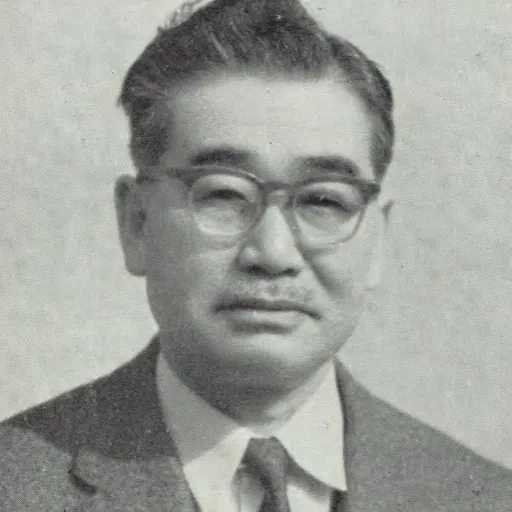
About Eiichi Nishimura
Lived 1904 – 1971 (aged 67). Eiichi Nishimura was a Japanese politician.
Eiichi Nishimura (Japanese: 西村 栄一, Nishimura Eiichi; 8 March 1904 – 27 April 1971) was a Japanese politician who served as the second chairman of the Democratic Socialist Party from 1967 to his death in 1971.
Early life Nishimura was born in a farmhouse in Kamata village (today a part of Gose, Nara) to a lumber-dealing father. After his father went bankrupt in 1910, Nishimura was entrusted to family relatives in Tokyo and went by himself to live with them. He studied at a French high school in Shanghai. While at Shanghai, Nishimura has said that he considered being baptised, but that he decided against it because he was unable to keep the Ten Commandments.
Nishimura was hard-working and worked a number of different jobs throughout his youth, such as being a shopkeeper, a hardware dealer for nails, and, after returning to his native Osaka (which was right next to his home village), he became an office assistant at an insurance company. Eventually, after reaching the age of 31, he was made the manager of the company's Osaka branch. In 1931, he was made a member of the central committee for the National Labor and Agriculture Mass Party.
Political career In 1933, he joined the Sakai city council, where he helped to form a national office worker union which was forcibly dissolved by the government only half a year later. In the 1946 election, he was elected to the House of Representatives as a member of the Right Socialist Party of Japan. In 1948, he served in the Ashida Cabinet as the Deputy Minister for Economic Stability.
While asking Prime Minister Shigeru Yoshida a question during a heated discussion at the House of Representatives Budget Committee in February 1953, Yoshida reflexively muttered "goddamn idiot" (bakayarō), which was accidentally picked up by his microphone. This further intensified the heated atmosphere and Yoshida dissolved the House of Representatives soon thereafter, an event which is still known as the bakayarō dissolution.
While a member of the Right Socialist Party of Japan, Nishimura was among those who took a more moderate stance on defence policies and the US-Japan Security Treaty, arguing that the United States should protect Japan for three years, during which Japan can develop its own independent defense forces, and after which the United States should withdraw all of its military presence from Japanese soil.
In 1967, Nishimura became the second Chairman of the Democratic Socialist Party, succeeding Suehiro Nishio. Under his rather brief tenure as chairman, the DSP's electoral performance was very stable, increasing their popular vote share by only 0.1% and their number of Diet seats by 3 in the 1968 House of Councillors election, and increasing their popular vote share by only 0.3% and gaining a single seat in the 1969 House of Representatives election. This was in contrast to the Japan Socialist Party, which saw heavy losses, and both Komeito as well as the Japanese Communist Party, both of which saw healthy victories. In preparation for the 1971 House of Councillors election, Nishimura called for a coalition between the JSP, Kōmeitō, and DSP, which resulted in only limited cooperation between the parties. However, Nishimura would pass away only a few months before the 1971 elections, which saw the Diet's landscape remain relatively stable compared to the past elections. Nishimura died on 27 April 1971.
Personal life In 1969, he established the Fuji Social Education Centre.
Although he decided not to be baptised as a youth in Shanghai, he finally received a deathbed baptism a day before his death.
His fourth son was Shingo Nishimura, a member of the House of Representatives.
Don’t just read it —
keep it.
Full-length biographies made to live with: read them, listen on the way to work, watch them tonight.
- E-book
- Audio
- Video
Instant download · yours to keep · every purchase keeps this site free
Important facts
People in Eiichi Nishimura's life
Named in this biography and alive at the same time


Related people
Same field, nearest in time






Contemporaries
People whose lives overlapped Eiichi Nishimura's

Frequently asked questions
Who was Eiichi Nishimura?
Japanese politician (1904–1971)
When was Eiichi Nishimura born?
Eiichi Nishimura was born on 8 March 1904 in Kashiba.
When did Eiichi Nishimura die?
Eiichi Nishimura died on 27 April 1971.
What was Eiichi Nishimura's occupation?
Eiichi Nishimura was a politician.
What nationality was Eiichi Nishimura?
Eiichi Nishimura was Japanese.
Sources & further reading
· DBpedia: Eiichi Nishimura (socialist politician)
Cite this page
APA: Biography.guide. (2026). Eiichi Nishimura. https://biography.guide/eiichi-nishimura-politician/
MLA: "Eiichi Nishimura." Biography.guide, https://biography.guide/eiichi-nishimura-politician/.
Chicago: "Eiichi Nishimura." Biography.guide. https://biography.guide/eiichi-nishimura-politician/.
Data last updated: 2026-09-24 · Spot an error? Report a correction.
Portrait: Wikimedia Commons · author & licence
Page generated 2026-09-27 05:08 UTC