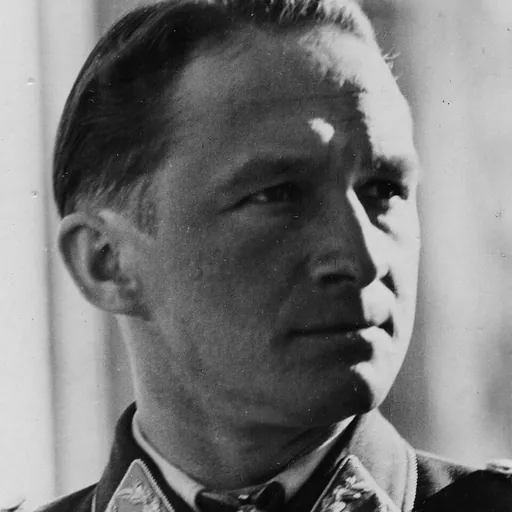
Egon Mayer
German World War II fighter pilot
About Egon Mayer
Lived 1917 – 1944 (aged 26). Egon Mayer was a German fighter pilot.
Egon Mayer (19 August 1917 – 2 March 1944) was a Luftwaffe wing commander and fighter ace of Nazi Germany during World War II. He was credited with 102 enemy aircraft shot down in over 353 combat missions. His victories were all claimed over the Western Front and included 26 four-engine bombers, 51 Supermarine Spitfires and 12 Republic P-47 Thunderbolts. Mayer was the first fighter pilot to score 100 victories entirely on the Western Front.
Born in Konstanz, Mayer, volunteered for military service in the Luftwaffe of Nazi Germany in 1937. Following flight training he was posted to Jagdgeschwader 2 "Richthofen" (JG 2—2nd Fighter Wing) in 1939. He fought in the Battle of France and claimed his first aerial victory in that campaign on 13 June 1940. Mayer was appointed squadron leader of the 7. Staffel (7th squadron) of JG 2 in June 1941. Two months later, following his 21st aerial victory, he received the Knight's Cross of the Iron Cross on 1 August 1941. He claimed 16 further victories and was awarded the German Cross in Gold on 16 July 1942. In November 1942, Mayer was appointed commander of the III. Gruppe (3rd group) of JG 2.
Mayer claimed his first victories over United States Army Air Forces (USAAF) four-engine bombers when he shot down two B-17 Flying Fortresses and a B-24 Liberator on 23 November 1942. Together with fellow fighter ace Georg-Peter Eder, Mayer developed the head-on attack as the most effective tactic against the Allied daylight heavy combat box bomber formations. He received the Knight's Cross of the Iron Cross with Oak Leaves on 16 April 1943 after 63 victories. On 1 July 1943, he replaced Walter Oesau as commander of JG 2. He claimed his 90th victory on 31 December 1943 and on 5 February 1944 became the first pilot on the Channel Front to reach 100 victories. Mayer was killed in action on 2 March 1944 while leading an attack on a USAAF bomber formation; he was shot down by P-47 Thunderbolt escort fighters near Montmédy, France. He was posthumously awarded the Knight's Cross of the Iron Cross with Oak Leaves and Swords.
Early life and career
Mayer, the son of a farmer, was born on 19 August 1917 in Konstanz at the Bodensee. Konstanz at the time was in the Grand Duchy of Baden of the German Empire. Mayer grew up on his parents' farm named Hauserhof and spent his spare time at the glider airfield at the Bellenberg near Engen. He went to school at the Langemarck-Realgymnasium—a secondary school built on the mid-level Realschule to achieve the Abitur (university entry qualification)—in Singen. Today, the Langemarck-Realgymnasium, which had been named after the location of the World War I Battle of Langemarck, is the Hegau-Gymnasium.
Following his graduation, Mayer volunteered for military service in the Luftwaffe on 1 November 1937. His military training began at the 2nd Air Warfare School (Luftkriegsschule 2) at Gatow, on the southwestern outskirts of Berlin. He was then trained as a fighter pilot and promoted to Leutnant (second lieutenant) on 1 August 1939. His classmates at Gatow included Gerhard Barkhorn and Julius Meimberg. Mayer was selected for specialized fighter pilot training and was posted to the Jagdfliegerschule Schleißheim, the fighter pilot school at Schleißheim.
World War II World War II in Europe began on Friday, 1 September 1939, when German forces invaded Poland, the day Mayer was en route to Schleißheim. Mayer received the Iron Cross 2nd Class on 25 October 1939 and was transferred to Jagdgeschwader 2 "Richthofen" (JG 2—2nd Fighter Wing), named after World War I fighter ace Manfred von Richthofen, on 6 December 1939. For his entire combat career, with the exception of a brief posting to the fighter pilot school at Werneuchen, Mayer served in JG 2 "Richthofen". He claimed his first aerial victory on 13 June 1940 during the Battle of France, shooting down a Morane-Saulnier M.S.406 belonging to the French Air Force (Armée de l'Air).
In the Battle of Britain, Mayer often flew over the English Channel as the wingman of Helmut Wick. He claimed three further victories in this campaign, all over Royal Air Force (RAF) Supermarine Spitfires, but was himself shot down or forced to land at the French coast. Once he had to swim in the Channel for an hour before he was rescued. At the end of 1940 Mayer had four victories to his credit and JG 2 "Richthofen" was withdrawn from combat to replenish the heavy losses it had sustained. Following a short tour as fighter pilot instructor at the Jagdfliegerschule (fighter pilot school) in Werneuchen, Mayer was sent back to the Channel Front.
On 10 June 1941, Oberleutnant (First Lieutenant) Mayer was appointed Staffelkapitän (squadron leader) of 7. Staffel (7th squadron) of JG 2 "Richthofen", based at Saint-Pol-Brias. He claimed his 19th and 20th victory on 23 July 1941 and was awarded the Knight's Cross of the Iron Cross on 1 August 1941 after his 21st aerial victory. He received the award with fellow JG 2 "Richthofen" pilots Oberleutnant Erich Leie and Oberleutnant Rudolf Pflanz on that day. The triple award presentation was recorded by the Deutsche Wochenschau (German Weekly Review), a newsreel series released in the cinemas. His score had increased to 28 aerial victories by the end of 1941.
On 12 February 1942 Mayer claimed a Westland Whirlwind during Operation Donnerkeil, the air cover plan for the Channel Dash of German warships from port in western France to Germany. Four of these uncommon aircraft were lost from No. 137 Squadron with their pilots. On 25 April 1942, Mayer claimed four RAF fighters. Fighter Command suffered high losses on this date; 15 of them have been attributed to JG 2 and Jagdgeschwader 26 "Schlageter" (JG 26—26th Fighter Wing). No. 118 Squadron lost two pilots killed in action with JG 2, and another five from No. 501 Squadron were shot down in the Cherbourg area leading to the death of four members. In May, III. Gruppe of JG 2 converted from the Messerschmitt Bf 109 F to the radial engine powered Focke-Wulf Fw 190 A.
Mayer received the German Cross in Gold on 16 July 1942. Mayer claimed a Spitfire off Selsey Bill on 31 July. Flying Officer Tadeusz Kratke, No. 317 Squadron, was wounded in the legs and parachuted to safety south of the land mark. On 19 August, his 25th birthday, Mayer shot down two Spitfires over Dieppe during the British/Canadian raid on Dieppe (Operation Jubilee), his 49th and 50th victory. 50 of RAF Fighter Command's losses were attributed to action with German fighters along with another 12 damaged. The Luftwaffe's losses were much smaller, but JG 2 and JG 26 had been worn down through losses and damaged aircraft and could not make much of an impression during the afternoon. Mayer was among the German pilots to file their claims in the later afternoon.
Group commander Combat box of a 12-plane B-17 squadron. Three such boxes completed a 36-plane group box. Mayer was promoted to Hauptmann (captain) and was appointed Gruppenkommandeur (group commander) of III. Gruppe of JG 2 "Richthofen" in November 1942. He succeeded Hauptmann Hans Hahn who had been transferred on 1 November. In consequence, command of 7. Staffel was passed to Oberleutnant Erich Hohagen. On 23 November, Mayer claimed his first victories over United States Army Air Forces (USAAF) four-engined bombers, when he shot down two B-17 Flying Fortresses and a B-24 Liberator. Together with Georg-Peter Eder, Mayer developed the head-on attack as the most effective tactic against the Allied daylight heavy combat box bomber formations. The concept was based on a Kette (chain), three aircraft flying in a "V" formation, attacking from ahead and to the left. When in range, the attackers opened fire with a deflection burst, aiming in front of the enemy aircraft. Following the attack, the pilots would pull up sharply to the left or right. This gave the attacking fighters the best chance of avoiding the massed firepower of the bombers' guns.
On 14 February 1943, Mayer claimed three RAF Hawker Typhoons, claiming his 60th to 62nd victories. Following his 63rd victory he was awarded the Knight's Cross of the Iron Cross with Oak Leaves on 16 April 1943, the 232nd officer or soldier of the Wehrmacht so honored. The presentation was made by Adolf Hitler in his office at the Reich Chancellery in Berlin on 11 May 1943. Mayer was then promoted to Major (major) on 1 June 1943. Fighter Command lost no aircraft on 14 February 1943. The previous day, it did report two Typhoons lost in combat with Fw 190s from JG 2—both pilots from No. 609 Squadron were killed.
On 22 June 1943, a flight led by Mayer encountered an RAF Spitfire unit. During the course of the engagement, he claimed one Spitfire shot down and damage to another. Fighter Command lost five fighters on 22 June. Four were lost in action with Jagdgeschwader 1 (JG 1—1st Fighter Wing). The only unattributed loss came when Flying Officer J Watlington, No. 400 Squadron was shot down and captured. He was later repatriated in 1944.
Wing commander and death Mayer was appointed Geschwaderkommodore (wing commander) of JG 2 "Richthofen" on 1 July 1943, thus succeeding Oberst (Colonel) Walter Oesau. Command of III. Gruppe was passed on to the Staffelkapitän of 8. Staffel, Hauptmann Bruno Stolle. Mayer accounted for a B-17 on 14 July. The 305th Bombardment Group formed part of an attack on the Paris area. Mayer led his wing into combat, but held position over Evreux, to stay clear of Allied fighter escorts and to await the bomber stream. The 305th bombed the target unscathed but were then attacked by two Fw 190s; one of the pilots being Mayer. Navigator Ed Burford gave a description of the attack:
Whoever it was gave a riveting display of aerobatics out in front of our entire 102nd Combat Wing before slashing in to fatally damage the leading ship of the 422nd Bombardment Squadron in the low slot. The attack took place at 08:18 near Etampes, southwest of Paris. After fires broke out between the #2 and the fuselage, and between the #3 and #4 engines, the ship nosed down in a spin - somehow seven men managed to hit the silk. I had never seen such a tremendous volume of tracer go after that one plane with a wingman in tow. Downright discouraging to hit nothing but air.
Mayer was not known for showboating, and his actions were probably a result of radio failure - an attempt to attract the attention of his pilots after finding the unescorted bombers. The claim matches exactly the time and place of the 305th Bomb Group's loss. The bomber was B-17F-1-35-DL, 42-3190, of the 322nd Bombardment Squadron.
His grave at the Saint-Désir-de-Lisieux German war cemetery. Mayer claimed two Spitfires on 22 August. JG 2 claimed six between 19:50 and 20:15. No. 66 Squadron lost one pilot killed while another evaded. No. 485 Squadron lost four; one pilot was killed, two captured and one evaded capture to return to Britain. He claimed three B-17s shot down within 19 minutes on 6 September. The Eighth Air Force was targeting Stuttgart that day and lost 45 aircraft. Mayer accounted for two Spitfires on 22 September near Evreux. Two No. 308 Polish Fighter Squadron pilots were shot down in the area; one was killed the other escaped capture. On 1 December 1943, Mayer shot down three Republic P-47 Thunderbolt fighters. His claimed aerial victories increased to 90 on 30 December 1943. Mayer was credited with four victories on 7 January 1944, three B-24s and one B-17 shot down in the vicinity of Orléans. On 4 February 1944 he claimed a P-47 from the US 56th Fighter Group, the only American fighter lost by the 8th Fighter Command on this date. It was Mayer's 100th victory, and he became the first fighter pilot on the Channel Front to achieve this mark.
Mayer's final score stood at 102 when he was shot down and killed in action by a P-47 Thunderbolt near Montmédy on 2 March 1944. Flying Fw 190 A-6 (Werknummer 470468—factory number), Mayer had led his Stabsschwarm (headquarters unit) and elements of III. Gruppe, 14 Fw 190s in total, in an attack on B-17s in the area of Sedan, but failed to detect the fighter escort of 29 P-47s above. His aircraft was seen taking hits at a range of in the nose and cockpit. It made a violent snap roll and went into a vertical dive, crashing within of Montmédy. He was posthumously decorated with the Knight's Cross of the Iron Cross with Oak Leaves and Swords that day. On 10 March, command of JG 2 was passed to Major Kurt Ubben.
Recent research by historian Norman Fortier suggests that Mayer was shot down by Lieutenant Walter Gresham of the 358th Fighter Squadron of the 355th Fighter Wing. The claim is based on gun camera footage and recollections of Mayer's wingman, who was forced to bail out during the action. Mayer was buried at the cemetery of Beaumont-le-Roger, France, and in 1955 re-interred at Saint-Désir-de-Lisieux German war cemetery near Lisieux, Normandy, France.
Alleged encounter with Robert S. Johnson alt=A fighter pilot sitting in an aircraft cockpit, shown in profile, viewed from the left. The pilot is smiling and waving his right hand in the air. The left side of the cockpit bears approximately 25 small black crosses arranged in five rows and five columns. In June 1943, Mayer had allegedly encountered Robert S. Johnson, a future ace from the 56th Fighter Group of the USAAF VIII Bomber Command. On 26 June, a German Fw 190 formation from II. Group of JG 26, led by Hauptmann Wilhelm-Ferdinand Galland, engaged the 56th Fighter Group near Forges-les-Eaux and claimed ten P-47s shot down. The P-47C Thunderbolt of Johnson, was damaged by the German pilots. As he returned home with a jammed canopy, a German pilot circled behind him to give him the coup de grâce. Johnson recounts in his memoir three gun passes failing to knock his plane out of the sky, before the German pilot ran out of ammunition, pulled alongside, saluted him, and headed home. Johnson landed safely, but with over 200 holes in his aircraft and damage from a 20 mm canon shell that made it impossible to open the canopy.
Gerald W. Johnson, also from the 56th Fighter Group, recounted in his memoir seeing two Fw 190s chasing Robert Johnson's aircraft. He said he shot down the attacking plane, but was not able to locate the second aircraft. After landing, he says he kept quiet to avoid "spoiling Robert's glory". Some sources believe Mayer was the German pilot chasing Robert Johnson's aircraft, and may have shot down as many as three Thunderbolt aircraft in the battle. In The Mighty Eighth, Freeman's account states that Mayer made a propaganda radio broadcast that night in which he identified one of his victims bearing the markings HV:P, those of Johnson. However, other authors have expressed doubt about Mayer's involvement. There is no direct evidence Mayer was involved in this battle, and neither Mayer nor any other III./JG 2 pilot is present in the day's victory or loss records according to the most complete German sources. Mayer's III. Gruppe was based in Brittany, France, at the time. Mayer had surrendered command of III. Gruppe of JG 2 to Hauptmann Bruno Stolle on 25 June and officially took command of JG 2 as Geschwaderkommodore on 1 July. However, unofficially he already led the Geschwader on 26 June. Mayer did not file claim for any aerial victories on 26 June, not with the Geschwaderstab nor with III. Gruppe.
Summary of career
Aerial victory claims According to US historian David T. Zabecki, Mayer was credited with 102 aerial victories. Mathews and Foreman, authors of Luftwaffe Aces — Biographies and Victory Claims, researched the German Federal Archives and found records for 102 aerial victory claims, plus five further unconfirmed claims. All of his victories were claimed on the Western Front and include 27 four-engined bombers.
Victory claims were logged to a map-reference (PQ = Planquadrat), for example "PQ 14 West 3853". The Luftwaffe grid map covered all of Europe, western Russia and North Africa and was composed of rectangles measuring 15 minutes of latitude by 30 minutes of longitude, an area of about . These sectors were then subdivided into 36 smaller units to give a location area in size.
Chronicle of aerial victories Claim Date Time Type Location Claim Date Time Type Location – 6. Staffel of Jagdgeschwader 2 "Richthofen" –Battle of France — 10 May – 25 June 1940 1 13 June 1940 18:00 M.S.406 – 3. Staffel of Jagdgeschwader 2 "Richthofen" –At the Channel and over England — 26 June 1940 – 21 June 1941 2? 7 October 1940 17:00 Hurricane northwest of Portland – 8. Staffel of Jagdgeschwader 2 "Richthofen" –At the Channel and over England — 26 June 1940 – 21 June 1941 3? 15 November 1940 17:10 Hurricane Chichester – 7. Staffel of Jagdgeschwader 2 "Richthofen" –At the Channel and over England — 26 June 1940 – 21 June 1941 4 17 June 1941 17:50 Spitfire north of Cherbourg – 7. Staffel of Jagdgeschwader 2 "Richthofen" –On the Western Front — 22 June 1941 – 31 December 1941 23 June 1941 Spitfire 16 21 July 1941 08:52 Spitfire 23 June 1941 Spitfire 17 23 July 1941 13:14 Spitfire Forest of Éperlecques 5 24 June 1941 20:42 Spitfire Gravelines/Ramsgate 18 23 July 1941 13:20 Spitfire Forest of Éperlecques 6 25 June 1941 16:33 Spitfire Saint-Omer/Boulogne 19 21 August 1941 10:20 Spitfire 7 2 July 1941 12:38 Blenheim 20 21 August 1941 14:50? Spitfire 8 2 July 1941 13:55? Spitfire 21 27 August 1941 09:30 Hurricane northwest of Le Touquet 9 3 July 1941 11:46 Spitfire 22 16 September 1941 19:32 Spitfire vicinity of Boulogne 10 3 July 1941 15:36 Spitfire 23 16 September 1941 19:40 Spitfire 11 5 July 1941 12:36? Spitfire 24 20 September 1941 16:32 Spitfire 12 9 July 1941 14:05 Spitfire 25 2 October 1941 15:14 Spitfire Pas-de-Calais 13 10 July 1941 12:08 Spitfire 26 13 October 1941 15:34 Spitfire over sea, vicinity of Boulogne 14 12 July 1941 19:26 Spitfire 27 21 October 1941 13:00 Spitfire 15 12 July 1941 19:28 Spitfire 28 21 October 1941 16:10 Spitfire – 7. Staffel of Jagdgeschwader 2 "Richthofen" –On the Western Front — 1 January – 31 December 1942 29 12 February 1942 14:38 Whirlwind north of Ostend 40 4 May 1942 10:39 Spitfire 30 15 April 1942 16:20? Spitfire 41 4 May 1942 15:48 Spitfire 15 April 1942 Spitfire 42 6 May 1942 12:29 Spitfire 31 16 April 1942 15:30 Spitfire 43 3 June 1942 15:35 Spitfire vicinity of Cherbourg 32 16 April 1942 15:33 Spitfire 44 3 June 1942 15:40 Spitfire vicinity of Cherbourg 33 17 April 1942 09:35 Spitfire 45 6 June 1942 17:22 Spitfire Cherbourg/Cap Lévi 17 April 1942 Spitfire 46 6 June 1942 17:22 Spitfire Cherbourg/Cap Lévi 17 April 1942 Spitfire 47 23 June 1942 19:30 Spitfire off Start Point 34 17 April 1942 16:05 Boston vicinity of Cherbourg 48 23 June 1942 19:32 Spitfire off Start Point 35 25 April 1942 09:45 Spitfire 49 31 July 1942 18:09 Spitfire south of Selsey Bill 36 25 April 1942 16:17 Spitfire 50 18 August 1942 11:28 Spitfire northeast of Cherbourg 37 25 April 1942 16:25 Spitfire 51 19 August 1942 16:03 Hurricane north of Dieppe 38 25 April 1942 16:29 Spitfire 52 19 August 1942 16:05 Spitfire north of Dieppe 39 30 April 1942 11:43 Spitfire – Stab III. Gruppe of Jagdgeschwader 2 "Richthofen" –On the Western Front — 1 January – 31 December 1942 53 23 November 1942 13:25 B-17 PQ 14 West 3853 55 23 November 1942 14:00 B-24 PQ 14 West 4855 54 23 November 1942 13:34 B-17 west of Loire estuary 56 30 December 1942 11:42 B-17 Île de Groix – Stab III. Gruppe of Jagdgeschwader 2 "Richthofen" –On the Western Front — 1 January – 31 December 1943 57 3 January 1943 11:32 B-17* southwest of Saint-Nazaire 62 14 February 1943 12:12 Typhoon northwest of CalaisPQ 05 Ost 1288 58 3 January 1943 11:35 B-17 south of Saint-Nazaire west of Loire estuary 63 16 April 1943 14:05 B-17 PQ 14 West 48346PQ 14 West 4829 59 11 February 1943 12:10 Spitfire northwest of Boulogne 64? 16 April 1943 14:22 B-17 PQ 14 West 4834 60 14 February 1943 11:36 Typhoon northwest of CalaisPQ 05 Ost 1287 65 29 May 1943 16:35 B-17 PQ 14 West 2938PQ 14 West 2928 61 14 February 1943 11:40 Typhoon east of DoverPQ 05 Ost 1284 66 29 May 1943 17:35 B-17 PQ 14 West 3072PQ 14 West 3871 – Stab of Jagdgeschwader 2 "Richthofen" –On the Western Front — 1 January – 31 December 1943 67 4 July 1943 12:36 B-17 PQ 04 Ost 1965 80 6 September 1943 12:29 B-17 Lens 68 4 July 1943 12:58 B-17 PQ 15 West 1065 81 22 September 1943 17:17 Spitfire east of Lisieuxeast of Évreux 69 14 July 1943 07:43 B-17 north of Évreux 82 22 September 1943 17:20 Spitfire east of Lisieuxnorth of Évreux 70 14 July 1943 08:24 B-17 Les Essarts-le-Roi, southwest of Paris 25 October 1943 B-25 northwest of Brest 71 30 July 1943 10:30 B-17 PQ 05 Ost 0422 25 October 1943 B-25 northwest of Brest 72 16 August 1943 10:37 P-47 Senneville-sur-Fécamp 83 5 November 1943 13:39 P-47 Rheydt 73 22 August 1943 19:56 Spitfire PQ 05 Ost 0028, Cany-Barville 84 5 November 1943 13:51 P-47 PQ 05 Ost NL-5Alken south of Hasselt 74 22 August 1943 20:10 Spitfire Pont-Authou, southeast of Pont-Audemer 85♠ 1 December 1943 12:50 P-47 PQ 05 Ost NL/MLGembloux-Huy 75 27 August 1943 09:45 Spitfire Tancarville 86♠ 1 December 1943 12:51? P-47 PQ 05 Ost NL/MLvicinity of Liège 76 3 September 1943 10:40 B-17 La GaillardeBailleul 87♠ 1 December 1943 12:53 P-47 PQ 05 Ost NL/MKvicinity of Gembloux 77 3 September 1943 11:25 B-17 PQ 14 West 2935Bailleul 88♠ 1 December 1943 12:53 P-47 vicinity of Leuven 78 6 September 1943 12:10 B-17 west of Mailly-le-Camp 89♠ 1 December 1943 13:10 B-17 PQ 05 Ost KHScheldt, Zierikzee 79 6 September 1943 12:17 B-17 west of Troyes 90 31 December 1943 12:18 B-24 PQ 14 West AE-9south of Albi – Stab of Jagdgeschwader 2 "Richthofen" –On the Western Front — 1 January – 2 March 1944 91 4 January 1944 16:02 B-26 PQ 05 Ost S/QB-2, off Dieppe 97 7 January 1944 13:15 B-24 Bouville 92 4 January 1944 16:05 Spitfire PQ 05 Ost S/QB-5, off Dieppe 98 7 January 1944 13:18 B-17 Les PlessysLes Buissons, Dreux 93 5 January 1944 10:55 P-47 northwest of Laval 99 14 January 1944 15:32 P-38 La Haye-le-Comte 94 5 January 1944 10:55 P-47 PQ 14 West DS-3Marennes 100 5 February 1944 12:49 P-47 PQ 05 Ost SD-7Argueil, south of Forges-les-Eaux 95 7 January 1944 13:05 B-24 PQ 04 Ost N/DE-7northeast of Orléans 101 6 February 1944 11:12 P-47 PQ 04 Ost N/CG-9 96 7 January 1944 13:06 B-24 northeast of Orléans 102 6 February 1944 11:14 P-47 PQ 04 Ost N/CG-9
Awards Wound Badge in Silver Front Flying Clasp of the Luftwaffe for Fighter Pilots in Gold with Pennant "300" Combined Pilots-Observation Badge Iron Cross (1939) 2nd Class (25 October 1939) 1st Class (May 1940) German Cross in Gold on 16 July 1942 as Oberleutnant in the 7./Jagdgeschwader 2 "Richthofen" Knight's Cross of the Iron Cross with Oak Leaves and Swords Knight's Cross on 1 August 1941 as Leutnant of the Reserves and pilot in Jagdgeschwader 2 "Richthofen" 232nd Oak Leaves on 16 April 1943 as Hauptmann and Gruppenkommandeur of the III./Jagdgeschwader 2 "Richthofen" 51st Swords on 2 March 1944 as Oberstleutnant and Geschwaderkommodore of Jagdgeschwader 2 "Richthofen"
Don’t just read it —
keep it.
Full-length biographies made to live with: read them, listen on the way to work, watch them tonight.
- E-book
- Audio
- Video
Instant download · yours to keep · every purchase keeps this site free
Important facts
People in Egon Mayer's life
Named in this biography and alive at the same time







Related people
Same field, nearest in time



Contemporaries
People whose lives overlapped Egon Mayer's

Frequently asked questions
Who was Egon Mayer?
German World War II fighter pilot (1917–1944)
When was Egon Mayer born?
Egon Mayer was born on 19 August 1917 in Constance.
When did Egon Mayer die?
Egon Mayer died on 2 March 1944 in Montmédy.
What was Egon Mayer's occupation?
Egon Mayer was a fighter pilot.
What nationality was Egon Mayer?
Egon Mayer was German.
Sources & further reading
Cite this page
APA: Biography.guide. (2026). Egon Mayer. https://biography.guide/egon-mayer-fighter-pilot/
MLA: "Egon Mayer." Biography.guide, https://biography.guide/egon-mayer-fighter-pilot/.
Chicago: "Egon Mayer." Biography.guide. https://biography.guide/egon-mayer-fighter-pilot/.
Data last updated: 2026-09-20 · Spot an error? Report a correction.
Page generated 2026-09-27 05:09 UTC