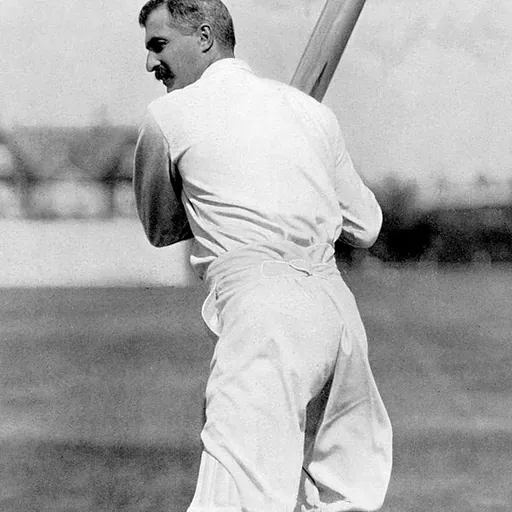
About Edwin Diver
Lived 1861 – 1924 (aged 63). Edwin Diver was a British association football player and cricketer.
Edwin James Diver (20 March 1861 – 27 December 1924) was an English first-class cricketer who played for Surrey and Warwickshire between 1883 and 1901. He was born in Cambridge and died at Pontardawe, Glamorgan, Wales.
The nephew of the mid-Victorian cricketer Alfred Diver, Edwin Diver was primarily a right-handed middle-order batsman, though he was also occasionally used as a wicketkeeper and even more occasionally as a right-arm medium-pace bowler, just once to devastating effect. He also played football as a goalkeeper for the Cambridgeshire county side and for Aston Villa.
Surrey cricketer Diver qualified to play cricket for Surrey by residence as a schoolmaster at a school in Wimbledon and played for the county for four years from 1883. In the first three seasons, he played as an amateur. Though to modern eyes his figures do not look out-of-the-ordinary, his early career with Surrey was judged as "short but brilliant" by the editor of Wisden Cricketers' Almanack, Sydney Pardon: in the obituary of Diver in the 1925 edition, Pardon wrote that he had been "a most attractive batsman in point of style, with splendid hitting power on the off side" and that his success had been instant. In the return match, which the Australians won, his scores were 20 and 0. His trio of representative matches that season were completed with failure to score in either innings in the Gentlemen v Players game.
For Surrey, Diver's best season was 1885 when he scored 941 runs in first-class matches and made his only century for the team, an innings of 143 against Oxford University. For the 1886 season, however, Diver went on to the Surrey staff as a professional cricketer: he was less successful as a batsman that season, though he did appear for the Players in the Gentlemen v Players fixture, an unusual distinction having played for the Gentlemen in 1884. He scored 25 runs in his only innings, the final day of the match being lost to rain. He did not stay at Surrey after the end of the season however: a note in The Times at the start of the 1887 season reported that he had returned to Cambridge.
Warwickshire cricketer Diver disappears from cricket records for the four seasons after he left Surrey in 1886, and there are no records of him in minor cricket either. In both 1891 and 1892, he played in first-class North v South matches, each time acting as wicketkeeper as well as batsman, and in 1893 he was picked for a "Second Class Counties" eleven which played a first-class match against the Australians.
From 1894, Warwickshire's matches against other first-class cricket teams counted as first-class and the county club began assembling a full professional side: Diver was in the side from the beginning and retired from football to become a professional cricketer again. The Birmingham Daily Post was particularly enthusiastic about Diver's bowling. It wrote that he had bowled very well "and should be most serviceable as a change bowler this season." It continued: "His great height gives him every advantage, and the ball delivered right over comes up very fast from the pitch. He bowls well on the offside to his field, and it will surprise us if he does not obtain a good number of wickets in Warwickshire's county matches." In 1896, he scored 998 runs at an average of 32.19, and the runs included his first Warwickshire century, an unbeaten innings of 112 made in the match against Essex. In this game he also kept wicket in the absence of the regular Warwickshire wicketkeeper, Dick Lilley, on Test match duty; he also on occasion kept wicket while Lilley's sometimes-effective bowling was used. His best season with the bat in terms of aggregate was 1899, when he scored more than 1000 runs in a season for the only time in his career: 1096 at an average of 29.62. It also saw a recall to representative cricket, with an appearance for the Players in the Gentlemen v Players match, though he contributed only seven runs to a total of 647, and selection for a Midland Counties XI against the Australians, when he again failed as a batsman.
The 1900 season was not successful for Diver. He scored just 421 runs in 19 matches for an average of 16.19, and passed 50 just twice. In the event, Diver played in only one match, the away fixture with Surrey at The Oval, and that was the last game of his first-class career.
Disappearance and reappearance In November 1901, some explanation for Diver's stuttering end to his cricket career emerged in newspaper reports of a court case in Walsall in which the North Worcestershire Brewery Company petitioned the police court to be allowed to transfer the licence of the Priory Hotel, Walsall, from Diver to his wife, Alice, because Diver had disappeared. Mrs Diver is reported to have told the court that her husband left on 12 November and that "she had not the slightest idea that he was going away".
Diver did not stay disappeared for long. He was formally not re-engaged by Warwickshire for the 1902 season but by August a local newspaper in his home town of Cambridge was reporting that he had been expected to turn out for Cambridgeshire in a fixture against the newly reformed Suffolk side, but had not played; he was described as "engaged at Hunstanton". In 1903, he was a professional at Newport, Monmouthshire and averaged more than 50 runs per innings in topping the averages. He also played in a minor match for a Monmouthshire side, and continued then to play for the county when it joined the Minor Counties in 1905, right through to the First World War outbreak in 1914, acting as a middle-order batsman and frequently as wicketkeeper. He also played in South Wales sides from 1905 to 1907 that played minor matches against the touring teams from Australia, the West Indies and South Africa.
Diver's tangled personal life was tidied up in 1909; his wife, still manager of the Priory Hotel, Walsall, petitioned for divorce on the grounds of desertion and misconduct with a Mrs Ellen Williams, and was granted a decree nisi. Diver had not, she claimed, ever returned to Walsall and nor had he given her any financial support; Mrs Diver was granted custody of the surviving child of the marriage, a daughter, Norah.
Diver remained as a cricket professional and coach at Newport until he moved to Pontardawe, where he was found dead in bed from heart failure on 27 December 1924, aged 63.
Don’t just read it —
keep it.
Full-length biographies made to live with: read them, listen on the way to work, watch them tonight.
- E-book
- Audio
- Video
Instant download · yours to keep · every purchase keeps this site free
Important facts
People in Edwin Diver's life
Named in this biography and alive at the same time



Related people
Same field, nearest in time



Contemporaries
People whose lives overlapped Edwin Diver's


Frequently asked questions
Who was Edwin Diver?
English cricketer (1861-1924)
When was Edwin Diver born?
Edwin Diver was born on 20 March 1861 in Cambridge.
When did Edwin Diver die?
Edwin Diver died on 27 December 1924 in Pontardawe.
What was Edwin Diver's occupation?
Edwin Diver was an association football player and cricketer.
What nationality was Edwin Diver?
Edwin Diver was British.
Sources & further reading
Cite this page
APA: Biography.guide. (2026). Edwin Diver. https://biography.guide/edwin-diver/
MLA: "Edwin Diver." Biography.guide, https://biography.guide/edwin-diver/.
Chicago: "Edwin Diver." Biography.guide. https://biography.guide/edwin-diver/.
Data last updated: 2026-09-20 · Spot an error? Report a correction.
Page generated 2026-09-27 05:09 UTC