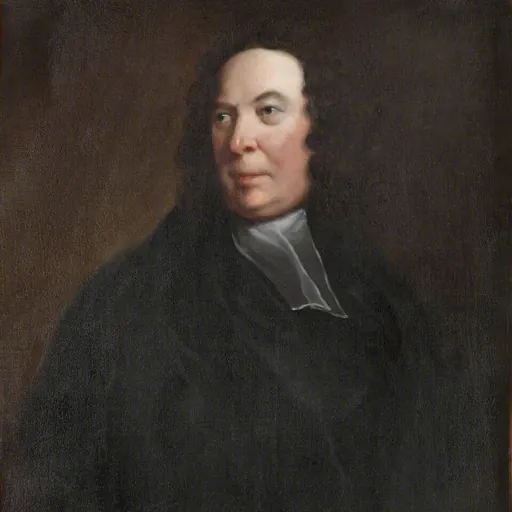
About Edward Young
Lived 1683 – 1765 (aged 81). Edward Young was a British poet, playwright, literary critic and writer.
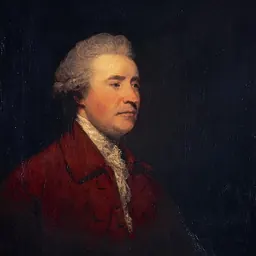
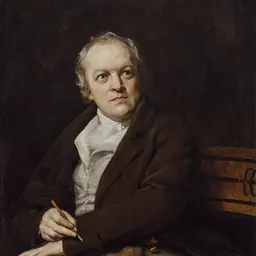
Edward Young ( – 5 April 1765) was an English poet, best remembered for Night-Thoughts, a series of philosophical writings in blank verse, reflecting his state of mind following several bereavements. It was one of the most popular poems of the century, influencing Goethe and Edmund Burke, among many others, and at the end of the century was illustrated by William Blake.
Young took holy orders, and wrote many fawning letters in search of preferment, attracting accusations of insincerity.
Early life
Young was a son of Edward Young, later Dean of Salisbury, and was born at his father's rectory at Upham, near Winchester, where he was baptised on 3 July 1683. He was educated at Winchester College, and matriculated at New College, Oxford, in 1702. He later migrated to Corpus Christi, and in 1708 was nominated by Archbishop Tenison to a law fellowship at All Souls. He took his degree of Doctor of Canon Law in 1719.
Literary career
Young's first publication was an Epistle to ... Lord Lansdoune (1713). This was followed by a Poem on the Last Day (1713), dedicated to Queen Anne; The Force of Religion: or Vanquished Love (1714), a poem on the execution of Lady Jane Grey and her husband, dedicated to the Countess of Salisbury; and an epistle to Joseph Addison, On the late Queen's Death and His Majesty's Accession to the Throne (1714), in which he rushed to praise the new king. The fulsome style of the dedications jars with the pious tone of the poems, and they are omitted from his own edition of his works. Polish and Magyar. In France it became a classic of the romantic school. Questions as to the "sincerity" of the poet did arise in the 100 years after his death. The publication of fawning letters from Young seeking preferment led many readers to question the poet's sincerity. In a famous essay, Worldliness and Other-Worldliness, George Eliot discussed his "radical insincerity as a poetic artist." If Young did not invent "melancholy and moonlight" in literature, he did much to spread the fashionable taste for them. Madame Klopstock thought the king ought to make him Archbishop of Canterbury, and some German critics preferred him to John Milton. Young's essay, Conjectures on Original Composition, was popular and influential on the continent, especially among Germans, as a testament advocating originality over neoclassical imitation. Young wrote good blank verse, and Samuel Johnson pronounced Night-Thoughts to be one of "the few poems" in which blank verse could not be changed for rhyme but with disadvantage. The poem was a poetic treatment of sublimity and had a profound influence on the young Edmund Burke, whose philosophic investigations and writings on the Sublime and the Beautiful were a pivotal turn in 18th-century aesthetic theory.
William Hutchinson included a gloss on Night-Thoughts in his series of lectures The Spirit of Masonry (1775), underlining the masonic symbolism of the text. It was reported that the author of Night-Thoughts was not, in his earlier days, "the ornament to religion and morality which he afterwards became", and his friendships with the Duke of Wharton and with Dodington did not improve his reputation. A statement attributed to Alexander Pope is that: "He had much of a sublime genius, though without common sense; so that his genius, having no guide, was perpetually liable to degenerate into bombast. This made him pass a foolish youth, the sport of peers and poets; but his having a very good heart enabled him to support the clerical character when he assumed it, first with decency and afterwards with honour" (O Ruffhead, Life of A. Pope, p. 291).
Other works Other works by Young are: Busiris, King of Egypt (1719), a play The Revenge (1721), a play The Instalment (to Sir R. Walpole, 1726) Cynthio (1727) The Brothers (1728), a play A Vindication of Providence ... (1728), a sermon An Apology for Punch (1729), a sermon Imperium Pelagi, a Naval Lyrick ... (1730) Two Epistles to Mr Pope concerning the Authors of the Age (1730) A Sea-Piece ... (1733) The Foreign Address, or The Best Argument for Peace (1734) The Centaur not Fabulous; in Five Letters to a Friend (1755) An Argument ... for the Truth of His [Christ's] Religion (1758), a sermon preached before the king Conjectures on Original Composition ... (1759), addressed to Samuel Richardson Resignation ... (1762), a poem.
Night-Thoughts was illustrated by William Blake in 1797, and by Thomas Stothard in 1799. The Poetical Works of the Rev. Edward Young ... were revised by himself for publication, and a completed edition appeared in 1778. The Complete Works, Poetry and Prose, of the Rev. Edward Young ..., with a life by John Doran, appeared in 1854. Sir Herbert Croft wrote the life included in Johnson's Lives of the Poets, but the critical remarks are by Johnson. Selections from Night-Thoughts was also set by New England Congregationalist composer William Billings in his Easter Anthem.
Don’t just read it —
keep it.
Full-length biographies made to live with: read them, listen on the way to work, watch them tonight.
- E-book
- Audio
- Video
Instant download · yours to keep · every purchase keeps this site free
Important facts
People in Edward Young's life
Named in this biography and alive at the same time

Related people
Same field, nearest in time



Contemporaries
People whose lives overlapped Edward Young's



Frequently asked questions
Who was Edward Young?
English poet (1683–1765)
When was Edward Young born?
Edward Young was born on 3 July 1683 in Upham.
When did Edward Young die?
Edward Young died on 5 April 1765 in Welwyn.
What was Edward Young's occupation?
Edward Young was a poet, playwright, literary critic and writer.
What nationality was Edward Young?
Edward Young was British.
Sources & further reading
Cite this page
APA: Biography.guide. (2026). Edward Young. https://biography.guide/edward-young/
MLA: "Edward Young." Biography.guide, https://biography.guide/edward-young/.
Chicago: "Edward Young." Biography.guide. https://biography.guide/edward-young/.
Data last updated: 2026-09-20 · Spot an error? Report a correction.
Portrait: Wikimedia Commons · author & licence
Page generated 2026-09-27 04:57 UTC