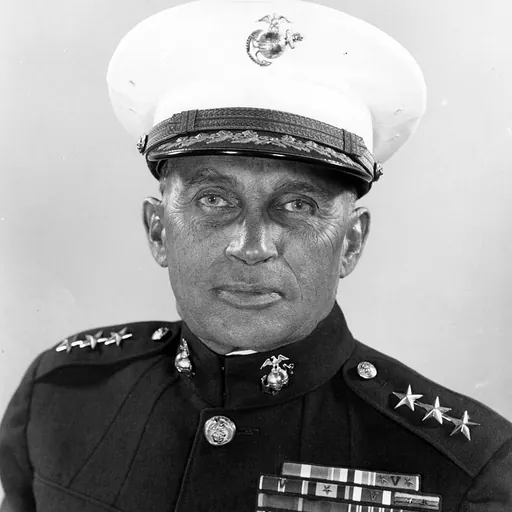
About Edward W. Snedeker
Lived 1903 – 1995 (aged 92). Edward W. Snedeker was an American military personnel.
Edward Walter Snedeker (February 19, 1903 – May 5, 1995) was a highly decorated officer of the United States Marine Corps with the rank of lieutenant general. He was decorated with the Navy Cross, the United States military's second-highest decoration awarded for valor in combat, for his service as commanding officer of 7th Marine Regiment during the Battle of Okinawa in June 1945. He completed his career as commandant of the Marine Corps Schools, Quantico on July 1, 1963.
Early career Captain Snedeker (second row, first from left) with the staff of 2nd Marine Brigade in July 1936. Edward W. Snedeker was born on February 19, 1903, in Peoria, Illinois, as the son of Albert Henry Snedeker and Mabel A. Kennedy. His family later moved to Benkelman, Nebraska, and he attended high school there in 1922. Snedeker subsequently received appointment to the United States Naval Academy at Annapolis, Maryland, and during his years there, he competed in track, boxing and football. He graduated on June 3, 1926, with bachelor's degree and was commissioned second lieutenant in the Marine Corps on the same date.
As any other new officer, Snedeker went first to the Basic School at Philadelphia Navy Yard for officer training. He completed the school in the spring of 1927 and was attached to the newly activated 11th Marine Regiment at Marine Barracks Quantico, Virginia. His regiment was then ordered to Nicaragua to support government units against rebel bandits under Augusto César Sandino. Snedeker spent three months there as a member of 1st Battalion, before his unit was ordered to Cap-Haïtien, Haiti at the end of August 1927.
Following his return to the United States, he was attached to the Headquarters Marine Corps in Washington, D.C., as chief of Operations Section at Division of Plans and Policies under Brigadier General Gerald C. Thomas. While in this capacity, Snedeker was promoted to the rank of colonel in June 1944. However this administrative work did not suit him, and he requested for combat duty again.
The regiment then attacked enemy's emplacements near Kokuba River and continued to Oroku Peninsula. The last enemy's stronghold was at Kunishi Ridge, where Japanese forces prepared defensive positions and waited for attack. Unfortunately all daylight assaults were halted by fierce Japanese resistance and rugged terrain. Snedeker personally conducted an aerial reconnaissance of the area and subsequently planned and executed a night attack, which surprised the enemy. On June 17, the 7th Marines under his command penetrated the enemy lines and caused total destruction of organized resistance.
Postwar career and Korea Colonel Edward W. Snedeker, deputy chief of staff, 1st Marine Division, at his command post in Korea. Snedeker returned to the Division of Plans and Policies at Headquarters Marine Corps in November 1945 and served as Chief of Operations section until May 1946. He was subsequently transferred to the Marine Corps Base Quantico and served briefly as Chief of Instruction section, before he was appointed commander of the Basic School in August 1946. In this capacity, he was responsible for Marine officers' training and taught them the basics of being an "Officer of Marines". He went overseas again in June 1949, when he was appointed assistant chief of staff for plans and area Marine officer within the staff of Commander Naval Forces Marianas under Rear Admiral Charles A. Pownall.
He was appointed division chief of staff in February 1951 and took part in the operations against Chinese and North Korean troops in Central Korea. Snedeker was ordered stateside in May 1951. For his service at Chosin and later in the Central Korea, he was decorated with his third Legion of Merit.
Snedeker died on May 5, 1995, at his home in Carlsbad, California.
Decorations
Here is the ribbon bar of Lieutenant General Edward W. Snedeker:
Navy Cross citation Citation: John Fitzgerald Kennedy The President of the United States of America takes pleasure in presenting the Navy Cross to Colonel Edward Walter Snedeker (MCSN: 0-4082), United States Marine Corps, for extraordinary heroism as Commanding Officer of the Seventh Marines, FIRST Marine Division, in action against enemy Japanese forces on Okinawa, Ryukyu Islands, from 2 to 22 June 1945. Following a period of sixty-two days of continuous fighting against a determined enemy, Colonel Edward Walter Snedeker assumed responsibility for a zone of action previously assigned two assault regiments. Skillfully maneuvering his forces to pass through these elements, Ed launched an aggressive assault on the enemy and, in a series of rapid advances, let his unit forward until it reached the sea, thereby splitting Japanese forces strongly entrenched on Oroku Peninsula. Completing this mission, Ed immediately directed his Regiment against the final enemy defensive position on Kunishi Ridge. When repeated daylight assaults to overrun the stronghold were halted by fierce hostile resistance and difficult terrain, Colonel Edward Walter Snedeker personally undertook an aerial reconnaissance of the area. Thereafter, Ed planned and executed a daring attack by night and, taking the enemy by surprise, succeeded in penetrating the hostile defenses and effecting subsequent total destruction of organized resistance. By his courage and determination in the face of overwhelming odds, Colonel Edward Walter Snedeker contributed materially to the success of his Regiment in winning the bitter fight for Southern Okinawa. His leadership throughout was in keeping with the highest traditions of the United States Naval Service.
Silver Star citation Citation:
The President of the United States of America takes pleasure in presenting the Silver Star to Lieutenant Colonel Edward Walter Snedeker (MCSN: 0-4082), United States Marine Corps, for gallantry and intrepidity in action while acting as Division Signal Officer, FIRST Marine Division, Fleet Marine Force, at Guadalcanal, British Solomon Islands, on the night of 13 October 1942. When the opening salvos of gunfire from hostile warships interrupted all wire circuits on the division switchboard, Lieutenant Colonel Snedeker, realizing that the security of our beachhead was threatened by the probability of a land attack, personally took charge of a wire repair crew. With utter disregard for his own safety, he fearlessly exposed himself during more than one hour of intensive naval bombardment in an effort to restore communications. His heroic conduct, employed at great risk in the face of grave danger, was in keeping with the highest traditions of the United States Naval Service.
Don’t just read it —
keep it.
Full-length biographies made to live with: read them, listen on the way to work, watch them tonight.
- E-book
- Audio
- Video
Instant download · yours to keep · every purchase keeps this site free
Important facts
People in Edward W. Snedeker's life
Named in this biography and alive at the same time




Related people
Same field, nearest in time



Contemporaries
People whose lives overlapped Edward W. Snedeker's
Frequently asked questions
Who was Edward W. Snedeker?
U.S. Marine Corps Lieutenant General
When was Edward W. Snedeker born?
Edward W. Snedeker was born on 19 February 1903 in Peoria.
When did Edward W. Snedeker die?
Edward W. Snedeker died on 5 May 1995 in Carlsbad.
What was Edward W. Snedeker's occupation?
Edward W. Snedeker was a military personnel.
What nationality was Edward W. Snedeker?
Edward W. Snedeker was American.
Sources & further reading
· Wikipedia: Edward W. Snedeker
Cite this page
APA: Biography.guide. (2026). Edward W. Snedeker. https://biography.guide/edward-w-snedeker/
MLA: "Edward W. Snedeker." Biography.guide, https://biography.guide/edward-w-snedeker/.
Chicago: "Edward W. Snedeker." Biography.guide. https://biography.guide/edward-w-snedeker/.
Data last updated: 2026-09-21 · Spot an error? Report a correction.
Portrait: Wikimedia Commons · author & licence
Page generated 2026-09-27 04:58 UTC