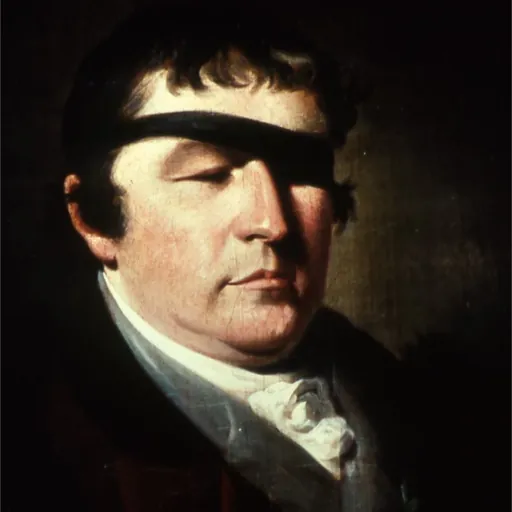
About Edward Rushton
Lived 1756 – 1814 (aged 58). Edward Rushton was a poet, abolitionist, writer and bookseller.
Edward Rushton (13 November 1756 – 22 November 1814) was an English poet, writer and bookseller from Liverpool. He worked as a sailor onboard several slave ships as a young man, and became an abolitionist as a result. After losing his own vision, Rushton opened a school for the blind, the oldest such school in continuous operation in the world.
Early life Edward Rushton was born in Liverpool, Lancashire on 13 November 1756. He was enrolled at the Liverpool Free School from the age of 6 until the age of 9. He left school and at the age of 11 he became an apprentice with Messrs. Watt and Gregson, a firm that traded in the West Indies.
Life at sea Rushton quickly became an experienced sailor. For example, at age 16, he took the helm of a ship which the captain and crew were about to abandon and guided them safely back to Liverpool. Because of this event, he was promoted from his apprenticeship to the position of second mate. In addition, at the age of 17 he survived the sinking of a slave ship he was aboard while on the way back from Guinea.
Working with human cargo gave Rushton first-hand experience with the ways that slaves were treated, and caused him to become an abolitionist later in life. In 1773, the same year that he survived the ship sinking, Rushton was sailing to Dominica with human cargo when a highly contagious outbreak of ophthalmia struck many of the slaves. The disease spread quickly and Rushton was appalled with the conditions that the slaves had to endure, so he would sneak food and water to them. He also reprimanded the captain, and because of this he was ultimately charged with mutiny. However, his contact with the slaves during the outbreak caused him to contract ophthalmia himself, and he became completely blind in his left eye and developed a cataract-like condition in his right eye.
Abolitionist and literary career in Liverpool Unable to sail because of his blindness, Rushton returned to Liverpool and moved in with his sister. He was supported financially by his father, and hired local boys to come read to him every week. He began to learn more about politics and philosophy, and started writing about these topics through dictation to the boys. His first poem, The Dismembered Empire, was published in 1782. In it, he criticised the British government's handling of the American Revolution.
Rushton was married in 1784 to Isabelle Rain. His father tried to set him up to run a tavern and make some money, but he was unsuited to the work and continued to write. His rhetorical battle against the slave trade continued with The West Indian Eclogues, a poem which was published in 1787. Rushton continued writing, using his firsthand experience with the slave trade and other experiences at sea for inspiration. His poetry became popular and he gained a reputation as a radical abolitionist author. Thomas Clarkson even personally sought out Rushton to credit his contribution to the abolitionist movement.
Soon after the publication of The West Indian Eclogues, Rushton became the editor of the Liverpool Herald. However, this was short-lived due to his radical ideals. When Rushton's partner suggested that he retract a particularly radical editorial, Rushton resigned. This incident inspired the poem Will Clewline. He tried to become a bookseller as well, but his outspoken views did nothing but gain him enemies. Rushton made no attempts to censor his radical beliefs about the French Revolution or the social unrest in Britain. Rushton also wrote letters to his heroes George Washington and Thomas Paine criticising their relationship with slavery, but neither man replied. Rushton's letter to Washington was sent in July 1796 and read in part:
On 20 February 1797, Rushton wrote on the letter he sent to Washington that "a few weeks ago it was returned under cover, without a syllable in reply."
Work with the blind Eventually, Rushton was able to make enough money from bookselling to live comfortably and educate his children. In the late 1780s, he became a member of the literary and philosophical society and began donating money to help blind paupers. This led to Rushton establishing the Liverpool School for the Indigent Blind, which opened in 1791, second only in the world to the Paris school. The school now exists under the name of The Royal School for the Blind, Liverpool.
In 1807, Rushton had an operation which allowed him to regain his sight. For the first time in 33 years, he was able to see his wife and children. In 1811, his wife Isabella and one of his daughters both died. Rushton died on 22 November 1814 of paralysis in Liverpool, Lancashire, England (UK).
Collected works 1782 – The Dismembered Empire. 1787 – West-Indian eclogues 1788 – Neglected genius: or, Tributary stanzas to the memory of the unfortunate Chatterton 1796 – Expostulatory Letter to George Washington, of Mount Vernon, in Virginia, on his continuing to be a proprietor of slaves 1800 – Lucy's ghost. A marine ballad 1801 – Will Clewline 1806 – Poems 1824 – Poems and Other Writings, ed. William Shepherd.
Legacy Edward Rushton appeared as a featured character in "The Dark," an interactive installation hosted at the Dana Centre of the Science Museum, London in 2004. The work, described as "a specially created three-dimensional audio environment in which the echoes of virtual ghosts inhabited a haunted soundscape," enables visitors to "experience life on board a slave ship in the 18th century." As of 2012, "The Dark" is also available online as an interactive web site. In March 2016, the play Unsung has its premiere at the Everyman Theatre, Liverpool. It tells the story of how his friendship with a former African slave changes his life.
Don’t just read it —
keep it.
Full-length biographies made to live with: read them, listen on the way to work, watch them tonight.
- E-book
- Audio
- Video
Instant download · yours to keep · every purchase keeps this site free
Important facts
People in Edward Rushton's life
Named in this biography and alive at the same time


Related people
Same field, nearest in time

Contemporaries
People whose lives overlapped Edward Rushton's






Frequently asked questions
Who was Edward Rushton?
British poet, writer, and bookseller
When was Edward Rushton born?
Edward Rushton was born on 13 November 1756.
When did Edward Rushton die?
Edward Rushton died on 22 November 1814.
What was Edward Rushton's occupation?
Edward Rushton was a poet, abolitionist, writer and bookseller.
Sources & further reading
Cite this page
APA: Biography.guide. (2026). Edward Rushton. https://biography.guide/edward-rushton/
MLA: "Edward Rushton." Biography.guide, https://biography.guide/edward-rushton/.
Chicago: "Edward Rushton." Biography.guide. https://biography.guide/edward-rushton/.
Data last updated: 2026-09-22 · Spot an error? Report a correction.
Portrait: Wikimedia Commons · author & licence
Page generated 2026-09-27 05:02 UTC