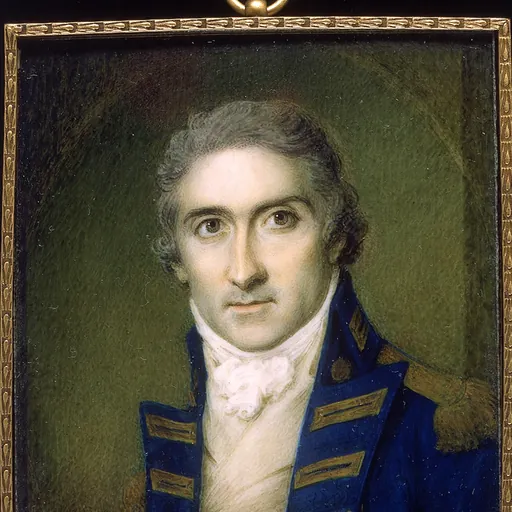
About Edward Riou
Lived 1762 – 1801 (aged 38). Edward Riou was a British military personnel.
Captain Edward Riou FRS (20 November 17622 April 1801) was a Royal Navy officer who served in the French Revolutionary Wars under several of the most distinguished naval officers of his age and won fame and honour for two incidents in particular.
Riou entered the navy at 12 years of age, and after a period spent in British and North American waters, served as a midshipman on Captain James Cook's third and final voyage of discovery. Prior to this voyage he had his portrait painted by popular artist Daniel Gardner. Rising through the ranks, he saw service on a number of the navy's stations, but also endured periods of unemployment. He received his first command in 1789, the former fifth-rate , which was being used to transport stores and convicts to Australia. He had the misfortune to run his ship onto an iceberg, which nearly caused his ship to sink outright. After several attempts to stop the flooding into the damaged hull, most of the crew abandoned ship. Despite fully anticipating his death, Riou refused to leave his ship, and he and a few others were left to attempt the nearly impossible task of navigating the sinking ship several hundred leagues to land. After nine weeks at sea, and with continued labour and endurance, Riou successfully navigated his half-sunk ship back to port, saving the lives of those who had elected to remain with him.
His feat earned him promotions and finally commands, but a period of ill-health forced his temporary retirement from active service. Recovering quickly, he was given command of the new 38-gun , and was assigned in 1801 to Sir Hyde Parker's expedition to the Baltic. Riou worked closely with Vice-Admiral Horatio Nelson during the approach to the Battle of Copenhagen, earning Nelson's trust and admiration. Nelson appointed Riou to command his frigate squadron during the battle, but when the engagement began badly for the British, Riou used his initiative to attack the Danish forts, despite being heavily outgunned. When Parker sent the signal to withdraw, Nelson ignored it and Riou felt he had no choice but to obey his commanding officer, despite his despair at what Nelson would think of retreat. As the Amazon swung away, she exposed her vulnerable stern to the Danish batteries. Riou was encouraging his men to the end when he was cut down by a round shot. Nelson, on learning of Riou's death, called the loss 'irreparable'. A monument was erected to his memory in St Paul's Cathedral, while a poem commemorated the loss of the 'gallant, good Riou'.
Family and early career Portrait of Midshipman Edward Riou, 1776 by Daniel Gardner. Mitchell Library, State Library of New South Wales, Sydney. Riou was born at Mount Ephraim, near Faversham, Kent, on 20 November 1762, the second son of Captain Stephen Riou of the Grenadier Guards, and his wife Dorothy. He embarked on a naval career at the age of 12, joining Sir Thomas Pye's flagship, the 90-gun at Portsmouth. His next ship was the 50-gun , flagship of Vice-Admiral John Montagu on the Newfoundland station.
Riou took and passed his lieutenant's examination on 19 October 1780, shortly after the expedition's return to Britain, and received his promotion on 28 October. His first appointment as lieutenant was to the 14-gun brig-sloop , which was sent to serve in the West Indies. Here Riou appears to have become ill, a common experience for naval officers serving in the tropics, but he survived to return to Britain and was discharged from his ship on 3 February 1782 and went into the Royal Naval Hospital at Haslar.
Command of the Guardian
Plan of , a sister ship of HMS Guardian. Resistance was ordered the same year and was laid down two months before HMS Guardian The Guardian was a former two-decked 44-gun fifth-rate, but had been armed en flûte and loaded with stores to be taken to the British colony at Botany Bay. He posted lookouts in the bows and rigging, and began to edge slowly forward. After sometime the danger seemed to be past, and the iceberg left behind, when at 9 o'clock a strange pale glow was reported by the lookout in the bows.
Riou gave the note to Mr Clements, the master of the Guardian, who was given command of the launch. A total of 259 people chose to join the five boats, leaving Riou with sixty-two people; himself, three midshipmen, including Thomas Pitt, the surgeon's mate, the boatswain, carpenter, three superintendents of convicts, a daughter of one of the superintendents, thirty seamen and boys and twenty-one convicts. The Guardian was nearly awash by now with 16 feet of water in the hold, but a bumping noise on the deck attracted attention, and on investigation was found to be a number of casks that had broken free and were floating in the hold, trapped under the lower gundeck. He was moved to the 40-gun in November 1794, capturing a number of small French vessels before ill-health forced him to be invalided home. In the meantime, he was appointed to the yacht HMS Princess Augusta, but his health improved and he was able to return to active service in June 1799 with an appointment to command the 38-gun . He was active against French privateers, before being assigned to Sir Hyde Parker's expedition to the Baltic in 1801 to compel the Danes to abandon the League of Armed Neutrality.
Battle of Copenhagen
The British fleet flying the blue ensign during the 1801 Battle of Copenhagen, the Royal Navy ships and running aground in the right foreground. After the British force had surveyed the Danish positions around Copenhagen, a council of war was held between Parker, his second in command Vice-Admiral Horatio Nelson, and the other British captains. Riou was among those present. Riou now found himself in a difficult position. Too junior an officer to risk disobeying a direct order, he reluctantly gave the order for his small squadron to withdraw. In doing so his ships were forced to turn their sterns to the Danish guns, leaving themselves open to heavy fire on their most vulnerable area. Lieutenant-Colonel William Stuart, commanding the soldiers of the 48th Regiment recorded that Riou: ...was sitting on a gun, was encouraging his men, and had been wounded in the head by a splinter. He had expressed himself grieved at being thus obliged to retreat, and nobly observed, 'What will Nelson think of us?' His clerk was killed by his side; and by another shot, several marines, while hauling on the main-brace, shared the same fate. Riou then exclaimed, 'Come, then, my boys, let us all die together!' The words were scarcely uttered, when the fatal shot severed him in two. The poet Thomas Campbell wrote The Battle of the Baltic, with the lines
Don’t just read it —
keep it.
Full-length biographies made to live with: read them, listen on the way to work, watch them tonight.
- E-book
- Audio
- Video
Instant download · yours to keep · every purchase keeps this site free
Important facts
People in Edward Riou's life
Named in this biography and alive at the same time



Related people
Same field, nearest in time



Contemporaries
People whose lives overlapped Edward Riou's





Frequently asked questions
Who was Edward Riou?
Royal Navy officer
When was Edward Riou born?
Edward Riou was born on 20 November 1762 in Faversham.
When did Edward Riou die?
Edward Riou died on 2 April 1801 in Copenhagen.
What was Edward Riou's occupation?
Edward Riou was a military personnel.
What nationality was Edward Riou?
Edward Riou was British.
Sources & further reading
Cite this page
APA: Biography.guide. (2026). Edward Riou. https://biography.guide/edward-riou/
MLA: "Edward Riou." Biography.guide, https://biography.guide/edward-riou/.
Chicago: "Edward Riou." Biography.guide. https://biography.guide/edward-riou/.
Data last updated: 2026-09-23 · Spot an error? Report a correction.
Portrait: Wikimedia Commons · author & licence
Page generated 2026-09-27 05:07 UTC