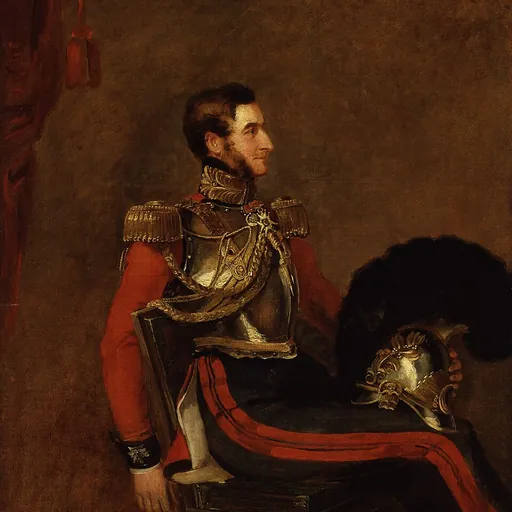
About Edward Pyndar Lygon
Lived 1786 – 1860 (aged 74). Edward Pyndar Lygon was a British politician and member of Parliament.
General Edward Pyndar Lygon (3 April 1786 – 11 November 1860) was a British Army officer and politician. He was the fourth son of William Lygon, 1st Earl Beauchamp and Catharine Denn, and the brother of Henry Lygon, 4th Earl Beauchamp, who also became a British Army general. Educated at Westminster School, Lygon entered the army in 1803 and rose to the rank of general, serving in major campaigns including the Peninsular War and the Battle of Waterloo. Lygon was educated at Westminster School. In 1803, at the age of seventeen, he entered the British Army as a cornet in the 2nd Life Guards, beginning a military career that would eventually see him rise to the rank of general.
Military career Lygon was promoted to lieutenant in 1805, captain in 1808, and major, and he fought in the Peninsular War from 1812 to 1814. He was promoted to major and Lieutenant colonel in 1815 and commanded the 2nd Life Guards at the Battle of Waterloo. He was awarded the Companion of the Order of the Bath (CB) on 22 June 1815.
Further promotions as a staff officer included lieutenant colonel in 1818, colonel in 1822, major-general in 1837, and lieutenant-general in 1846. He was subsequently appointed Inspector General of Cavalry. He was promoted to full general on 20 June 1854.
Parliamentary career In 1818, Lygon was elected as a Member of Parliament for Callington, a small borough in Cornwall, and held the seat until 1820.
Death and legacy He died on 11 November 1860 at his London residence, 12 St. James's Square, aged 74. He remained unmarried throughout his life and left no direct heirs. Lygon's death marked the end of his long and distinguished military career, during which he had risen to the rank of full general and held senior command positions, including Inspector General of Cavalry and colonelcy of the 13th Regiment of Light Dragoons.
Following his death, his estate and personal papers were managed in accordance with the family trust established by the Lygons of Madresfield Court, a family noted for its enduring influence in Worcestershire politics and military service. Lygon was buried in the family vault at Madresfield Church, Worcestershire.
The Lygon Arms in Chipping Campden was named after him.
Lygon Street in Melbourne, Australia, was also named in his honour.
Don’t just read it —
keep it.
Full-length biographies made to live with: read them, listen on the way to work, watch them tonight.
- E-book
- Audio
- Video
Instant download · yours to keep · every purchase keeps this site free
Important facts
Related people
Same field, nearest in time



Contemporaries
People whose lives overlapped Edward Pyndar Lygon's

Frequently asked questions
Who was Edward Pyndar Lygon?
British Member of Parliament (1786-1860)
When was Edward Pyndar Lygon born?
Edward Pyndar Lygon was born on 3 April 1786.
When did Edward Pyndar Lygon die?
Edward Pyndar Lygon died on 11 November 1860.
What was Edward Pyndar Lygon's occupation?
Edward Pyndar Lygon was a politician and member of Parliament.
What nationality was Edward Pyndar Lygon?
Edward Pyndar Lygon was British.
Sources & further reading
· Wikipedia: Edward Pyndar Lygon
· DBpedia: Edward Pyndar Lygon
Cite this page
APA: Biography.guide. (2026). Edward Pyndar Lygon. https://biography.guide/edward-pyndar-lygon/
MLA: "Edward Pyndar Lygon." Biography.guide, https://biography.guide/edward-pyndar-lygon/.
Chicago: "Edward Pyndar Lygon." Biography.guide. https://biography.guide/edward-pyndar-lygon/.
Data last updated: 2026-09-21 · Spot an error? Report a correction.
Portrait: Wikimedia Commons · author & licence
Page generated 2026-09-27 05:00 UTC