
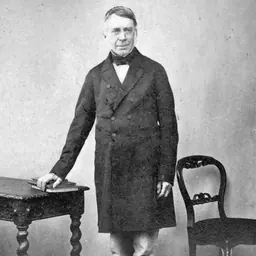
Edward O'Meagher Condon
Irish nationalist and Civil War (Union) officer
About Edward O'Meagher Condon
Lived 1840 – 1915 (aged 75).
Edward O'Meagher Condon (27 January 1840 - 15 December 1915) was an Irish nationalist and Fenian who fought in the American Civil War and attempted to participate in the Fenian Rising of 1867 in Ireland. After the Fenian Rising failed, In September 1867 O'Meagher Condon led a rescue party which attempted to save Irish Republican Brotherhood leader Thomas J. Kelly from imprisonment in Manchester, England. The rescue attempt led to the death of an English police officer and the arrest of sixty Irishmen, and led directly into the Manchester Martyrs case, in which O'Meagher Condon himself was one of the five main defendants. For his role in the attempted Manchester rescue, O'Meagher Condon was sentenced to death. During the trial, O'Meagher Condon gave a memorable speech in his own defence which ended with the rallying cry "God Save Ireland!", which was immediately repeated in unison by his fellow defendants. Not only did "God Save Ireland" become a popular slogan amongst Irish nationalists, but it was also turned into a song which became the "Unofficial Irish national anthem" until 1916, and continued to enjoy popularity long after.
O'Meagher Condon was an American citizen and his sentence was commuted to life imprisonment following an intervention from the American ambassador to Britain Charles Francis Adams Sr. O'Meagher Condon remained imprisoned until June 1878, when after semi-persistent petitioning from Irish-American politicians he was released on condition he not return to the United Kingdom for 30 years. O'Meagher Condon went into exile and settled in New York City, where many other Fenians had also gone. There, O'Meagher Condon joined the Irish Republican organisation Clan na Gael and continued to espouse radical Irish nationalism, expressing support for the Fenian dynamite campaign. However, following the murder of Patrick Henry Cronin in Chicago by members of Clan na Gael which caused shock and outrage across the United States, O'Meagher Condon was forced to reduce his radicalism and thereafter withdrew from public politics, beginning a career in journalism. During a tour of Ireland in 1909, O'Meagher Condon's legacy was widely celebrated and he was given the freedom of the cities of Dublin, Cork and Waterford.
Biography Early life
O'Meagher Condon was born in January 1840 to Thomas Condon, a farmer, and his wife Ellen Condon ( O'Meagher) near Mitchelstown in County Cork. The family immigrated to Prince Edward Island, near Nova Scotia, Canada in 1842. O'Meagher Condon was educated via a private tutor and by his teenage years was working (briefly) as a carpenter and sailing instructor.
In 1857 O'Meagher Condon was in New York City when he encountered the Gaelic scholar and leader of the Irish nationalist organisation the Fenian Brotherhood John O'Mahony, whom he quickly befriended. O'Mahoney had set up the Fenian Brotherhood two years prior, and upon O'Meagher Condon's return to Canada, resettling in Toronto, he set up his own branch of the organisation there.
Rescue of Thomas Kelly and Manchester Martyrs case
Nevertheless, Thomas Kelly was arrested alongside fellow Fenian Timothy Deasy for loitering by British authorities on 11 September 1867. Immediately O'Meagher Condon became the principal organiser of a rescue mission to break the two free. — Edward O'Meagher Condon title=Excerpt from O'Meagher Condon's speech from the Dock, 28 October 1867
Upon yelling "GOD SAVE IRELAND" before the court, all four of his co-accused immediately repeated the phrase. When this was reported in the newspaper, it rapidly became a rallying cry and slogan amongst Irish nationalists. O'Brien, Allen and Larkin received no reprieve and were publicly executed via hanging on 22 November 1867 in front of 10,000 spectators. The executioner, William Calcraft, botched two of the executions and had to pull down on the legs of Larkin and O'Brien to kill them (their necks should have broken on the initial drop). From there he was quickly feted at large events in New York, Boston and Philadelphia. He was recruited into the Irish Republican organisation Clan na Gael and was installed as the Clan na Gael leader in Washington, D.C., where O'Meagher Condon managed to secure work as a member of the clerical staff of the US treasury department. After the Land League dissolved in 1882, O'Meagher Condon responded by endorsing the Fenian Dynamite Campaign, which saw Irish Republicans travelling to England to bomb infrastructure and institutions.
However, after O'Meagher Condon's close friend William Mackey Lomasney was killed in November 1884 alongside three other Fenians in an attempt to bomb London Bridge, O'Meagher Condon turned against the campaign. He also began to distance himself from Clan na Gael's leadership.
Following the sensational murder of Patrick Henry Cronin in Chicago and the subsequent investigation into Clan na Gael in 1889, O'Meagher Condon signed a message to the American public which denied that the organisation was guilty of ‘un-American behaviour'. Nonetheless, in the aftermath of the Cronin murder O'Meagher Condon pulled away from revolutionary Irish nationalism.
Life after politics Following many years in which he worked as an electrical engineer for the postal and fire departments of the municipal government of New York, O'Meagher Condon pivoted to working as a journalist by the early 1900s. He was mostly involved in Irish-American newspapers such as the Irish World.
On the urging of John Finerty and Patrick Egan, O'Meagher Condon became involved in the American wing of the United Irish League. In 1909, the UIL brought O'Meagher Condon back to Ireland as part of a lecture tour. As part of this tour, O'Meagher Condon was widely celebrated and he was given the Freedom of the City of Dublin as well as the Freedom of the cities of Cork, Sligo, Waterford, and Wexford. O'Meagher Condon remained affiliated with the UIL until his death in New York on 15 December 1915.
Don’t just read it —
keep it.
Full-length biographies made to live with: read them, listen on the way to work, watch them tonight.
- E-book
- Audio
- Video
Instant download · yours to keep · every purchase keeps this site free
Important facts
People in Edward O'Meagher Condon's life
Named in this biography and alive at the same time


Contemporaries
People whose lives overlapped Edward O'Meagher Condon's


Frequently asked questions
Who was Edward O'Meagher Condon?
Irish nationalist and Civil War (Union) officer
When was Edward O'Meagher Condon born?
Edward O'Meagher Condon was born on 27 January 1840.
When did Edward O'Meagher Condon die?
Edward O'Meagher Condon died on 15 December 1915.
Sources & further reading
· Wikipedia: Edward O'Meagher Condon
· DBpedia: Edward O'Meagher Condon
Cite this page
APA: Biography.guide. (2026). Edward O'Meagher Condon. https://biography.guide/edward-o-meagher-condon/
MLA: "Edward O'Meagher Condon." Biography.guide, https://biography.guide/edward-o-meagher-condon/.
Chicago: "Edward O'Meagher Condon." Biography.guide. https://biography.guide/edward-o-meagher-condon/.
Data last updated: 2026-09-20 · Spot an error? Report a correction.
Page generated 2026-09-27 05:14 UTC