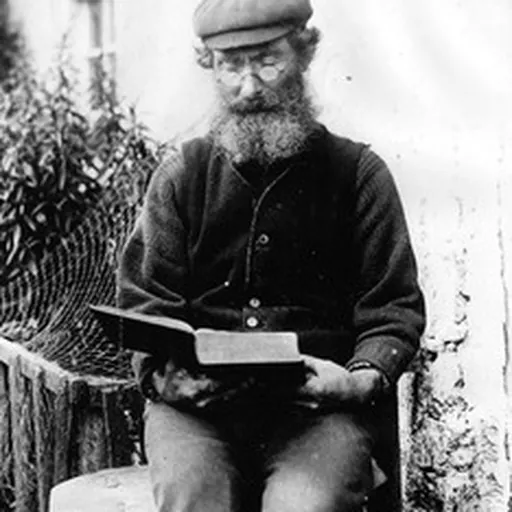
About Edward Faragher
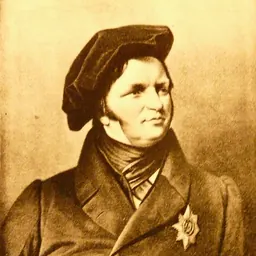
Lived 1831 – 1908 (aged 76–77). Edward Faragher was a British writer, poet and fisherman.
Edward Faragher (1831–1908), also known as , was a Manx language poet, folklorist, and cultural guardian. He is considered to be the last important first language writer of Manx literature and perhaps the most important guardian of Manx culture during a time when it was most under threat. Celticist Charles Roeder wrote that Faragher had "done great services to Manx folklore, and it is due to him that at this late period an immense amount of valuable Manx legends have been preserved, for which indeed the Isle of Man must ever be under gratitude to him."
Youth (1831–1876) Faragher was born into a large family of twelve children in Cregneash, a fishing village at the south of the Isle of Man. At this time Manx was the only language spoken in Cregneash, and so his mother stood out as "the only person who could converse with strangers"
Faragher attended infants' school in Port St Mary followed by the parish school of Kirk Christ Rushen, but his family could not afford for him to attend any longer than two years. The rest of his education came from his parents, or else was self-taught.
At a young age he began earning his living as a fisherman in his father's boat. He was a fisherman for the next seven years; then he moved to Liverpool to work in a safe-making factory.
Faragher enjoyed himself in England, finding that his natural talent at composing verse proved to be popular with young women. In 1899 he would write of this time that:
"[...] when I was living in England, I was putting the young women in a frenzy with my songs. I was often forced to stay at the house on Sunday afternoon because there were so many of them coming after me. And I was serving them all on the same plate. When I would be writing a song to one, she would be reading it to her comrades and they would be all striving to get acquaintance with me, and to get me to do a song for themselves until they were bothering my head."
It was whilst in Liverpool, aged around 26, that Faragher began to write down his verse for the first time, having previously retained it only in his head.
Farewell to phantasy and art That never can fill up my heart, And those fair maids, with witching smile, No more can my sad heart beguile; For still my fancy lingers where The youthful Kitty blooms so fair, And father tills my native soil Among the hills of Mona's Isle.
Fisherman (1876–1889)
Faragher returned to Cregneash in around 1876, and earned a living fishing for mackerel at Kinsale and on the west coast of Ireland for the rest of his working life. During this time he encountered rough storms and was even shipwrecked, narrowly surviving. Also at this time his poetry expanded from the romantic and lyrical to include more contemplative and sacred topics.
Despite his phenomenal output, Faragher's poetry and song received little attention in his own community. Instead they tended to bring him only the "jeers and derision of his uncultured companions and the buxom village belles." A strong friendship developed between them that would last until Faragher's death.
Through Roeder, Faragher became well known in circles concerned with Manx Gaelic culture. He became connected with the major figures of the Manx cultural revival, including Sophia Morrison, John Kneen, Edmund Goodwin and John Clague. As this was at the time of Pan-Celticism, there was also an interest in Faragher from outside the island. Faragher's letters to Roeder tell of visits from gentlemen who had "heard [Faragher's] name mentioned in London," academics such as the Professor of Gaelic from Scotland who communicated with him through Scottish Gaelic, In 1896 the foreign interest in Faragher reached such an extent that he would write that he was being "kept busy answering young ladies letters ones that I never saw." By this time Faragher was in his 60s and was beginning to be afflicted by rheumatism, from which he was to suffer increasingly and which threatened to keep him from work entirely.
Arrane Mychione Eirinee Sayntoilagh / A Song About Covetous Farmers [extract]Feer-veg t'ad cur da labree boght Son e hooilliel as laboraght: Son kiangley arroo ayns yn ouyr Ny-yeih t'ad geam dy vel eh rouyr. Very little do they give the poor labourer For his toil and labour: For binding corn in the harvest. Yet they exclaim that it is too much.
In response to Faragher's struggle to earn enough to live on, Roeder tried to create an interest in him as a literary and cultural figure, so that a public fund might be raised to support him. In 1898 he wrote to the Manx novelist Hall Caine, at that time perhaps the British isles' most popular and successful writer, to ask him to write about Faragher so as to raise his profile and the public's awareness of him. However, Caine responded with a letter that reflected the lack of understanding or interest in Faragher at that time: Realising the value of the work, despite the lack of interest at that time, Roeder deposited Faragher's full manuscript in the library of the Manx Museum for safekeeping, where it still remains today. Manx Notes and Queries, Charles Roeder's serialised column in The Isle of Man Examiner, which was at that time "sympathetic to the Manx language revival." His poetry has been described as "of the homely, descriptive kind, and appeals to the simple emotions of the heart." He wrote in thanks to Roeder, commenting sadly that "I am not longing for much but a sight of the sea." One of the most striking poems of this period comments on his sorrow at the decline of Manx culture:
In the obituary notice for Faragher in The Manx Quarterly, Roeder wrote that:
Don’t just read it —
keep it.
Full-length biographies made to live with: read them, listen on the way to work, watch them tonight.
- E-book
- Audio
- Video
Instant download · yours to keep · every purchase keeps this site free
Important facts
People in Edward Faragher's life
Named in this biography and alive at the same time






Related people
Same field, nearest in time

Contemporaries
People whose lives overlapped Edward Faragher's



Frequently asked questions
Who was Edward Faragher?
Manx poet
When was Edward Faragher born?
Edward Faragher was born in 1831 in Cregneash.
When did Edward Faragher die?
Edward Faragher died on 5 June 1908 in Alfreton.
What was Edward Faragher's occupation?
Edward Faragher was a writer, poet and fisherman.
What nationality was Edward Faragher?
Edward Faragher was British.
Sources & further reading
Cite this page
APA: Biography.guide. (2026). Edward Faragher. https://biography.guide/edward-faragher/
MLA: "Edward Faragher." Biography.guide, https://biography.guide/edward-faragher/.
Chicago: "Edward Faragher." Biography.guide. https://biography.guide/edward-faragher/.
Data last updated: 2026-09-22 · Spot an error? Report a correction.
Portrait: Wikimedia Commons · author & licence
Page generated 2026-09-27 05:03 UTC