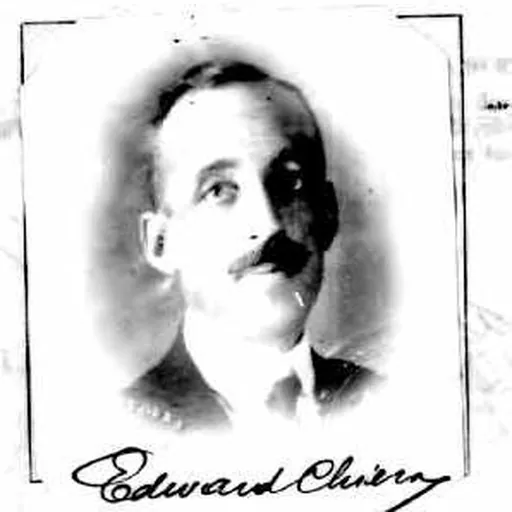
About Edward Chiera
Lived 1885 – 1933 (aged 47). Edward Chiera was an Italian and American anthropologist, archaeologist, assyriologist and orientalist.
Edward Chiera (August 5, 1885 – June 20, 1933) was an Italian-American archaeologist, Assyriologist, and scholar of religions and linguistics.
Born in Rome, Italy, in 1885, Chiera trained as a theologian at the Crozer Theological Seminary (B.D. 1911, Th.M. 1912). He completed his doctorate at the University of Pennsylvania (Ph.D. 1913). He was faculty of the University of Pennsylvania until 1927, at which time he joined the Oriental Institute of the University of Chicago. thumb
Chiera was Annual Professor of the American Schools of Oriental Research (ASOR) at Baghdad in 1924 – 1925. At that time he conducted archaeological excavations in ancient Nuzi, near Kirkuk, Iraq, at the invitation of Gertrude Bell and sponsored by the Iraq Museum. His discovery and deciphering of the Nuzi Tablets was an important archaeological result. He traveled to Istanbul in 1924 and copied some fifty pieces of inscribed clay tablets from the Nippur collection. In the years that followed, he copied and translated more than two hundred literary tablets, among which Istanbul #2461 containing the oldest known love song and others with some of the Gilgamesh poems. This work gave scholars important new insights into Sumerian history and literature.
A pre-eminent scholar of ancient cuneiform languages, Chiera became Editor of the Chicago Assyrian Dictionary Project, a monumental work which had been started in 1921, and eventually took 85 years to complete. He was a close associate of the director and founder of the Oriental Institute, James Henry Breasted. Chiera also acted as a curator of the Museum of the Oriental Institute, and made significant acquisitions for its collections, in addition to his own discoveries.
Chiera led Oriental Institute excavations at Khorsabad, near Mosul, Iraq in 1928 - 1929, again with great success. The site of the ancient palace of King Sargon II was excavated. Valuable works of Assyrian art were recovered, including a colossal Lamassu which had guarded the entrance to the palace. He continued as field director of ASOR in 1931, in a joint expedition of ASOR and Harvard University. He was instrumental in the development of plans for the ASOR, for the Iraq Museum, and in the careers of other noted archaeologists.
Don’t just read it —
keep it.
Full-length biographies made to live with: read them, listen on the way to work, watch them tonight.
- E-book
- Audio
- Video
Instant download · yours to keep · every purchase keeps this site free
Important facts
People in Edward Chiera's life
Named in this biography and alive at the same time



Related people
Same field, nearest in time


Contemporaries
People whose lives overlapped Edward Chiera's




Frequently asked questions
Who was Edward Chiera?
Italian-American archaeologist (1885-1933)
When was Edward Chiera born?
Edward Chiera was born on 5 August 1885 in Rome.
When did Edward Chiera die?
Edward Chiera died on 20 June 1933 in Chicago.
What was Edward Chiera's occupation?
Edward Chiera was an anthropologist, archaeologist, assyriologist and orientalist.
What nationality was Edward Chiera?
Edward Chiera was Italian and American.
Sources & further reading
Cite this page
APA: Biography.guide. (2026). Edward Chiera. https://biography.guide/edward-chiera/
MLA: "Edward Chiera." Biography.guide, https://biography.guide/edward-chiera/.
Chicago: "Edward Chiera." Biography.guide. https://biography.guide/edward-chiera/.
Data last updated: 2026-09-20 · Spot an error? Report a correction.
Portrait: Wikimedia Commons · author & licence
Page generated 2026-09-27 04:58 UTC