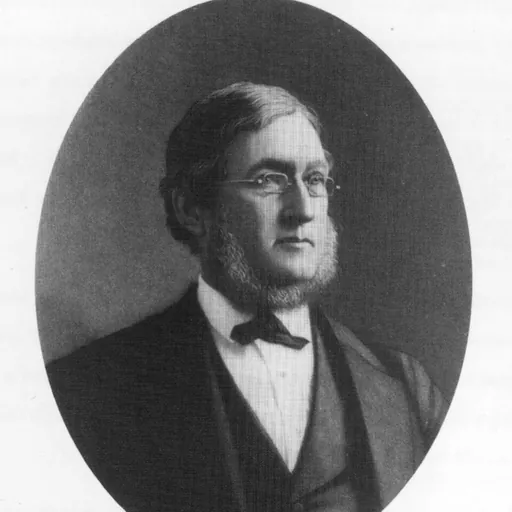
About Edward C. Clark
Lived 1811 – 1882 (aged 70). Edward C. Clark was an American lawyer, businessperson and entrepreneur.
Edward Cabot Clark (December 19, 1811 – October 14, 1882) He was the eldest child of three sons born to Nathan Clark (1787–1880) and Julia (née Nichols) Clark (1793–1873), who married in February 1811. His younger brothers were Nathan Henry Clark (who died in infancy), and Nathan Clark Jr., who took over their father's potter company.
His maternal grandparents were from Waterbury, Connecticut, and his paternal grandparents were Reuben Clark and Mary (née Peppard) Clark.
After spending four years at the Lenox Academy in Lenox, Massachusetts, where he learned Latin and Greek, in the fall of 1826, Clark began attending Williams College in Williamstown, Massachusetts, where he graduated in August 1831 and later built Clark Hall. before becoming a partner of Jordan and moving the firm to New York City in 1838 where the firm became "the most prestigious law firm in the city." which "Singer assigned Edward three-eighths of it, apparently in lieu of paying legal fees that the penniless inventor could not afford." In 1856, Clark created the hire-purchase plan, which was the first American installment plan. After Singer's death in 1875, Clark returned to the company, which had been reorganized in 1865, and guided the company to greater success as president from 1875 until his retirement in 1882. Clark and his heirs also built a row of houses immediately north of the Dakota, which were completed in 1884–1885.
In Cooperstown, New York, where his father-in-law practiced law and had served as the District Attorney, Clark bought significant amounts of land had built the Hotel Fenimore, Pioneer Mills, and several cottages and farm houses. In 1874, he acquired an additional 500 acres where he built a Swiss chalet and, in 1876, he again hired Hardenbergh to build him a Gothic Revival castle that rose out of Otsego Lake and became known as Kingfisher Tower. Together, they traveled around Europe, collecting art and renting homes, in France and in Italy where they spent a winter. who married Elizabeth Scriven (1848–1909) at Withecombe in Raleigh. After his death, his widow remarried to Bishop Henry Codman Potter. Upon his death, he left an estate estimated between $25,000,000 (equivalent to $ today) and $50,000,000 (equivalent to $ today), excluding his real estate portfolio, which he left to his grandsons.
Descendants Through his son Alfred, his only child to marry and have children, he was the paternal grandfather of Edward Severin Clark, F. Ambrose Clark, Robert Sterling Clark, Stephen Carlton Clark.
Don’t just read it —
keep it.
Full-length biographies made to live with: read them, listen on the way to work, watch them tonight.
- E-book
- Audio
- Video
Instant download · yours to keep · every purchase keeps this site free
Important facts
Family & relationships
People in Edward C. Clark's life
Named in this biography and alive at the same time

Related people
Same field, nearest in time





Contemporaries
People whose lives overlapped Edward C. Clark's




Frequently asked questions
Who was Edward C. Clark?
American businessman (1811–1882)
When was Edward C. Clark born?
Edward C. Clark was born on 19 December 1811 in New York.
When did Edward C. Clark die?
Edward C. Clark died on 14 October 1882 in Cooperstown.
What was Edward C. Clark's occupation?
Edward C. Clark was a lawyer, businessperson and entrepreneur.
What nationality was Edward C. Clark?
Edward C. Clark was American.
Sources & further reading
Cite this page
APA: Biography.guide. (2026). Edward C. Clark. https://biography.guide/edward-c-clark/
MLA: "Edward C. Clark." Biography.guide, https://biography.guide/edward-c-clark/.
Chicago: "Edward C. Clark." Biography.guide. https://biography.guide/edward-c-clark/.
Data last updated: 2026-09-23 · Spot an error? Report a correction.
Portrait: Wikimedia Commons · author & licence
Page generated 2026-09-27 05:05 UTC