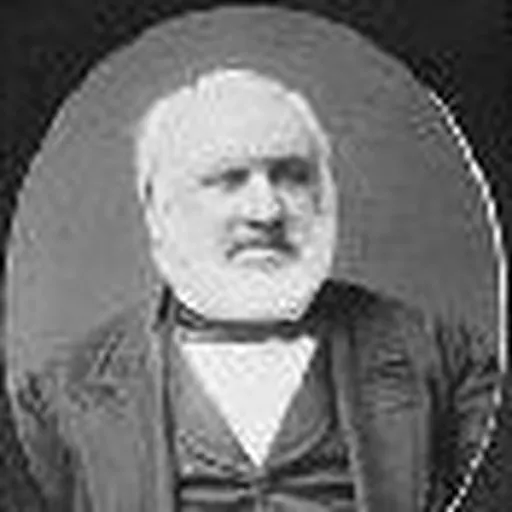
About Edward Baigent
Lived 1813 – 1892 (aged 79). Edward Baigent was a New Zealand politician.
Edward Baigent (22 June 1813 – 9 November 1892) was a 19th-century New Zealand politician. He served two terms as a member of Parliament from Nelson, New Zealand, and is regarded as one of the most successful saw-millers of the region; his company existed for well over 100 years.
Family Edward Baigent was born in 1813 in Windlesham, Surrey, England, and christened on 31 July 1814. His parents were Thomas Baigent (1782–1860) and Dorothy Ann Coule (1782–1869). Baigent was brought up as a mechanic, but afterwards engaged in farming. He married Mary Ann Hern at Windlesham, in 1833.
The Baigents and their five children emigrated to Nelson on the Clifford in May 1842; he was thus one of the earliest settlers in the Nelson region.
His son Joseph was born three days after their arrival in the colony and he was only the seventh child to be born in Nelson. After Henry, the Baigents had four more children; eleven in total.
Mary Ann Baigent began providing school education at their home in Wakefield in mid-1843, but the school moved to a cob house in November of that year. On 1 January 1844, the new school was officially opened, making Wakefield School the oldest continuous school in New Zealand. In 1846 he was instrumental in the construction of St John's Church in Wakefield.
Professional life
In 1844, Baigent built a water race on the Wai-iti River and a water wheel drove a flour-mill. In 1845, he added a saw-milling plant, and the timber was rafted down the Wai-iti River to the nearest road. He was a member for Waimea South on the Provincial Council for the entire length of its existence, On election day, Baigent, Shephard and Kelling received 99, 71 and 32 votes, respectively, and Baigent was thus declared elected. He represented the electorate until the end of the term in 1870.
The next general election was held on 13 February 1871 in the Waimea electorate, and it was contested by Baigent and Shephard. Shephard won by 149 to 91 votes.
At the nomination meeting on 22 December 1875 for the next general election, Baigent and Shephard were proposed, with the show of hands in favour of Baigent. The interest in the election on 7 January 1876 was low, with a voter turnout of less than half. Baigent was elected with 88 votes to 76, and represented the electorate until the end of the parliamentary term in 1879, when he retired. He was succeeded by Shephard, who was elected unopposed.
Death Baigent's wife died on 3 November 1892. Baigent himself died less than a week after her, on 9 November 1892 in Wakefield, aged 79. He was buried there three days later.
Don’t just read it —
keep it.
Full-length biographies made to live with: read them, listen on the way to work, watch them tonight.
- E-book
- Audio
- Video
Instant download · yours to keep · every purchase keeps this site free
Important facts
Family & relationships
People in Edward Baigent's life
Named in this biography and alive at the same time


Related people
Same field, nearest in time



Contemporaries
People whose lives overlapped Edward Baigent's





Frequently asked questions
Who was Edward Baigent?
New Zealand politician
When was Edward Baigent born?
Edward Baigent was born on 22 June 1813 in Windlesham.
When did Edward Baigent die?
Edward Baigent died on 9 November 1892 in Wakefield.
What was Edward Baigent's occupation?
Edward Baigent was a politician.
What nationality was Edward Baigent?
Edward Baigent was New Zealand.
Sources & further reading
Cite this page
APA: Biography.guide. (2026). Edward Baigent. https://biography.guide/edward-baigent/
MLA: "Edward Baigent." Biography.guide, https://biography.guide/edward-baigent/.
Chicago: "Edward Baigent." Biography.guide. https://biography.guide/edward-baigent/.
Data last updated: 2026-09-21 · Spot an error? Report a correction.
Portrait: Wikimedia Commons · author & licence
Page generated 2026-09-27 05:01 UTC