About Edward Atkinson Hornel
Lived 1864 – 1933 (aged 68). Edward Atkinson Hornel was a British painter and visual artist.
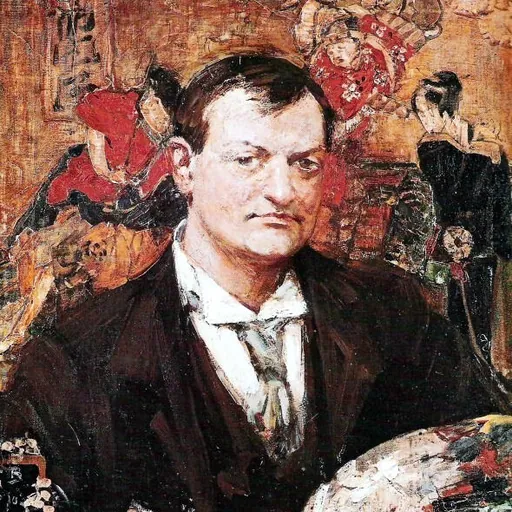
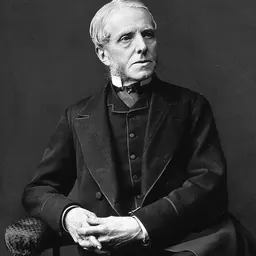
Portrait of E.A. Hornel by Glasgow School contemporary Bessie MacNicol Edward Atkinson Hornel (17 July 1864 – 30 June 1933) was a Scottish painter of landscapes, flowers, and foliage, with children. He was a cousin of James Hornell. His contemporaries in the Glasgow Boys called him Ned Hornel.
Biography Hornel was born in Bacchus Marsh, Victoria, Australia, of Scottish parents. He was brought up and lived practically all his life in Scotland after his family moved back to Kirkcudbright in 1866. He studied for three years at the art school at Edinburgh, and for two years in Antwerp under Charles Verlat. Returning from Antwerp in 1885, he met George Henry and associated himself with the Glasgow Boys.
Hornel and Henry collaborated upon The Druids Bringing in the Mistletoe (1890), a procession of druidic priests bringing in the sacred mistletoe, gorgeous with polychrome and gold. The two worked side by side to achieve decorative splendor of colour, Hornel boldly and freely employing texture effects produced by loading and scraping, roughening, smoothing, and staining. In 1893–94 (funded by William Burrell via their friend and art dealer Alexander Reid ) the two artists spent a year and a half in Japan, where Hornel learned much about decorative design and spacing. In this period they met the resident British artist, Percy Sturdee.
Towards the close of the 1890s Hornel's colours, while preserving their glow and richness, became more refined and more atmospheric, and his drawing more naturalistic, combining sensuous appeal with emotional and poetic significance. In 1901 he declined election to the Royal Scottish Academy. A member of Glasgow Art Club, Hornel exhibited in the club's annual exhibitions.
In 1901 he acquired Broughton House, a townhouse and garden in Kirkcudbright, which was his main residence for the rest of his life with his sister Elizabeth. There he made several modifications to the house and designed garden taking inspiration from his travels in Japan. he also made an addition of a gallery for his paintings. On his death the house and library were donated for the benefit of the citizens and Broughton House is now administered by the National Trust for Scotland.
There are examples of his works in the museums of Aberdeen, Buffalo, Bradford, St. Louis, Toronto, Montreal, Glasgow, Edinburgh, Leeds, Manchester, Hull, Bath, and Liverpool.
Don’t just read it —
keep it.
Full-length biographies made to live with: read them, listen on the way to work, watch them tonight.
- E-book
- Audio
- Video
Instant download · yours to keep · every purchase keeps this site free
Important facts
People in Edward Atkinson Hornel's life
Named in this biography and alive at the same time





Related people
Same field, nearest in time
Contemporaries
People whose lives overlapped Edward Atkinson Hornel's


Frequently asked questions
Who was Edward Atkinson Hornel?
painter (1864-1933)
When was Edward Atkinson Hornel born?
Edward Atkinson Hornel was born on 11 July 1864 in Victoria.
When did Edward Atkinson Hornel die?
Edward Atkinson Hornel died on 30 June 1933 in Kirkcudbright.
What was Edward Atkinson Hornel's occupation?
Edward Atkinson Hornel was a painter and visual artist.
What nationality was Edward Atkinson Hornel?
Edward Atkinson Hornel was British.
Sources & further reading
· Wikipedia: Edward Atkinson Hornel
· DBpedia: Edward Atkinson Hornel
Cite this page
APA: Biography.guide. (2026). Edward Atkinson Hornel. https://biography.guide/edward-atkinson-hornel/
MLA: "Edward Atkinson Hornel." Biography.guide, https://biography.guide/edward-atkinson-hornel/.
Chicago: "Edward Atkinson Hornel." Biography.guide. https://biography.guide/edward-atkinson-hornel/.
Data last updated: 2026-09-22 · Spot an error? Report a correction.
Portrait: Wikimedia Commons · author & licence
Page generated 2026-09-27 05:01 UTC