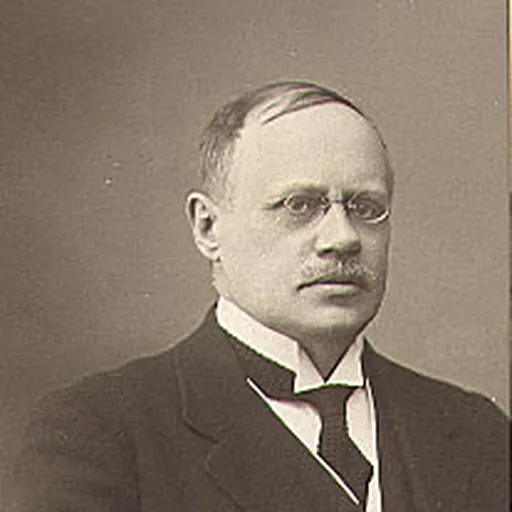
About Edvard Westermarck
Lived 1862 – 1939 (aged 76). Edvard Westermarck was a Finnish anthropologist, philosopher, physician, sociologist, university teacher and essayist, known for Westermarck effect.
Edvard Alexander Westermarck (20 November 1862 – 3 September 1939) was a Finnish social anthropologist, sociologist and philosopher. He was the most internationally prominent Finnish scholar of his time, known for his work on the history of marriage and the origin of moral ideas. He was the first to lecture on sociology in both England and the Nordic countries, and held professorships at the London School of Economics, the University of Helsinki and Åbo Akademi University, where he also served as the first rector. He is perhaps best remembered today for the Westermarck effect, the hypothesis that children raised in close proximity develop a natural aversion to sexual relations with each other. His scholarly interest in human sexuality and marriage has been linked by some biographers to his own presumed homosexuality.
Biography
Early life and education Westermarck was born in 1862 in a well-off Lutheran family, part of the Swedish-speaking population of Finland. His father worked at the University of Helsinki as a bursar, and his maternal grandfather was a professor at the same university. It was thus natural for Edvard to study there. He enrolled in 1881, initially studying aesthetics, literature and history before turning to philosophy, and obtained his degree in 1886.
Academic career In 1892, Westermarck became a lecturer in sociology at the University of Helsinki. He was the first to lecture on sociology in England, as well as in the Nordic countries. An arrangement allowed him to hold his London and Helsinki (later Turku) professorships in parallel, and to spend part of each year in Morocco. In 1898 Westermarck first visited Morocco, and was immediately captivated by the country. At a later visit he bought a house in Tangier and learned the local Arabic dialect. His students included Ragnar Numelin.
While still teaching philosophy in Turku, he helped found academic sociology in the United Kingdom, becoming the first Martin White Professor of Sociology (with Leonard Trelawny Hobhouse) in 1907 in the University of London. as well as "an authority in the history of morals and of marriage customs."
The phenomenon of reverse sexual imprinting, the diminution in sexual attraction between persons who lived in close domestic proximity during the first few years in the life of either one, now known as the Westermarck effect, was first formally described in his thesis The History of Human Marriage (1891).
Morocco Westermarck was also a scholar of Morocco and offered a positivist view of how its folk religion was formed in his two-volume work Ritual and Belief in Morocco (1926). He also studied marriage in Morocco, publishing Marriage Ceremonies in Morocco in 1914.
Moral philosophy Westermarck critiqued Christian institutions and Christian ideas on the grounds that they lacked foundation. He was also a moral relativist and in his two-volume The Origin and Development of Moral Ideas (1906–1908) he argued that moral judgements are not rational but are based on emotions and on social approval or disapproval. As a consequence, he also denied the existence of general or universal moral truth.
Political engagement In 1899, Westermarck mobilised support among Western European intellectuals against Emperor Nicholas II's Russification policies, in defence of Finland's cultural autonomy. One of the original reasons he spent time in London was that he did not feel safe in Helsinki or Turku because of this advocacy.
When the League of Nations considered the Åland question in 1920–1921, Westermarck represented the Swedish Assembly of Finland before the assembly. Although the Ålanders almost unanimously favoured joining Sweden, Westermarck argued that it was vital for the Finland-Swedish minority that Åland remain part of Finland.
He also worked for popular education in Finland, notably in connection with the founding of the in Ingå.
Influence and legacy Westermarck had a considerable influence on the development of anthropology. Bronisław Malinowski, his student in London and one of the most prominent anthropologists of the 20th century, credited Westermarck as a model for his classical fieldwork on the Trobriand Islands. Claude Lévi-Strauss described Westermarck as the last and most notable representative of the English anthropological school. Among his Finnish students were Rafael Karsten, Gunnar Landtman, Hilma Granqvist and . He also influenced the art theorist and the philosopher .
After World War II, anthropology's qualitative descriptions of foreign cultures gave way in the West to a sociology oriented towards quantitative studies of one's own society. The last representative of the scholarly paradigm Westermarck had introduced in Finland was Arne Runeberg. The Finnish sociologists' learned society still bears Westermarck's name. In certain respects, Westermarck's ideas anticipated the sociobiological and evolutionary psychological currents that became dominant in the behavioural sciences a century later, after a period during which scholars had emphasised the uniqueness of individual cultures. His insistence on seeking direct biological explanations for human behavioural patterns, and his use of evidence from the animal kingdom, place him as a forerunner of these later developments. Paradoxically, it was the fieldwork methodology he developed in his Moroccan studies that proved more lastingly influential than the comparative method of his early works.
Books 1891: The History of Human Marriage. 3 Vol, Macmillan, London. 1906: The Origin and Development of the Moral Ideas. 2 Vol, MacMillan, London 1907: Siveys ja kristinusko: Esitelmä. Ylioppilasyhdistys Prometheus, Helsinki. 1914: Marriage Ceremonies in Morocco. Macmillan, London. 1919: Tapojen historiaa: Kuusi akadeemista esitelmää: Pitänyt Turussa syksyllä 1911 Edward Westermarck. 2nd edition. Suomalaisen kirjallisuuden seura, Helsinki. 1920: Religion och magi (Religion and magick), Studentföreningen Verdandis Småskrifter 149, Albert Bonniers Förlag, Stockholm 1926: Ritual and Belief in Morocco. 2 Vol. 1926: A short History of Human Marriage. Macmillan, London. 1929: Memories of My Life. 1930: Wit and Wisdom in Morocco. Routledge, London. 1932: Ethical Relativity. 1932: Avioliiton historia. WSOY, Helsinki. 1932: Early Beliefs and Their Social Influence. London: Macmillan. 1933: Pagan Survivals in Mohammedan Civilisation. London: Macmillan. 1933: Moraalin synty ja kehitys. WSOY, Helsinki. 1934: Three Essays on Sex and Marriage. Macmillan, London. 1934: Freuds teori on Oedipuskomplexen i sociologisk belysning. Vetenskap och bildning, 45. Bonnier, Stockholm. 1936: The future of Marriage in Western Civilisation. Macmillan, London. 1937: "Forward" in The Wandering Spirit: A Study of Human Migration. Macmillan, London 1939: Kristinusko ja moraali (Christianity and Morals). Otava, Helsinki.
Don’t just read it —
keep it.
Full-length biographies made to live with: read them, listen on the way to work, watch them tonight.
- E-book
- Audio
- Video
Instant download · yours to keep · every purchase keeps this site free
Important facts
People in Edvard Westermarck's life
Named in this biography and alive at the same time



Related people
Same field, nearest in time




Contemporaries
People whose lives overlapped Edvard Westermarck's



Frequently asked questions
Who was Edvard Westermarck?
Finnish academic (1862–1939)
When was Edvard Westermarck born?
Edvard Westermarck was born on 20 November 1862 in Helsinki.
When did Edvard Westermarck die?
Edvard Westermarck died on 3 September 1939 in Tenala.
What was Edvard Westermarck's occupation?
Edvard Westermarck was an anthropologist, philosopher, physician, sociologist, university teacher and essayist.
What was Edvard Westermarck known for?
Edvard Westermarck was known for Westermarck effect.
What nationality was Edvard Westermarck?
Edvard Westermarck was Finnish.
Sources & further reading
· Wikipedia: Edvard Westermarck
Cite this page
APA: Biography.guide. (2026). Edvard Westermarck. https://biography.guide/edvard-westermarck/
MLA: "Edvard Westermarck." Biography.guide, https://biography.guide/edvard-westermarck/.
Chicago: "Edvard Westermarck." Biography.guide. https://biography.guide/edvard-westermarck/.
Data last updated: 2026-09-22 · Spot an error? Report a correction.
Portrait: Wikimedia Commons · author & licence
Page generated 2026-09-27 05:03 UTC