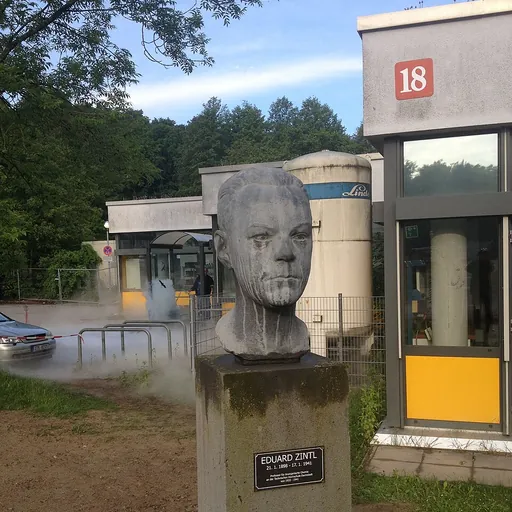
About Eduard Zintl
Lived 1898 – 1941 (aged 42). Eduard Zintl was a chemist and university teacher, known for Zintl phase.
Eduard Zintl (21 January 1898 – 17 January 1941) was a German chemist. He gained prominence for research on intermetallic compounds.
Family background After his family moved from Weiden and Bayreuth to Munich and after he had finished school, he was drafted for military service during World War I. At the age of 21, he started studying at the Ludwig-Maximilians-Universität München with Otto Hönigschmid. He was an excellent student, and later became an assistant for Otto Hönigschmid, head of the German atomic weight laboratory.
Career He earned his PhD in 1923, at the age of 25, with a thesis on the molar mass of bromine. He stayed with Otto Hönigschmid's group, where he was involved in the supervision of PhD students, for example Josef Goubeau and Günther Rienäcker. From 1928 till 1933 he was professor of inorganic chemistry at the University of Freiburg. During this period he studied the structure of complex anions formed by metals in a solution of sodium in ammonia. [Na(NH3)x]+4[Pb9]4 is one of the examples he discovered.
Working in an atomic weight laboratory as a student assistant had provided him a lot of experience with chemical elements and how they react with each other. He noted that the atomic volume contraction between these compounds were formed, and it could indicate cation formation.
Work at Darmstadt In 1933, he moved to a position at the Technische Universität Darmstadt, where a new building for inorganic and physical chemistry was planned and built. The research on complex anions led him to the discovery of the Zintl phases. The structure of Zintl phases were ionic, and the structure of the anion (aka Zintl ion) could result an electronic state. His study focused on intermetallic compounds and how the electron could be transferred from a more electropositive metal. In the Zintl phase, the structure of the Zintl ion (polyanion) should be similar to an isoelectronic element. For example, in Na2Tl, the polyanion is tetrahedral (Tl4)8 , similar to the phosphorus molecule P4.
Don’t just read it —
keep it.
Full-length biographies made to live with: read them, listen on the way to work, watch them tonight.
- E-book
- Audio
- Video
Instant download · yours to keep · every purchase keeps this site free
Important facts
People in Eduard Zintl's life
Named in this biography and alive at the same time

Related people
Same field, nearest in time



Contemporaries
People whose lives overlapped Eduard Zintl's



Frequently asked questions
Who was Eduard Zintl?
German chemist (1898–1941)
When was Eduard Zintl born?
Eduard Zintl was born on 21 January 1898 in Weiden in der Oberpfalz.
When did Eduard Zintl die?
Eduard Zintl died on 17 January 1941 in Darmstadt.
What was Eduard Zintl's occupation?
Eduard Zintl was a chemist and university teacher.
What was Eduard Zintl known for?
Eduard Zintl was known for Zintl phase.
What nationality was Eduard Zintl?
Eduard Zintl's recorded nationality: German Reich.
Sources & further reading
Cite this page
APA: Biography.guide. (2026). Eduard Zintl. https://biography.guide/eduard-zintl/
MLA: "Eduard Zintl." Biography.guide, https://biography.guide/eduard-zintl/.
Chicago: "Eduard Zintl." Biography.guide. https://biography.guide/eduard-zintl/.
Data last updated: 2026-09-23 · Spot an error? Report a correction.
Portrait: Wikimedia Commons · author & licence
Page generated 2026-09-27 05:07 UTC