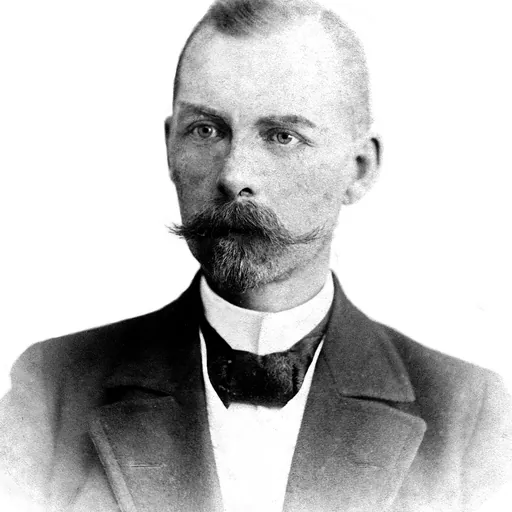
About Eduard von Toll
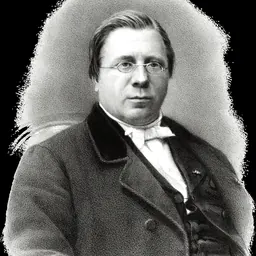
Lived 1858 – 1902 (aged 43–44). Eduard von Toll was a Russian explorer, paleontologist, zoologist, geologist, naturalist and polar explorer.
Eduard Gustav Freiherr von Toll (; disappeared 26 October 1902), also known as Baron von Toll, was a Russian geologist and Arctic explorer of Baltic German descent. He led the Russian polar expedition of 1900–1902 in search of the legendary Sannikov Land, a phantom island purported to lie off Russia's Arctic coast. During the expedition, Toll and a small party of explorers disappeared from Bennett Island, and their fate remains unknown to this day.
Early life Eduard von Toll was born on , in Reval of the Governorate of Estonia (now Tallinn, Estonia). He belonged to the Baltic German noble Toll family and was married to Emmeline "Emmy" Magdalene . His family's origin was debated, but genealogists had suggested them to be from Leiden in the County of Holland. He was a close relative of the Middendorff family, and one of the Toll's teachers was the academician of the Imperial Academy of Sciences Alexander von Middendorff.
Toll graduated from the Imperial University of Dorpat (Tartu) as a zoologist in 1882. As a student, he had travelled to the Mediterranean and researched the fauna, flora and geology of Algeria and the Balearic Islands.
Expeditions and surveys
In 1885–1886 Toll took part in an expedition to the New Siberian Islands, organized by the St. Petersburg Academy of Sciences and led by Alexander Bunge. Eduard Toll explored the Great Lyakhovsky Island, Bunge Land, Faddeyevsky Island, Kotelny Island, as well as the western shores of the New Siberia Island. In 1886 Toll thought that he had seen an unknown land north of Kotelny. He guessed that this was the so-called "Zemlya Sannikova" (Sannikov Land), a land that Yakov Sannikov and Matvei Gedenschtrom claimed to have seen during their 1808–1810 expedition, but whose existence had never been proved.
Eduard Toll was among the first to report in detail about the abundance of Pleistocene fossils found within Bolshoy Lyakhovsky Island, one of the New Siberian Islands. Under a peat composed of water mosses covering what he described as "perpetual ice", now known to be permafrost, Toll found fragments of willow and the bones of post-Neogene mammals, like the shoulder-bone of a sabre-toothed tiger. He also reported having found in a frozen, sandy clay layer and lying on its side, a complete Alnus fruticosa tree 15 to 20 ft (4.5 to 6 m) in length, including roots, with leaves and cones adhering. His reports have been frequently either misrepresented or badly garbled by popular accounts of his findings, stating it to be a plum tree of a different size. The academy appreciated the results of this expedition as "a true geographical deed".
In 1893 Toll led an expedition of the Petersburg Academy of Sciences to the northern parts of Yakutia and explored the region between the lower reaches of the Lena and Khatanga Rivers. He became the first to map the plateau between the Anabar and Popigay Rivers and a mountain ridge between the Olenek and Anabar Rivers (which he named after Vasily Pronchischev). He also carried out geological surveys in the basins of the following rivers: Yana, Indigirka, and Kolyma. In one year and two days the expedition covered 25,000 km, of which 4,200 km were up the rivers, carrying out geodesic surveys en route. Owing to the difficulties of the expedition and his hard work, the Russian Academy of Sciences awarded Toll the N.M. Przhevalsky Large Silver Medal.
The name of Eduard von Toll remained on the geographical maps Fridtjof Nansen published. In 1893, he named the Toll Bay on the north-west coast of the Taymyr Peninsula in honour of Eduard von Toll. There is also the Tollievaya River, a cape on the Tsirkul Island in the Minina Skerries, mountains in Novaya Zemlya, the northernmost cape at Stolbovoy Island, the strait and a plateau at Kotelny Island and the central ice cap at Bennett Island.
In certain fields, like paleontology, zoology and botany many specimens of fauna and flora are named after Baron Eduard von Toll, like for example the foraminiferan named Dendrophyra tolli (Awerinzew, 1911).
Baron Toll was an expert in Siberian palaeontology. The following statement of Russian Academician V. A. Obruchev is well-known: "In all our guides on physical geography you can encounter the name of Eduard v. Toll as the founder of the doctrine of fossilized ice formation' – the doctrine which became a classic one".
The Arctic icebreaking LNG tanker MV Eduard Toll is named after him.
Don’t just read it —
keep it.
Full-length biographies made to live with: read them, listen on the way to work, watch them tonight.
- E-book
- Audio
- Video
Instant download · yours to keep · every purchase keeps this site free
Important facts
People in Eduard von Toll's life
Named in this biography and alive at the same time


Related people
Same field, nearest in time



Contemporaries
People whose lives overlapped Eduard von Toll's

Frequently asked questions
Who was Eduard von Toll?
Baltic German explorer (1858–1902)
When was Eduard von Toll born?
Eduard von Toll was born on 2 March 1858 in Tallinn.
When did Eduard von Toll die?
Eduard von Toll died in 1902 in East Siberian Sea.
What was Eduard von Toll's occupation?
Eduard von Toll was an explorer, paleontologist, zoologist, geologist, naturalist and polar explorer.
What nationality was Eduard von Toll?
Eduard von Toll was Russian.
Sources & further reading
Cite this page
APA: Biography.guide. (2026). Eduard von Toll. https://biography.guide/eduard-von-toll/
MLA: "Eduard von Toll." Biography.guide, https://biography.guide/eduard-von-toll/.
Chicago: "Eduard von Toll." Biography.guide. https://biography.guide/eduard-von-toll/.
Data last updated: 2026-09-21 · Spot an error? Report a correction.
Portrait: Wikimedia Commons · author & licence
Page generated 2026-09-27 04:59 UTC