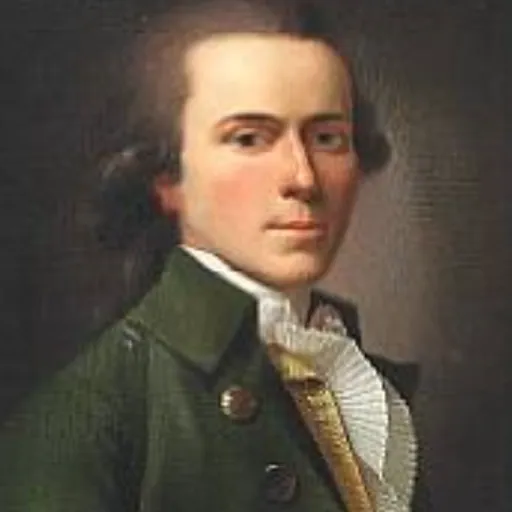
About Edmund Bourke
Lived 1761 – 1821 (aged 59). Edmund Bourke was a Danish diplomat.
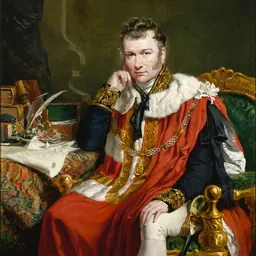
Count Edmund Bourke, also Edmond or Edmound Burke (2 November 1761 in St. Croix, Danish West Indies – 12 August 1821 in Vichy, France) was a Danish diplomat who negotiated and signed the Treaty of Kiel.
Early life and family Edmund Bourke was born in Danish-ruled St. Croix, where his father, Theobald Bourke, was a plantation owner and later judge. Theobald Bourke originally came from Ireland but obtained Danish citizenship in 1779.
Career Edmund Bourke inherited a considerable fortune from his father and pursued a career as a Danish diplomat. In 1789 he became chargé d'affaires to Poland and from 1790 to 1792 he was envoy to Poland, where he won the goodwill of King Stanislaus, who made him a knight of the Order of the White Eagle. In 1792 Bourke was sent as an envoy to the Kingdom of Naples, in 1797 to Stockholm and in 1801 to Spain, and he resided in Madrid for several years. In appreciation of his work, Bourke was made a Chamberlain in 1793 and in 1811 was awarded the Grand Cross of the Order of the Dannebrog.
In January 1814 Bourke negotiated the Treaty of Kiel with Sweden and England. Bourke showed skill and determination despite Denmark's poor negotiating position, having been on the losing side before switching to the Allied side after the Battle of Leipzig. Under the treaty the United Kingdom returned all occupied Danish possessions other than the island of Heligoland, and the Danish king ceded Norway to the Kingdom of Sweden. On 8 February Russia was added to the peace treaty at Hanover.
Bourke succeeded in obtaining as tolerable terms as possible, so that, for example, part of the Danish-Norwegian government debt was transferred to Norway by its separation from Denmark, and that the Faroe Islands, Iceland and Greenland remained with Denmark. Bourke undeniably was assisted by the fact that the Swedish negotiator had no idea that these islands had previously belonged to Norway. The exemption formulated by Bourke was an addition to the Swedish draft treaty but the desire to clarify the exception of the Atlantic islands seems to have arisen as a consequence of English policy. Bourke became a Danish Privy Councillor in recognition of his work.
Later Bourke was sent to the English court and in 1820 to France. However, Bourke quickly died in 1821 and was buried in Père-Lachaise Cemetery in Paris.
Don’t just read it —
keep it.
Full-length biographies made to live with: read them, listen on the way to work, watch them tonight.
- E-book
- Audio
- Video
Instant download · yours to keep · every purchase keeps this site free
Important facts
Related people
Same field, nearest in time


Contemporaries
People whose lives overlapped Edmund Bourke's




Frequently asked questions
Who was Edmund Bourke?
Danish diplomat
When was Edmund Bourke born?
Edmund Bourke was born on 2 November 1761 in Saint Croix.
When did Edmund Bourke die?
Edmund Bourke died on 12 August 1821 in Vichy.
What was Edmund Bourke's occupation?
Edmund Bourke was a diplomat.
What nationality was Edmund Bourke?
Edmund Bourke was Danish.
Sources & further reading
· DBpedia: Edmund Bourke (1761–1821)
Cite this page
APA: Biography.guide. (2026). Edmund Bourke. https://biography.guide/edmund-bourke-diplomat/
MLA: "Edmund Bourke." Biography.guide, https://biography.guide/edmund-bourke-diplomat/.
Chicago: "Edmund Bourke." Biography.guide. https://biography.guide/edmund-bourke-diplomat/.
Data last updated: 2026-09-23 · Spot an error? Report a correction.
Portrait: Wikimedia Commons · author & licence
Page generated 2026-09-27 05:07 UTC