
About Edmund Boulter
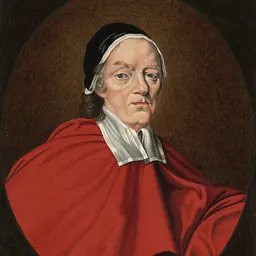
Lived 1635 – 1709 (aged 73–74). Edmund Boulter was a politician and merchant.
Edmund Boulter (abt 1635 – 1709), was a London merchant and politician. He was the eldest son of John Boulter, a maltster, twice mayor of Abingdon and his wife born Susannah Cutler, sister of Sir John Cutler, 1st Baronet, later Edmund's business partner.
Family Growing up during the interregnum Boulter seems to have been by choice a Dissenter or Presbyterian. He was apprenticed to the Haberdashers' Company 23 July 1647 when he may have been as young as twelve. His father died young and Boulter helped educate his siblings and, later, their children. His brother Robert, a Cornhill stationer, and substantial supplier of books to Massachusetts was one of the original publishers of Milton's Paradise Lost.
House of Commons In 1698 Boulter was elected Member of Parliament for the parliamentary borough of Boston, Lincolnshire, having business of long standing there. This may have been designed to defuse the effect of a claim of parliamentary privilege by his cousin's widower, the Earl of Radnor, by acquiring similar privilege. Boulter did not stand again. a pewterer in Gracechurch street".
Edmund Boulter died 15 February 1708/1709 and was buried nine days later in the south chancel of St Christopher le Stocks, Threadneedle Street, London.
Aside from the reverted properties of Wimpole, Gawthorpe and Harewood, where Sir John Cutler had lived for a time in the castle, Boulter owned Little Haseley Oxfordshire, estates in Lincolnshire, the manor of Deptford near London, and estates in Hampshire Wherwell and Goodworth Clatford acquired in 1695 from Lord de la Warr, property in Kent and London and in Somerset.
Boulter Exhibition, Pembroke College, Oxford In 1736 his nephew of the same name died at Avignon where he had taken his daughter for the benefit of her health. "Edmund Boulter (1678-1736), of Harewood, Yorks, and Hasely Court, Oxon, left to the College £20 yearly for a Scholarship, to be called the Cutler-Boulter Scholarship, in honour of his [great-]uncle, Sir John Cutler. This is the millionaire, the opening of whose will on 20 April 1693 excited so much interest (see Luttrell's Brief Relation, iii. 81, and Wood's Life and Times, iii. 409, 420). In it were bequeathed lands worth £6000 a year to the testator's daughter, the Countess of Radnor, and her issue, and failing such issue to Sir John's nephew, Mr. Boulter, who also inherited half the personal estate, about £300,000, and was executor of the will."
Distinguished exhibitioners include Oswald Lewis, Thomas Smith, Richard Sorabji.
Cutler Boulter Almshouses Wherwell crypt for John Fryer's descendantsThe younger Edmund Boulter also left money to found the Cutler Boulter Almshouses in St Clement's, then just outside Oxford. The almshouses and apothecary's house were demolished in the 1880s but the money from the sale of the land was used to set up the Cutler Boulter Provident Dispensary which operated from 1884 to 1950.
Don’t just read it —
keep it.
Full-length biographies made to live with: read them, listen on the way to work, watch them tonight.
- E-book
- Audio
- Video
Instant download · yours to keep · every purchase keeps this site free
Important facts
People in Edmund Boulter's life
Named in this biography and alive at the same time

Related people
Same field, nearest in time


Contemporaries
People whose lives overlapped Edmund Boulter's





Frequently asked questions
Who was Edmund Boulter?
London merchant and politician
When was Edmund Boulter born?
Edmund Boulter was born in 1635.
When did Edmund Boulter die?
Edmund Boulter died in 1709.
What was Edmund Boulter's occupation?
Edmund Boulter was a politician and merchant.
Sources & further reading
Cite this page
APA: Biography.guide. (2026). Edmund Boulter. https://biography.guide/edmund-boulter/
MLA: "Edmund Boulter." Biography.guide, https://biography.guide/edmund-boulter/.
Chicago: "Edmund Boulter." Biography.guide. https://biography.guide/edmund-boulter/.
Data last updated: 2026-09-20 · Spot an error? Report a correction.
Page generated 2026-09-27 05:12 UTC