
About Edmond O'Brien
Lived 1915 – 1985 (aged 69). Edmond O'Brien was an American film actor, stage actor, television actor, actor, film producer and film director.
Eamon Joseph O'Brien (; September 10, 1915 – May 8, 1985), known professionally as Edmond O'Brien, was an American actor of stage, screen, and television, and film director. His career spanned almost 40 years, and he won an Academy Award, two Golden Globe Awards, two Photoplay Awards, and two stars on the Hollywood Walk of Fame.
O'Brien was both leading man and a character actor of American cinema, with his co-starring performances in The Barefoot Contessa (1954) and Seven Days in May (1964) each earning him the nomination for an Academy Award for Best Supporting Actor; he won for his role in The Barefoot Contessa. His other notable films include The Hunchback of Notre Dame (1939), The Killers (1946), A Double Life (1947), White Heat (1949), D.O.A. (1950), The Hitch-Hiker (1953), Julius Caesar (1953), 1984 (1956), The Girl Can't Help It (1956), The Man Who Shot Liberty Valance (1962), Fantastic Voyage (1966), The Wild Bunch (1969), and The Other Side of the Wind (2018).
Early years O'Brien was born in Brooklyn, New York, His father died when he was four years old.
O'Brien performed magic shows for children in his neighborhood, spelling his last name backwards and billing himself as "Neirbo the Great". An aunt who taught high school English and speech took him to the theatre from an early age and he developed an interest in acting. He began acting in plays at school.
After attending Fordham University for six months, O'Brien went to Neighborhood Playhouse School of the Theatre on a scholarship.
O'Brien took classes with the Columbia Laboratory Players group, which emphasized training in Shakespeare.
He played a grave digger in Hamlet, toured in Parnell, and then appeared in Maxwell Anderson's The Star-Wagon with stars Lillian Gish and Burgess Meredith. In 1940, O'Brien performed with Ruth Chatterton in John Van Druten's Leave Her to Heaven on Broadway. Twelve years later, O'Brien appeared in Van Druten's I've Got Sixpence.
Film O'Brien's theatre work attracted the attention of Pandro Berman at RKO. Berman offered O'Brien the role of a romantic lead in The Hunchback of Notre Dame (1939).
O'Brien returned to Broadway to play Mercutio opposite Laurence Olivier and Vivien Leigh in Romeo and Juliet.
RKO offered O'Brien a long-term contract. Harold Lloyd was then producing comedies for RKO, and co-starred O'Brien with Lucille Ball and George Murphy in A Girl, a Guy, and a Gob (1941). O'Brien co-starred with Nancy Kelly, whom O'Brien would later marry, in Parachute Battalion (1941).
O'Brien went back to the Harold Lloyd unit, which continued to function after the producer's departure, and displayed a breezy sense of humor in the farce comedy Obliging Young Lady (1942), a vehicle for the young Broadway star Joan Carroll. In May 1942, Universal bought out O'Brien's RKO contract so he could star opposite Deanna Durbin in The Amazing Mrs. Holliday (1943). After that, O'Brien joined the armed services.
World War II During World War II, O'Brien served in the U.S. Army Air Forces and appeared in the Air Forces' Broadway play Winged Victory. He was joined in the Moss Hart production by Red Buttons, Karl Malden, Kevin McCarthy, Gary Merrill, Barry Nelson, and Martin Ritt. The play was filmed in 1944 with O'Brien reprising his stage performance and Judy Holliday co-starring. O'Brien toured for two years in the stage production, appearing alongside a young Mario Lanza. voted that O'Brien had more "male magnetism" than any other man in America. "All women adore ruggedness," league president Shirley Connolly said. "Edmund O'Brien's magnetic appearance and personality most fully stir women's imaginative impulses. We're all agreed that he has more male magnetism than any of the 60,000,000 men in the United States today." (Runners-up were Ezio Pinza, William O'Dwyer and Doak Walker.)
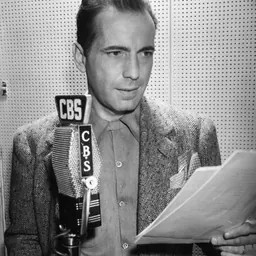
Broadcasting O'Brien's contract with Warner Bros. ended following his appearance as the second lead in Backfire (shot in 1948 but not released until 1950). In the meantime, he signed on with CBS Radio for the radio drama Yours Truly, Johnny Dollar, playing the title role of a two-fisted insurance investigator. He remained with the role for exactly 31 months, starring in 103 half-hour episodes from February 3, 1950 to October 3, 1952. His other work in radio included Philip Morris Playhouse on Broadway.
Freelance O'Brien returned to film noir, where he was a frequent player, and made one of his most famous movies, D.O.A., where he portrays a man investigating his own murder. He followed this with the lead in the noir 711 Ocean Drive (1950). Next was a starring role in the comedy The Admiral Was a Lady, co-starring roles in the noir Between Midnight and Dawn (1950) and the Western The Redhead and the Cowboy (1951), then the leads in the crime film Two of a Kind and the Westerns Warpath and Silver City, all in 1951. These were followed by the lead in the Western Denver and Rio Grande, and second lead in the noir The Turning Point.
However, even though O'Brien still managed to command leading-man roles, the prestige of his pictures and casts had begun to diminish and his career hit a slump. According to TCM, "In the early '50s, O'Brien started struggling with his weight, which could change significantly between films. He had no problems if that relegated him to character roles, but for a few years, "it was hard to come by anything really first rate."
In 1951, he was in a well-publicized brawl with Serge Rubinstein at a cafe.
In spite of the ups and downs of his Hollywood career, O'Brien was still capable of greatness, both on the stage and on film. In 1954, Mankiewicz cast O'Brien as press agent Oscar Muldoon in The Barefoot Contessa,
O'Brien followed this with a number of important roles, including the second lead in the musical crime film Pete Kelly's Blues, the lead in the dystopian political movie 1984 and the noir A Cry in the Night (1956), co-lead in the World War II drama D-Day the Sixth of June (all 1956).
That same year, he had a refreshing change of pace as the comedy lead (a Runyonesque gangster who stumbles into rock-and-roll) in The Girl Can't Help It,
Television
O'Brien appeared extensively in television, including the 1957 live 90-minute broadcast on Playhouse 90 of The Comedian, a drama written by Rod Serling and directed by John Frankenheimer in which Mickey Rooney portrayed dictatorial television comedian Sammy Hogarth. O'Brien played Al Preston, the show's headwriter driven to the brink of insanity. Burned out dealing with the volatle Hogarth, unable to come up with new material for the show's comedy sketches, Preston deliberately plagiarizes material authored by a young comedy writer who died in combat during World War II. When the ruse is discovered, Preston is fired, but tells Hogarth his rages are rooted in his inability to find love.
In 1958, he directed and starred in a TV drama written by his brother, "The Town That Slept With the Lights On", about two Lancaster murders that so frightened the community that residents began sleeping with their lights on.
From 1959 to 1960, O'Brien portrayed the title role in the syndicated crime drama Johnny Midnight, about a New York City actor-turned-private detective. The producers refused to cast him unless he shed at least 50 pounds, so he went on a crash vegetarian diet and quit drinking.
He made a French film, The Restless and the Damned for a fee more than $200,000. He was cast on the strength of his performance in The Girl Can't Help It and his Oscar.
O'Brien had roles on many television series, including an appearance on Target: The Corruptors!, The Eleventh Hour, Breaking Point and Mission: Impossible.
1960s film work O'Brien walked off the set of The Last Voyage in protest at safety issues during the shoot. He later came back and found out that his co-starring role had been trimmed. He was cast as American reporter Jackson Bentley in Lawrence of Arabia (1962), but had a heart attack during filming and was replaced in the co-starring role by Arthur Kennedy.
O'Brien recovered to direct his first feature Man-Trap (1961), a neo-noir starring Jeffrey Hunter and Stella Stevens, co-starred in the Disney comedy Moon Pilot (1962), and in the star-studded ensemble cast of the World War II epic The Longest Day (1962).
He continued to receive good roles, co-starring in The Man Who Shot Liberty Valance (1962) and as the author of the Robert Stroud biography the Birdman of Alcatraz (1962) was based upon.
"I've never made any kind of personality success," he admitted in a 1963 interview. "People never say 'that's an Eddie O'Brien part.' They say, 'That's a part Eddie O'Brien can play.'"
He was a cast member of The Other Side of the Wind, Orson Welles' unfinished 1970s movie that finally was released in 2018.
In 1971, he was hospitalized with a "slight pulmonary condition."
His last works, both in 1974, were an episode of the television series Police Story and main role in the film 99 and 44/100% Dead.
Recording In 1957, O'Brien recorded a spoken-word album of The Red Badge of Courage (Caedmon TC 1040). Billboard said, "Edmond O'Brien brings intensity in the narrative portions and successfully impersonates the varied characters in dialog."
Personal life O'Brien was first married to actress Nancy Kelly from 1941 until 1942. He married his second wife, actress Olga San Juan in 1948. San Juan was the mother of his three children, television producer Bridget O'Brien and actors Maria O'Brien (1950–2026) and Brendan O'Brien (1962–2023).
Walk of Fame For his contribution to the motion picture industry, Edmond O'Brien has a star on the Hollywood Walk of Fame at 1725 Vine Street, and a second star at 6523 Hollywood Boulevard for his contribution to the television industry. Both were dedicated on February 8, 1960.
Biography
Complete filmography
Partial television credits
Theatre Hamlet (Oct 1936) Daughters of Atreus (Oct 1936) The Star Wagon (Sept 1937 – April 1938) Julius Caesar (May 1938) King Henry IV Part I (Jan–April 1939) Leave Her to Heaven (Feb–March 1940) Romeo and Juliet (May–June 1940) Winged Victory (Nov 1943 – May 1944) I've Got Sixpence (Dec 1952)
Don’t just read it —
keep it.
Full-length biographies made to live with: read them, listen on the way to work, watch them tonight.
- E-book
- Audio
- Video
Instant download · yours to keep · every purchase keeps this site free
Important facts
Family & relationships
People in Edmond O'Brien's life
Named in this biography and alive at the same time




Related people
Same field, nearest in time



Contemporaries
People whose lives overlapped Edmond O'Brien's




Frequently asked questions
Who was Edmond O'Brien?
American actor (1915–1985)
When was Edmond O'Brien born?
Edmond O'Brien was born on 10 September 1915 in New York City.
When did Edmond O'Brien die?
Edmond O'Brien died on 9 May 1985 in Inglewood.
What was Edmond O'Brien's occupation?
Edmond O'Brien was a film actor, stage actor, television actor, actor, film producer and film director.
What nationality was Edmond O'Brien?
Edmond O'Brien was American.
Sources & further reading
Cite this page
APA: Biography.guide. (2026). Edmond O'Brien. https://biography.guide/edmond-o-brien/
MLA: "Edmond O'Brien." Biography.guide, https://biography.guide/edmond-o-brien/.
Chicago: "Edmond O'Brien." Biography.guide. https://biography.guide/edmond-o-brien/.
Data last updated: 2026-09-26 · Spot an error? Report a correction.
Page generated 2026-09-27 05:15 UTC