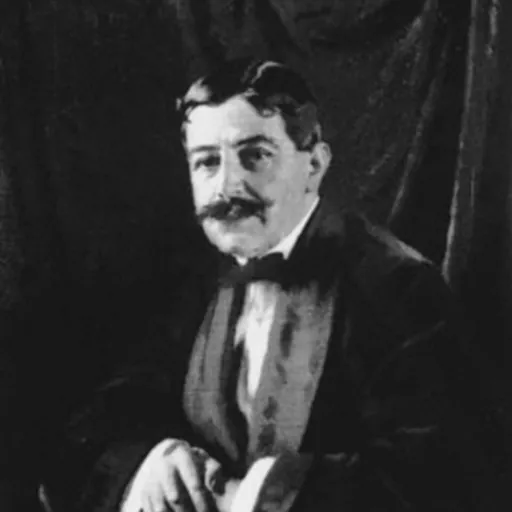
Edgar Speyer
British-American financier and philanthropist
About Edgar Speyer
Lived 1862 – 1932 (aged 69). Edgar Speyer was an American banker, patron of the arts and philanthropist.
Sir Edgar Speyer, 1st Baronet (7 September 1862 – 16 February 1932) was an American-born financier and philanthropist. He became a British subject in 1892 and was chairman of Speyer Brothers, the British branch of the Speyer family's international finance house, and a partner in the German and American branches. He was chairman of the Underground Electric Railways Company of London (UERL, a forerunner of the London Underground) from 1906 to 1915, a period during which the company opened three underground railway lines, electrified a fourth and took over two more.
Speyer was a supporter of the musical arts and a friend of several leading composers, including Edward Elgar, Richard Strauss and Claude Debussy. He was chairman of the Classical Music Society for ten years, and he largely funded the Promenade Concerts between 1902 and 1914. His non-musical charitable activities included being honorary treasurer of the fund for Captain Scott's Antarctic expedition. For his philanthropy he was made a baronet in 1906 and a Privy Counsellor in 1909.
After the start of the World War I, he became the subject of anti-German attacks in the Press. In 1915, Speyer offered to resign from the Privy Council and to relinquish his baronetcy, but the Prime Minister turned down the offer. He resigned as chairman of the UERL and went to the United States.
In 1921, the British government investigated accusations that Speyer had traded with the enemy during the war, and had participated in other wartime conduct incompatible with his status as a British subject. Speyer denied the charges, but his naturalisation was revoked and he was struck off the list of members of the Privy Council.
Life to 1914
Family Speyer was born on 7 September 1862 in New York City, |group="note" They had met at a concert held by Maude Valérie White at which Leonora performed. They had three daughters: Pamela, Leonora, and Vivien.
Financier In 1884, Speyer became a partner in each of his father's businesses. He headed the Frankfurt office before taking control of the London office, Speyer Brothers, in 1887. His older brother, James, headed the New York company. The firm specialised in arbitrage with Europe and the United States, and the financing of railway projects.
Speyer Brothers' involvement in railway finance brought Speyer into contact with American Charles Yerkes in 1900. In Chicago, Yerkes had led the development of the city's urban transport system, and he went to London to capitalise on the emerging opportunities for new deep-level underground "tube" railways there. He and Speyer headed a consortium of international investors involved in the construction of three of London's underground railways and the electrification of a fourth.
With Yerkes as chairman, the Underground Electric Railways Company of London (UERL) was established in 1902 with a capitalisation of £5 million, the majority of shares sold to overseas investors. Further share issues followed, which, by 1903, raised a total of £18 million (£ today) to be used across all of the UERL's projects. Yerkes died in December 1905, and Speyer took his place as chairman of the UERL. By 1907, the three new railways had opened and the electrification works had been completed. Despite the UERL's engineering success in carrying out the works in such a short time, the company was in a difficult financial position. The preliminary estimates of passenger numbers proved to be over optimistic and revenues were not covering operating costs.
After bailing out the company, Speyer, with Managing Director Albert Stanley, struggled for a number of years to restore its finances. This was finally achieved with the purchase of the London General Omnibus Company in 1912, as its profits could be used to offset losses elsewhere in the group. In November 1912, Speyer further consolidated the UERL's control of London's underground railways when he negotiated the purchase of London's two other main tube railways, the City and South London Railway and the Central London Railway.
Philanthropist and patron As head of the London arm of the family businesses, Speyer became wealthy. He owned a pair of neighbouring houses at 44 and 46 Grosvenor Street, Mayfair, that he had rebuilt as a single residence at the cost of £150,000 (equivalent to £ in ). The rebuilding work was carried out by Detmar Blow and Fernand Billery in 1910 and 1911; the architects gave the house a "Beaux-Arts" style portland stone façade and lavish interiors including 11 bedrooms and a large music room. Speyer also had a large country house built in 1908, in the fashionable Edwardian resort of Overstrand on the Norfolk coast.
The house was named "Sea Marge" (meaning land that borders the sea) and was designed in the Mock Tudor style, surrounded by gardens. To decorate his homes, Speyer collected works of art, furniture and decorative items from across Europe. and his own portrait, painted by William Orpen, which was exhibited at the Royal Academy in 1914. |group="note"
Like his cousin Edward Speyer, Edgar was a music lover and patron of the arts, frequently holding concerts in his home. He was friends with composers Edward Elgar, Edvard Grieg, Richard Strauss, Claude Debussy and Percy Grainger, and with the German cellist and composer Hugo Becker. Speyer owned violins by Stradivarius and Giuseppe Guarneri, used by his wife in public and private performances. Following financial problems experienced by Robert Newman, Speyer held the position of chairman of the Queen's Hall Concert board from 1902 to 1914, paying £2,000 per year to underwrite the Promenade Concerts.
Speyer increased rehearsal time for the Queen's Hall Orchestra and was involved in the challenge to the deputy system then operating, stopping musicians from sending under-prepared substitutes to perform in their places. He was described by Bird as "the sole monetary force which kept the Queen's Hall Orchestra afloat". Speyer's control of the Queen's Hall enabled him to attract musicians and composers to perform modern new works at his concerts including Strauss, whom he brought to London to conduct the first English performance of A Hero's Life, and Arnold Schoenberg, whose Five Orchestral Pieces received its première in 1912. Becker dedicated Three Pieces for Cello with Piano Accompaniment to Speyer in recognition of their friendship, and Strauss dedicated his opera Salome to him.
Speyer also contributed £2,500 to the foundation of Whitechapel Art Gallery where he was a trustee for 15 years. He was chairman of the Nervous Diseases Research Fund, president of Poplar Hospital, and sat on the board of the King Edward's Hospital Fund, In December 1904, having read of the loss in a newspaper article, Speyer donated £5,700 to replace all of the funds lost by investors in the failure of a penny savings bank at Needham Market, Suffolk.
From 1909, Speyer was honorary treasurer of the fund raised to finance Robert Falcon Scott's 1910 British Antarctic Expedition to which he donated £1,000 of the £40,000 that was required. Speyer was prepared to take personal responsibility for a share of the liabilities of the expedition, although the money raised from public donations was sufficient. Mount Speyer in Antarctica is named in his honour. One of Scott's last letters was written to Speyer. It was found when Scott's body was recovered from his last camp after his unsuccessful return from the South Pole.
On 25 July 1906, Speyer was created a baronet. Politically, Speyer was a Liberal. He was a member of the Reform Club, and a friend of H. H. Asquith, by whose recommendation he was made a Privy Counsellor (PC) in 1909. In 1911, he was awarded the Order of the Crown, 2nd class by Kaiser Wilhelm II.
Life after 1914
Anti-German pressure Solid, an anti-German cartoon regarding Germany's opposition to the Anglo-French entente, from Punch, 1911GERMANY: "Donnerwetter! It's rock. I thought it was going to be paper." The end of the 19th century and the first decade of the 20th century saw rising anti-German sentiment in Britain. As the naval arms race between Britain and Germany escalated, distrust of Germans and those of German origin was stirred-up by press warnings of the rising military threat from Germany. This was developed further in popular magazines such as the National Review and in novels such as Erskine Childers' The Riddle of the Sands and invasion novels such as William Le Queux's The Invasion of 1910.
Following the British declaration of war with Germany on 4 August 1914, Speyer resigned as a partner of the Frankfurt branch of the bank. After a Royal Proclamation on 11 September 1914 requiring British subjects to have no links with companies doing business with Germany, Speyer resigned as a partner of the American bank. Nonetheless, suspicions regarding Speyer's German parentage led to a hate campaign against him. Crowds gathered outside his home and jeered visitors.
Accusations of his disloyalty and treachery appeared in the Press, and he was accused of signalling to German submarines from his Norfolk house.
Speyer ignored a call to write one of the "loyalty letters" that Sir Arthur Pinero proposed be provided by prominent naturalised citizens of German origin. Instead, on 17 May 1915, Speyer wrote to Asquith, then Prime Minister, asking him to accept his resignation as a Privy Counsellor and to revoke his baronetcy, stating:
Nothing is harder to bear than a sense of injustice that finds no vent in expression.
For the last nine months I have kept silence and treated with disdain the charges of disloyalty and suggestions of treachery made against me in the Press and elsewhere. But I can keep silence no longer, for these charges and suggestion have now been repeated by public men who have not scrupled to use their position to inflame the overstrained feelings of the people.
I am not a man who can be driven or drummed by threats or abuse into an attitude of justification. But I consider it due to my honour as a loyal British subject and my personal dignity as a man to retire all my public positions.
I therefore write to ask you to accept my resignation as a Privy Councillor and to revoke my baronetcy.
He resigned as chairman of the UERL and from the boards of the King Edward's Hospital Fund, the Poplar Hospital and the Whitechapel Art Gallery.
It is doubtful whether it was possible for Speyer to resign from the Privy Council or as a baronet, there being no normal mechanism to do so, but the Prime Minister's response was supportive: "I have known you long, and well enough to estimate at their true value these baseless and malignant imputations upon your loyalty to the British Crown. The King is not prepared to take any step such as you suggest in regard to the marks of distinction which you have received in recognition of public services and philanthropic munificence." On 26 May 1915, Speyer and his family left for America. Makgill's claim was that the Act of Settlement 1701 prevented a person born outside Britain or its dominions from being a Privy Counsellor. In December 1915, Lord Chief Justice Lord Reading rejected the application on the grounds that the relevant sections of the Act of Settlement had been repealed by later legislation.
Revocation of naturalisation
On 2 August 1918, in a House of Lords debate on the Denaturalisation Bill, the subject of Speyer's membership of the Privy Council was brought up by Lord Lincolnshire, who condemned "the brutal and insolent German manner in which Sir Edgar Speyer had resigned his dignity." Speyer again offered the Prime Minister, then David Lloyd George, his resignation from the council, but received no response.
Following an investigation into Speyer's wartime conduct held in camera by the Home Office's Certificates of Naturalisation (Revocation) Committee, Speyer's naturalisation was revoked by an order dated 1 December 1921. On 13 December 1921 an order was issued by King George V for Speyer to be struck off the list of the Privy Council. The next person to be struck off the list was Elliot Morley in 2011, though others resigned in the intervening period.
The committee decided that Speyer had "shown himself by act and speech to be disaffected and disloyal to His Majesty; and [had]... unlawfully communicated with subjects of an enemy State and associated with a business which was to his knowledge carried on in such manner as to assist the enemy in such war." Lady Speyer and the couple's children also lost their British nationality.
The report of the committee was published on 7 January 1922. The committee had considered nine issues in making its decision: Retirement from Speyer & Co. – it was decided that Speyer had been slow and reluctant to resign as a partner of the American bank of which he was still in partnership with his German brother-in-law, Edward Beit von Speyer. Association with enemy traffic – Speyer Brothers had continued to trade jointly with a Dutch firm, Teixeira de Mattos Brothers, between February and June 1915. As they were based in a neutral country, Teixeira had continued to trade with German businesses. The committee calculated that Speyer Brothers had made £1,000 by these trades, despite an inspection of the company's accounts showing no trade with Germany. It concluded that "Sir Edgar Speyer seems to have preferred his private financial interests to the prompt discharge of his duty to the State." Communication with enemy subjects – Speyer had continued to correspond with his German brother-in-law throughout the war. Evasion of the censorship – in his correspondence with his brother-in-law, Speyer had used various means including aliases and intermediaries to avoid the censor inspecting his letters. Proposed return to Berlin – the contents of intercepted letters from Edward Beit von Speyer suggested that Speyer had proposed living in Germany after the war. Speyer denied this and stated that the meaning of the letters had been misconstrued in the absence of his side of the correspondence being before the committee. Association with Muck – while living in America Speyer had become friendly with Karl Muck, the German conductor of the Boston Symphony Orchestra, who remained strongly pro-German even after the United States entered the war. Unknown to Speyer, who stated that their friendship was based on a shared love of music, Muck was suspected of being a German agent. Association with Koren – in America, Speyer was friendly with John Koren, an American statistician who represented the United States on the International Prisons Commission. In 1916, Speyer had funded a fact-finding trip by Koren to Europe, during which Koren visited Germany and met Speyer's sister and friends. Although the committee considered the trip strange, they drew no inference of disloyalty from the events. The Boston Journal – in April 1917, on the advice of John Koren, Speyer had provided a loan to The Boston Journal newspaper to prevent it from going out of business. The newspaper had printed some articles of a pro-German nature and the committee thought it imprudent but not disloyal of Speyer to have lent the money. Paying money to enemy subjects – some of Speyer's friends had made claims at the Frankfurt bank for payment of sums due to them that were in the hands of Speyer in London. Speyer had authorised the payments, although this was not allowed by the wartime regulations. The committee commented that in similar circumstances it had shown leniency to others doing the same thing, and would not have attached great importance to the matter if it had stood alone. Two days later, Speyer also issued a statement responding to the report and rebutting the committee's interpretation of the facts. A month later, Speyer put the Grosvenor Street house up for sale although it did not reach its reserve price at auction. The Grosvenor Street house was eventually sold in early 1923 and became the American Women's club.
Speyer rejoined the surviving American and German branches of the family bank and continued to live in New York. He died on 16 February 1932 in Berlin, after having travelled there for an operation on his nose. He was buried in Dahlem, Berlin. He had continued to hold his baronetcy, although it became extinct with his death as he had no male heirs.
After his death, Speyer's UK estate was assessed at £3,362 and his US estate at $245,287, equivalent to a net worth of approximately £ and $ today.
Legacy Speyer's two principal legacies are the three deep-level tube lines of the London Underground, and the Promenade Concerts. The former might not have been built without the finance he raised with Yerkes, and would have struggled without his chairmanship. The latter may have failed in the early 20th century without his financial support. The characters of Sir Hermann and Lady Aline Gurtner in E. F. Benson's 1919 novel Robin Linnet were based on Sir Edgar and Lady Speyer. Leanne Langley suggests that the character of Appleton, a villainous stockbroker, in John Buchan's The Thirty-Nine Steps may have been based on Speyer.
After the American Women's club moved out, his London home served as the Japanese Embassy for some years and is now the offices of stockbrokers Killik & Co. It is a Grade II* listed building. The Sea Marge was sold after his death and became a hotel in 1935 and, between 1955 and 1990, a home for the elderly. It re-opened as a hotel in 1996 and is listed Grade II. After the Speyers returned to America, Leonora began writing poetry and won the Pulitzer Prize for Poetry in 1927. She died in 1956.
The Speyers' three daughters returned to Britain. Pamela Speyer married Count Hugo Moy in 1926, but was widowed shortly after when he was killed in a hunting accident. She died in Sussex in 1985. Leonora was married for less than a year and then lived with concert pianist Maria Donska and died in Kent in 1987. Vivien came to Britain as a member of the United States Women's Army Auxiliary Corps and died in Norwalk, Connecticut, in 2001.
Don’t just read it —
keep it.
Full-length biographies made to live with: read them, listen on the way to work, watch them tonight.
- E-book
- Audio
- Video
Instant download · yours to keep · every purchase keeps this site free
Important facts
Family & relationships
People in Edgar Speyer's life
Named in this biography and alive at the same time





Related people
Same field, nearest in time


Contemporaries
People whose lives overlapped Edgar Speyer's



Frequently asked questions
Who was Edgar Speyer?
British-American financier and philanthropist
When was Edgar Speyer born?
Edgar Speyer was born on 7 September 1862 in New York City.
When did Edgar Speyer die?
Edgar Speyer died on 16 February 1932 in Berlin.
What was Edgar Speyer's occupation?
Edgar Speyer was a banker, patron of the arts and philanthropist.
What nationality was Edgar Speyer?
Edgar Speyer was American.
Sources & further reading
Cite this page
APA: Biography.guide. (2026). Edgar Speyer. https://biography.guide/edgar-speyer/
MLA: "Edgar Speyer." Biography.guide, https://biography.guide/edgar-speyer/.
Chicago: "Edgar Speyer." Biography.guide. https://biography.guide/edgar-speyer/.
Data last updated: 2026-09-23 · Spot an error? Report a correction.
Portrait: Wikimedia Commons · author & licence
Page generated 2026-09-27 05:07 UTC