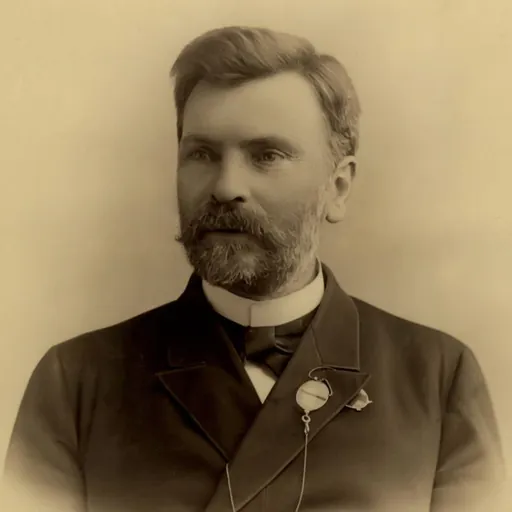
About Vladimir Kovalevsky
Lived 1848 – 1934 (aged 85). Vladimir Kovalevsky was a Russian banker, ecologist, politician, statesperson, scientist and entrepreneur, known for Saint Petersburg Polytechnic Institute.
Vladimir Ivanovich Kovalevsky (; 10 November 1848 – 2 November 1935) was a Russian statesman, scientist and entrepreneur. He was the author of numerous articles and works on agricultural themes. From 1892 to 1900, he was the director of the Commerce and Manufacturing Department of the Ministry of Finance of the Russian Empire, and one of the fathers of the concept of Russian protectionism. From 1900 to 1902, he was the Deputy Minister of Finance. From 1906 to 1916, he was the chairman of the Russian Technical Society. Kovalevsky was one of the creators of the Saint Petersburg State Polytechnical University and the Institute of Plant Industry in Leningrad.
Life
Early years Vladimir Kovalevsky was born to the middle-class family of a retired army major on 9 November 1848, in Novo-Serpukhov (currently Balakliia) in the Zmiyov uyezd of the Kharkov Governorate. He was brought up in the Poltava Military School. In August 1865, he entered the Konstantinov Military Academy. In July 1867 he was released into the Derbent 154th Infantry Regiment, serving in the Caucasus. Kovalevsky resigned from military service on 14 May 1868, at the rank of praporschik, equivalent to ensign. In that same year, he began studying at the Saint Petersburg State Polytechnical University, where he was taught by Dmitry Lachinov.
Revolutionary involvement While studying at the university, Kovalevsky participated in the 1869 student protests, meeting narodnik Sergey Nechayev there. For some time, he attended a group of Nechayev followers in St. Petersburg. In November 1869, Nechayev murdered his former follower I. I. Ivanov, and Kovalevsky gave him an opportunity to stay the night at his house. On 5 January 1870, Kovalevsky was arrested on accusations of sheltering Nechayev, and on 10 September he was transferred to the Peter-Paul Fortress. On 1 July 1871, Kovalevsky was brought to the court of the St. Petersburg judicial chamber on the accusation that without necessarily taking part in the plot to overthrow the existing order of control in Russia, he contributed in providing accommodation for Sergey Nechayev. On 22 August 1871, Kovalevsky was acquitted and released from the Peter-Paul Fortress on that same day. As a result, he was also subject to a brief arrest relating to the business of Sergey Stepnyak-Kravchinsky. He also contributed to the conclusion of trade agreements with Germany and other countries. With Kovalevsky's active involvement, the 1896 All-Russia industrial and art exhibition took place in Nizhniy Novgorod. Later, in 1898, he was involved in the development of a new law on state-industrial taxes. From 1899 to 1901, Kovalevsky was chairman of the Special conference on the preparation of legislation on the establishment of industrial enterprises.
In April 1899, he was bestowed the civil rank of Privy Councillor.
The Saint Petersburg State Polytechnical University in 1902, three years after its creation by Dmitry Mendeleev, Sergey Witte, and Vladimir Kovalevsky and others.
In 1899, along with Sergey Witte, Dmitry Mendeleev and others, Kovalevsky helped organize the Saint Petersburg State Polytechnical University.
In 1900, he was appointed Deputy to the Minister of Finance, having power over matters of trade and industry.
Fake promissory notes and resignation A serious blow to Kovalevsky's career was dealt by a scandalous affair involving fake promissory notes. Back in 1896, he met the actress and entrepreneur Elizaveta Shabel'skaya, and they had an affair. But in 1902, he became interested in Maria Ilovayskaya and accused his former lover of faking promissory notes in his name. The controversy dragged on until 1905. To marry Ilovayskaya, Kovalevsky divorced his wife, Ekaterina Lukhutina, on the premise of her unfaithfulness. With that, he promised to the consistory, under the oath, that he never failed to perform his conjugal responsibilities. His wife, however, accused him of lying and perjury, and in order not to discredit the Ministry of Finance, Kovalevsky was forced to resign as Deputy Finance Minister in 1902. His duties in the Ministry of Finance were filled by Vassily Timiryazev.
V. I. Kovalevsky (sitting, center) and members of the first soviet of the Polytechnical university. 1902.
After resignation In 1904 Kovalevsky became a member of the Council (Soviet) of Ural Mountains Developers' Congresses, and until October 1905, he was the Council's representative in Saint Petersburg. In that same year, he was also one of the organizers of the Council of Congresses of Representatives of Trade and Industry. It is also known that Kovalevsky disapproved of Pyotr Stolypin's agrarian politics, and showed that by turning down an invitation to meet him. In that same year, he became the chair of the administration of the Saint Petersburg Rail Car Factory Union, and in 1913, of the Ural-Caspian Petroleum Society. In 1914, he was head of the Society of Mechanical Factories "Brothers of Bromley". From 1903, he was the deputy chairman of the Russian Technical Society, and on 2 December 1906, he was elected Chairman. Kovalevsky carried this duty until 23 January 1916. During World War I, Kovalevsky was a member of a bureau of the and chairman of the Peat Committee of the General Directorate of Land Management and Agriculture.
After the revolution After the October Revolution, Kovalevsky stayed in Russia and worked in several central scientific agricultural establishments: from 1919 to 1929 he occupied the post of Chairman of the Scientific Committee of the Narkomzem - the country's foremost scientific center in agronomy and agriculture, and from 1923, he was the Honorable Chairman of the Scientific Council of the Institute of Plant Industry. There he worked with Nikolay Vavilov. In 1923, Kovalevsky was appointed chairman of the Scientific-Technical Council of the First All-Union Agriculture and Orchard Industry Exhibition in Moscow. He worked on the project of creating the USSR VDNKh. During the course of several years, Kovalevsky was the senior editor of the Great Agricultural Encyclopedia, which was one of the most complete worldwide publications of that type.
In November 1928, in the Mariinsky Palace in Leningrad, he celebrated his eightieth birthday. Due to this notable date, he was recognized as Honored Worker of Science and Technology of the RSFSR. Vladimir Kovalevsky died on 2 November 1935 from pulmonary edema, having not lived to his 86th birthday by a week. He was buried at the Smolensk Cemetery.
Personal life Georgiy KovalevskyVladimir Kovalevsky was married twice. His first wife was E. N. Lukhutina, 57 Gertsen Street, Leningrad. Kovalevsky was one of the founders of agricultural ecology, whose challenges he identified as such: "Explanation of joint interaction on the harvest quality of grain, constitutions of the soils, methods of working the land, meteorological conditions, protection of plants, etc.".
He also contributed many articles about various agricultural topics to the Agriculture and Forestry and Agricultural Gazette magazines. Under his editing, the Ministry of Finance published "Production Powers of Russia" (1896) and "Russia at the End of the 19th Century" (1900).
Translated works Emil von Wolff, "Rational feeding of agricultural animals by the newest physiological findings" (1875). Wilhelm Fleischmann, "Milk and the dairy business" (1879—1880). Gottlieb Haberlandt, "General agricultural plant-growing" (1879—1880). F. Prosch, "Breeding of large livestock and its caretaking" (1881). Alexander von Middendorff, "Descriptions of the Fergana Valley" (1882). Girolamo Azzi, "Agricultural ecology" (1928).
Don’t just read it —
keep it.
Full-length biographies made to live with: read them, listen on the way to work, watch them tonight.
- E-book
- Audio
- Video
Instant download · yours to keep · every purchase keeps this site free
Important facts
People in Vladimir Kovalevsky's life
Named in this biography and alive at the same time



Related people
Same field, nearest in time


Contemporaries
People whose lives overlapped Vladimir Kovalevsky's




Frequently asked questions
Who was Vladimir Kovalevsky?
Russian scientist and politician (1848–1934)
When was Vladimir Kovalevsky born?
Vladimir Kovalevsky was born on 10 November 1848 in Balakliia.
When did Vladimir Kovalevsky die?
Vladimir Kovalevsky died on 2 November 1934 in Saint Petersburg.
What was Vladimir Kovalevsky's occupation?
Vladimir Kovalevsky was a banker, ecologist, politician, statesperson, scientist and entrepreneur.
What was Vladimir Kovalevsky known for?
Vladimir Kovalevsky was known for Saint Petersburg Polytechnic Institute.
What nationality was Vladimir Kovalevsky?
Vladimir Kovalevsky was Russian.
Sources & further reading
· Wikipedia: Vladimir Kovalevsky
· DBpedia: Vladimir Kovalevsky
Cite this page
APA: Biography.guide. (2026). Vladimir Kovalevsky. https://biography.guide/vladimir-kovalevsky-banker/
MLA: "Vladimir Kovalevsky." Biography.guide, https://biography.guide/vladimir-kovalevsky-banker/.
Chicago: "Vladimir Kovalevsky." Biography.guide. https://biography.guide/vladimir-kovalevsky-banker/.
Data last updated: 2026-09-21 · Spot an error? Report a correction.
Portrait: Wikimedia Commons · author & licence
Page generated 2026-09-27 04:59 UTC