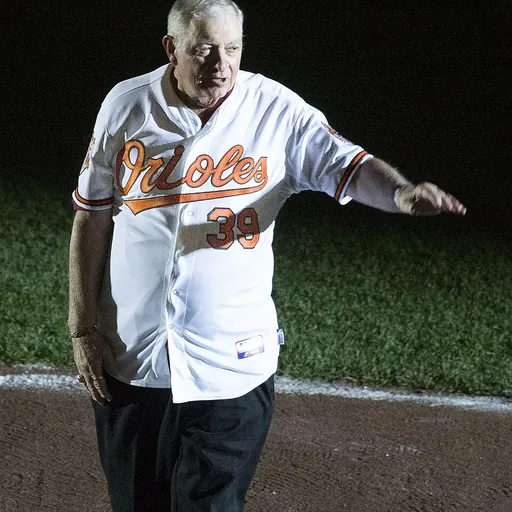
About Eddie Watt
Born 1941. Eddie Watt is an American baseball player.
Eddie Dean Watt (born April 4, 1941) is an American former professional baseball player. He played in Major League Baseball (MLB) as a right-handed relief pitcher from through , most prominently as a key member of the Baltimore Orioles dynasty that won three consecutive American League pennants from 1969 to 1971, and won the World Series in 1970. He was also on the Orioles 1966 World Series championship team that swept the Los Angeles Dodgers. He also played for the Philadelphia Phillies and the Chicago Cubs. In 2000, Watt was inducted into the Baltimore Orioles Hall of Fame. He was involved in professional baseball as a player, manager or coach from 1962 to 2002.
Early life Watt was born on April 4, 1941, in Lamoni, Iowa, the son of Lawrence and Bonnie (Currie) Watt and the youngest of four children. Watt moved to Iowa City as a young teen, and became involved in organized baseball, including American Legion Baseball and semi-pro ball. He was an All-American basketball player in high school.
In 1959, Watt attended Iowa State Teachers College (ISTC) (later the University of Northern Iowa) on a basketball scholarship. Orioles’ scout Jim Russo helped sign Watt.
He left school in 1961, just before his junior year in college, after signing a major league baseball contract with the Baltimore Orioles in early September 1961. Watt spent each fall taking classes at ISTC through 1965, until graduating in January 1966. In 1963, he was promoted to the Single-A Aberdeen Pheasants, managed by Cal Ripken Sr., where he was 10–12 in 23 starts, with a 3.14 ERA and 136 strikeouts in 172 innings pitched. His teammates included future Baltimore Orioles battery mate Andy Etchebarren. In 1964, he split time between Aberdeen and the Double-A Elmira Pioneers of the Eastern League. Still under Ripken at Aberdeen, in 16 starts he was 14–1, with a 1.77 ERA and 105 strikeouts in 137 innings pitched. His teammates included future Hall of Fame Orioles pitcher Jim Palmer, and Orioles gold glove shortstop Mark Belanger.
At Elmira in 1964, he played under future Orioles Hall of Fame manager Earl Weaver. He was 3–1 in seven starts, with a 2.86 ERA and 34 strikeouts in 44 innings pitched. In 1965, he spent time with both Elmira and the Orioles' Triple-A affiliate, the Rochester Red Wings. Still under Weaver at Elmira, he was 7–2 in 13 starts, with 1.85 ERA and 100 strikeouts in 107 innings pitched. He pitched two no-hitters with Elmira in 1965, two weeks apart, including on opening day. Two no-hitters in one season was a first in the Eastern League. At Rochester, he was 6–4 in 12 starts, with a 3.52 ERA and 73 strikeouts in 92 innings pitched.
Watt started in 93 of the 100 games in which he appeared as a minor league pitcher. Watt was called up to the Orioles in 1966, under manager Hank Bauer. In spring training that year, much to Watt's surprise, Bauer told Watt he would be joining the Orioles in 1966. He also told Watt he was planning to use Watt as a relief pitcher, even though he had been a starter in the minor leagues. After 1966, he did not start another game for the remainder of his MLB career (1967 to 1975).
In 1966, he was 2–5 as a starter. He had a 7–2 record and 4 saves as a reliever for the 1966 World Series Champion Orioles. He was 6–1 as a relief pitcher before the All-Star break, and 12 of his 13 starts came after the break. During the 1966 regular season, one writer called Watt the Orioles' "most pleasant surprise". During the season, he led the team in pitching appearances (49), on a pitching staff that also included relief pitchers Stu Miller, Drabowsky and Eddie Fisher. Watt was 3–5, with a 2.26 ERA, eight saves and 93 strikeouts in 103.2 innings pitched. In 1968, he became the Orioles closer. He pitched in 59 games (tied for fifth in the American League), with a 5–5 record and 11 saves (tied for eighth in the American League). He had a 2.27 ERA and 72 strikeouts in 83.1 innings pitched. Miller and Fisher were no longer on the team, but lefthanded relief pitcher Pete Richert joined the Orioles in 1968. During the 1968 season, his former Elmira manager Earl Weaver took over as Orioles manager after Bauer was fired.
In 1969, the Orioles won the American League pennant, after defeating the Minnesota Twins in the first American League Championship Series (ALCS), and were upset in the World Series by the New York Mets. Watt contributed to Baltimore's 109–53 regular season record with a career-high 16 saves and a career-low 1.65 earned run average in 71 innings. He was again the Orioles closer, appearing in a team high 56 games. He appeared in two games in the 1969 World Series, giving up only one run in three innings; but was the losing pitcher in Game 5.
Watt was an important part of Baltimore's 1970 Championship season though it was not one of his best seasons statistically. He won seven games and saved 12 with a 3.25 ERA in 53 appearances.
The Orioles won the 1970 World Series over the Cincinnati Reds, 4–1. Watt was the losing pitcher in the Orioles' 6–5 loss to the Reds in Game 4. With the Orioles leading 5–3, he entered the contest in relief of Jim Palmer who had allowed a walk to Tony Pérez and a single to Johnny Bench to open the top of the eighth inning. Watt's first pitch to Reds' first baseman Lee May resulted in a three-run homer to left field that prevented the Orioles from sweeping the Series which it would eventually win the following day. Watt had not pitched in any game during the previous two weeks.
Some Baltimore fans remained unkind over the years toward Watt because of May's home run and the sole loss in that series; and while the incessant booing of fans did not bother him over the next three years as an Oriole, it did upset his children. Ironically, Watt was known for not throwing many home run pitches during his career, giving up only 10 from 1968 to 1972, in 295 innings pitched. May later became a popular player for the Orioles.
In 1971, Watt pitched in only 35 games, tied with Richert for most appearances in relief. He was 3–1 with a team-leading 11 saves. He had 26 strikeouts and only eight bases on balls in 39.2 innings pitched. His 1.8 bases on ball per nine innings and 3.25 strikeout to walk ratio were the best of his career. The Orioles would go on to sweep the Athletics in three games. The Orioles faced the Pittsburgh Pirates in the 1971 World Series, losing in seven games. Watt made relief appearances in Games 3 and 4.
Watt played two more years for the Orioles. In 1972, he was 2–3 with seven saves and a 2.17 ERA. He had 23 strikeouts in 45.2 innings, the lowest strikeout per nine inning average of his career.
He was consistently effective during seven seasons of pitching exclusively in relief for Baltimore. From 1967 to 1973 he averaged 46 appearances, 67 innings, and 10 saves with an ERA of 2.40.
As an Oriole he won 37 games, with 74 saves, and a 2.73 ERA.
Philadelphia Phillies, Chicago Cubs and minor leagues On December 7, 1973, Watt's contract was purchased by the Philadelphia Phillies for an estimated $70,000. In 1974 he appeared in 42 games for the Phillies, going 1–1 with 6 saves and a 3.99 ERA.
In 1976 and 1977, he pitched for the Hawaii Islanders, the San Diego Padres Triple-A affiliate in the Pacific Coast League. He was a player/coach in 1977. He played his last professional baseball in 1978, pitching in two games for the Padres' Single-A affiliate in the California League, the Reno Silver Fox. The Padres then moved him up to the Amarillo Gold Sox of the Double-A Texas League in 1980. The team finished the season in first place in the West Division with a 77–59 record. He again managed the Gold Sox in 1981, with a 42–26 record for part of the season (winning the second half) and a 77–59 full season record again; just ½ game behind the San Antonio Dodgers on the season in the West Division. The 1981 team included future Hall of Famer Tony Gwynn. He was named Texas League Manager of the Year in 1981. He worked as a Phillies minor league pitching instructor in 1982 and 1983. After instructing rookies in early 1982, he managed the Phillies rookie league team in Bend, Oregon. In 1985, he coached the Peninsula Pilots of Hampton, Virginia, the Phillies Single-A affiliate in the Carolina League.
In 1986, he became the pitching coach for the Triple-A Tucson Toros of the Pacific Coast League, an affiliate of the Houston Astros.
In 1990, he became pitching coach for the Burlington Braves of the Single A Midwest League, an affiliate of the Atlanta Braves.
Personal life As a player, manager and coach, Watt was known for being honest and direct in how he communicated with people, and not always concerned about how untactful this might appear.
During his career in Baltimore, Watt taught adult education in the offseason. In 1970, he visited with American soldiers in Viet Nam as part of a USO tour.
Watt married is second wife Betty Chapman in 1972. He moved to the small town of North Bend, Nebraska, where his wife was from, and had a 300-acre farm; growing corn and soybeans. During his minor league coaching years, in the offseason he worked 14-hour days at the Pops-Right Popcorn factory in North Bend. During his rookie league coaching career with the Braves, the Watts lived in various Florida cities for 12 years, though often spending the winters in North Bend.
Don’t just read it —
keep it.
Full-length biographies made to live with: read them, listen on the way to work, watch them tonight.
- E-book
- Audio
- Video
Instant download · yours to keep · every purchase keeps this site free
Important facts
People in Eddie Watt's life
Named in this biography and alive at the same time



Related people
Same field, nearest in time


Contemporaries
People whose lives overlapped Eddie Watt's



Frequently asked questions
Who is Eddie Watt?
American baseball player
When was Eddie Watt born?
Eddie Watt was born on 4 April 1941 in Lamoni.
What is Eddie Watt's occupation?
Eddie Watt is a baseball player.
What nationality is Eddie Watt?
Eddie Watt is American.
Sources & further reading
Cite this page
APA: Biography.guide. (2026). Eddie Watt. https://biography.guide/eddie-watt/
MLA: "Eddie Watt." Biography.guide, https://biography.guide/eddie-watt/.
Chicago: "Eddie Watt." Biography.guide. https://biography.guide/eddie-watt/.
Data last updated: 2026-09-20 · Spot an error? Report a correction.
Page generated 2026-09-27 05:10 UTC