
About Ebba Sparre
Lived 1629 – 1662 (aged 32–33). Ebba Sparre was a Swedish lady-in-waiting, known for Christina, Queen of Sweden.
Ebba Larsdotter Sparre (1626 – 19 March 1662) was a Swedish lady-in-waiting, noblewoman and favourite of Queen Christina of Sweden. The intimate nature of her relationship with the queen has led to historical interpretations that the two women were lovers.
Early life Ebba Larsdotter Sparre was born in 1626, the daughter of statesman and marshal and Märta Banér. Her paternal grandfather was chancellor Erik Larsson Sparre.
Ebba arrived at court in 1644, and was appointed hovfröken (maid of honour) to the queen. She was a celebrated beauty at the royal court, gaining the nickname La belle comtesse , and she soon acquired several suitors. Ebba frequently played the part of Venus in the amateur ballets performed by the nobility at court.
Relationship with Queen Christina Ebba's intimate relationship with Queen Christina gave rise to the speculation that they were lovers. This has been widely accepted by historians, who look to Christina's attitude and interactions with Ebba as proof of her sexuality. Christina's sexuality has been interpreted in various ways. Most of Christina's spare time was spent with "la belle comtesse", and she often called attention to her beauty. She introduced her to the English ambassador Bulstrode Whitelocke as her 'bed-fellow', assuring him that Ebba's intellect was as striking as her body. When Raimondo Montecuccoli visited Sweden, Christina invited him to exclusive dances and paired him with Ebba. Christina admitted to being in love with Ebba.thumb However, besides Ebba and a few other ladies of the court, notably Lady Jane Ruthven and Louise van der Nooth, Queen Christina did not show any interest in her female courtiers, and generally mentions them only to express contempt over their femininity and portray herself as more masculine than them. In 1639 she mentions her attitude toward her ladies in waiting in regard to Beata Oxenstierna and her daughter, maid of honor Märta Ulfsparre: "The Mistress of the Robes Lady Beata Oxenstierna and her daughter arrived just now. The more of them that comes here the worse it is".
Gossip about Christina's female relationships existed during her lifetime, though it mainly came from her French enemies, who used accusations of lesbianism and general sexual profligacy to undermine her reputation. A forged volume entitled Lettres Secretes de Christine, Reine de Suede, was published in 1761, containing suggestive letters to Ebba.
Bain calls Ebba "[Christina's] only female friend", and states that Ebba was Christina's "exception to her general contempt of women". According to Nordisk familjebok, Ebba was Christina's only female favourite. Christina typically preferred the company of men, "not because they are men, but because they are not women." Ebba was an exception to this, during the later years of Christina's reign. Conversely, Tiernan claims that Ebba was one of many women Christina courted. Nevertheless, Christina was heavily involved with her, and her affection for Ebba was a constant in her turbulent career. Christina was outspoken on her negative views of marriage. Ebba far from agreed with the queen's views, and suffered much from the pretense she had to observe. Ultimately Christina's sexuality, Ebba was upset on Christina's leaving, and subsequently kept in touch with the queen via many letters. From Rome on 6 January 1655, Christina wrote: How happy I should be if only I could see you, Beautiful One. But I am condemned by Destiny to love and cherish you always without seeing you; and [...] I cannot be completely happy when I am separated from you. Never doubt this fact, and believe that, wherever I may be, I shall always be entirely devoted to you, as I always have been. [...] Good-bye, Beautiful One, good-bye. I embrace you a million times.Christina wrote to Ebba again on 27 March 1657, after her return from France, pressing her to come and stay with her in Italy. It was probably prevented by Magnus Gabriel De la Gardie himself. Another explanation for the missed trip was Ebba's state of health. Ebba became ill for a long time, and she died from fever on 19 March 1662. She was buried in Stockholm on 19 October.
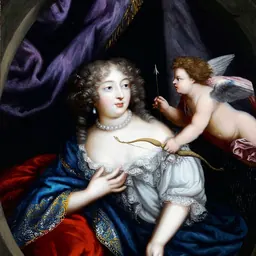
Legacy French artist Sébastien Bourdon, who was appointed First Painter by Christina, painted a portrait of Ebba in 1652 or 1653. The portrait was probably commissioned by Christina, and was among Christina's goods sent to Rome.
It has been suggested that Ebba Sparre was the subject of Skogekär Bergbo's Venerid, a collection of 101 sonnets.
Historians have varying interpretations of Christina's sexuality, which has led to different perspectives on Ebba's relationship with her queen. In Christina of Sweden (1930), in which Margaret L. Goldsmith asserts that Christina was a lesbian, Ebba is depicted as a faithless, passive noblewoman with no initiative who opts for a conventional heterosexual marriage. Sarah Waters criticised Goldsmith's biography for cherry picking evidence to suggest a sexual dimension to Christina and Ebba's relationship.
In film
Filmmakers have offered distinct interpretations of Ebba and Christina's relationship. American actress Elizabeth Young portrayed Ebba Sparre in Rouben Mamoulian's 1933 biographical film Queen Christina. The Pre-Code film implies a relationship between Ebba and Christina by showing a chaste kiss between the two women. Bisexual Swedish actress Greta Garbo, who played Christina, had an influential role in shaping Christina and Ebba's relationship in the film and insisted on the scene. In dialogue, Ebba complains that Christina is "surrounded by musty old papers and musty old men," so the queen promises to spend time with her in the country. Betsy Erkkila notes that the scene is subtle enough to be missed by the censors, but "nevertheless succeeds in inscribing not only the queen's but Garbo's own bisexual nature". The scene created controversy upon its release. Later in the film, when Ebba's fiance entreats her to ask for the queen's approval to marry, Ebba is shown troubled and fearful of Christina's displeasure. She complains about the queen's "dominating" attitude. Following a scene where Christina falls in love with Spanish ambassador Antonio Pimentel de Prado (John Gilbert), Christina adopts more feminine attire and cheerfully gives Ebba's marriage her blessing.
Ebba Sparre was portrayed by Anglo-Polish actress Ania Marson in the 1974 historical drama film The Abdication. The Abdication does touch on the concept of a relationship between Christina and Ebba, but not to the extent of Queen Christina. In comparison to Queen Christina, The Girl King decisively portrays Christina as a lesbian, and depicts Ebba and Christina's relationship as unmistakably sexual in nature. Although Gadon's performance was praised, as evident by a scene where she passionately seduces Ebba atop the Codex Gigas. In the film, Christina's affection for Ebba is manipulated by Swedish courtiers in a ploy to control the queen. Ebba's marriage to Jakob is arranged against her will, and the couple's separation hastens Christina's abdication.
Don’t just read it —
keep it.
Full-length biographies made to live with: read them, listen on the way to work, watch them tonight.
- E-book
- Audio
- Video
Instant download · yours to keep · every purchase keeps this site free
Important facts
Family & relationships
People in Ebba Sparre's life
Named in this biography and alive at the same time

Related people
Same field, nearest in time


Contemporaries
People whose lives overlapped Ebba Sparre's





Frequently asked questions
Who was Ebba Sparre?
Swedish countess (1626-1662)
When was Ebba Sparre born?
Ebba Sparre was born in 1629 in Stockholm.
When did Ebba Sparre die?
Ebba Sparre died on 19 March 1662.
What was Ebba Sparre's occupation?
Ebba Sparre was a lady-in-waiting.
What was Ebba Sparre known for?
Ebba Sparre was known for Christina, Queen of Sweden.
What nationality was Ebba Sparre?
Ebba Sparre was Swedish.
Sources & further reading
Cite this page
APA: Biography.guide. (2026). Ebba Sparre. https://biography.guide/ebba-sparre/
MLA: "Ebba Sparre." Biography.guide, https://biography.guide/ebba-sparre/.
Chicago: "Ebba Sparre." Biography.guide. https://biography.guide/ebba-sparre/.
Data last updated: 2026-09-22 · Spot an error? Report a correction.
Page generated 2026-09-27 05:22 UTC