
About Earl Butz
Lived 1909 – 2008 (aged 98). Earl Butz was an American politician, university teacher, economist and writer.
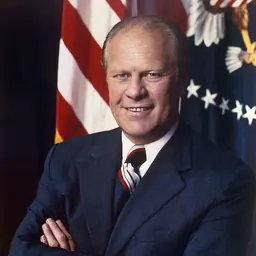
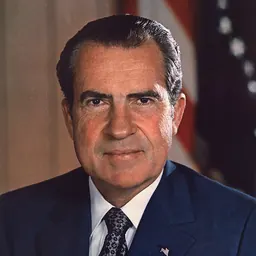
Earl Lauer "Rusty" Butz (July 3, 1909 – February 2, 2008) was a United States government official who served as the secretary of agriculture under Presidents Richard Nixon and Gerald Ford. His policies favored large-scale corporate farming and an end to New Deal programs.
Background Butz was born in Albion, Indiana, and brought up on a dairy farm in Noble County, Indiana. He was the eldest of five children and worked on his parents' farm while growing up. He attended a one-room country school through eighth grade and graduated from high school in a class of seven. He was the uncle of American football player Dave Butz.
Butz met the former Mary Emma Powell (1911–1995) from North Carolina in 1930, at the National 4-H Camp in Washington, DC.
For example, he abolished a program that paid corn farmers to not plant all their land. (See Henry Wallace's "Ever-Normal Granary".) This program had unsuccessfully attempted to prevent a national oversupply of corn and low corn prices. His mantra to farmers was "get big or get out", and he urged farmers to plant commodity crops such as corn "from fencerow to fencerow". These policy shifts coincided with the rise of major agribusiness corporations, and the declining financial stability of the small family farm.
He was featured in the documentary King Corn, recognized as the person who started the rise of corn production, large commercial farms, and the abundance of corn in American diets. In King Corn, Butz argued that the corn subsidy had dramatically reduced the cost of food for all Americans by improving the efficiency of farming techniques. By artificially increasing demand for food, food production became more efficient and drove down the cost of food for everyone.
Scandals and resignation Pope joke At the 1974 World Food Conference in Rome, Butz made fun of Pope Paul VI's opposition to "population control" by quipping, in a mock Italian accent: "He no playa the game, he no maka the rules." A spokesman for Cardinal Cooke of the New York archdiocese demanded an apology, and the White House Butz issued a statement saying that he had not "intended to impugn the motives or the integrity of any religious group, ethnic group or religious leader".
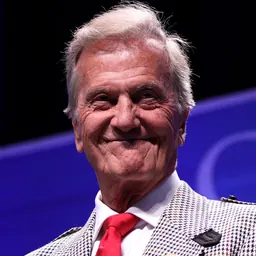
Racist joke News outlets revealed a racist remark he made in front of entertainers Pat Boone and Sonny Bono and former White House counsel John Dean while aboard a commercial flight to California following the 1976 Republican National Convention. The October 18, 1976, issue of Time reported the comment while obscuring its vulgarity:
Butz resigned his cabinet post on October 4, 1976.
The reference in Time was to John Dean's article published in Rolling Stone issue #223.
In any case, according to The Washington Post, anyone familiar with Beltway politics could "have not the tiniest doubt in [their] mind as to which cabinet officer" uttered it.
The Lubbock Avalanche-Journal said the original statement was available in the newspaper office. More than 200 stopped by to read it. The San Diego Evening Tribune offered to mail a copy of the whole quotation to anyone who requested it; more than 3,000 readers did.
Retirement and death
Butz returned to West Lafayette, Indiana, and was named dean emeritus of Purdue's School of Agriculture.
In November 1977, Butz debated writer Wendell Berry at Manchester University in Manchester, Indiana. In this debate he defended what he saw as the achievements of an industrial agriculture that was replacing the longstanding structure of small family farms and rural communities.
On May 22, 1981, Butz pleaded guilty to federal tax evasion charges for having under-reported income he earned in 1978. On June 19, he was sentenced to five years in prison. All but 30 days of the term were suspended. He was fined $10,000 and ordered to pay $61,183 in civil penalties.
Butz continued to serve on corporate boards and speak on agricultural policy. At an international conference in Geneva, Switzerland, sponsored by the Agri-Energy Roundtable (AER) on May 23, 1983, Butz warned his audience, concerning ethanol production and subsidies, "Those who ride the Tiger may find dismounting difficult". A number of those present had represented their countries during the famous 1974 World Food Security Summit (Rome) where Butz had led the US delegation.
At age 98, Butz died in his sleep on February 2, 2008, in Kensington, Maryland. He is buried at the Tippecanoe Memory Gardens in West Lafayette, Indiana. At his death, Butz was the oldest living former Cabinet member from any administration.
Don’t just read it —
keep it.
Full-length biographies made to live with: read them, listen on the way to work, watch them tonight.
- E-book
- Audio
- Video
Instant download · yours to keep · every purchase keeps this site free
Important facts
People in Earl Butz's life
Named in this biography and alive at the same time





Related people
Same field, nearest in time





Contemporaries
People whose lives overlapped Earl Butz's


Frequently asked questions
Who was Earl Butz?
American government official (1909-2008)
When was Earl Butz born?
Earl Butz was born on 3 July 1909 in Albion.
When did Earl Butz die?
Earl Butz died on 2 February 2008 in Washington, D.C..
What was Earl Butz's occupation?
Earl Butz was a politician, university teacher, economist and writer.
What nationality was Earl Butz?
Earl Butz was American.
Sources & further reading
Cite this page
APA: Biography.guide. (2026). Earl Butz. https://biography.guide/earl-butz/
MLA: "Earl Butz." Biography.guide, https://biography.guide/earl-butz/.
Chicago: "Earl Butz." Biography.guide. https://biography.guide/earl-butz/.
Data last updated: 2026-09-24 · Spot an error? Report a correction.
Page generated 2026-09-27 05:00 UTC