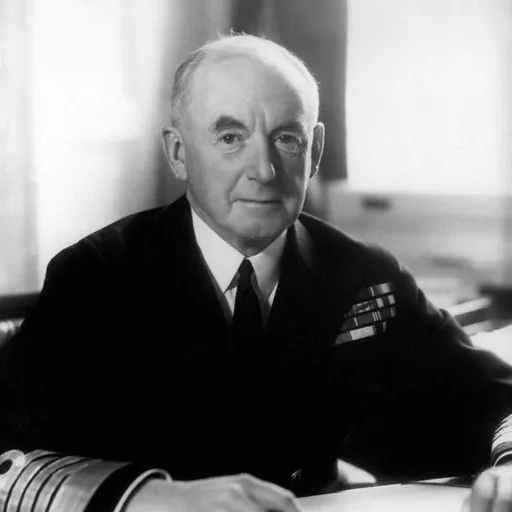
About Dudley Pound
Lived 1877 – 1943 (aged 66). Dudley Pound was a British naval officer.
Admiral of the Fleet Sir Alfred Dudley Pickman Rogers Pound (29 August 1877 – 21 October 1943) was a British senior officer of the Royal Navy. He served in the First World War as a battleship commander, taking part in the Battle of Jutland with notable success, contributing to the sinking of the German cruiser .
He served as First Sea Lord, the professional head of the Royal Navy, for the first four years of the Second World War. In that role his greatest achievement was his successful campaign against the German U-boats and the winning of the Battle of the Atlantic but his judgment has been questioned over the failed Norwegian Campaign in 1940, and his dismissal of Admiral Dudley North in 1940. His order in July 1942 to disperse Convoy PQ 17 and withdraw its covering forces, to counter a possible (though never transpired) threat from heavy German surface ships, led to the convoy's destruction by submarines and aircraft, damaging relations with ally Russia, which was awaiting the convoy's supplies. His health failed in 1943 and he resigned, dying shortly thereafter.
Early life Born the son of Alfred John Pound, an Eton-educated barrister, by his marriage to Elizabeth Pickman Rogers, an American from Boston, Pound's maternal grandfather was Richard Saltonstall Rogers, but was also descended on his mother's side from Dudley Leavitt Pickman, an early Salem, Massachusetts, merchant. He was educated at Fonthill School in East Grinstead, Sussex.
Early career Pound joined the Royal Navy as a cadet in the training ship HMS Britannia in January 1891 and was posted as a midshipman to the battleship in the Channel Squadron in January 1893. He transferred to the cruiser in May 1894 on the China Station and then joined in the Training Squadron. he joined the destroyer in October 1897 and the battleship in January 1898. he joined the torpedo school in September 1899 and qualified as a torpedo specialist in December 1901. he transferred to the battleship in the Home Fleet in May 1911. He also planned the use of radio remote controlled vessels that were developed by the Navy's D.C.B. Section.
Interwar career Pound was appointed a Companion of the Order of the Bath in the 1919 Birthday Honours and given command of the battlecruiser in October 1920 before becoming director of the planning division at the Admiralty in June 1923. Following Roger Keyes' appointment as commander-in-chief of the Mediterranean Fleet in May 1925, Pound became his chief of staff. and became Assistant Chief of the Naval Staff in April 1927. he became Second Sea Lord and Chief of Naval Personnel in August 1932.
On 16 January 1933 Pound was promoted to full admiral he became Chief of Staff of the Mediterranean Fleet. In March 1936, he was appointed Commander-in-Chief, Mediterranean Fleet. In the 1939 New Year Honours, Pound advanced to the rank of Knight Grand Cross of the Order of the Bath.
First Sea Lord
Pound became First Sea Lord in June 1939 and was promoted to Admiral of the Fleet on 31 July 1939. His health was doubtful even then, but other experienced admirals were in even poorer health. He also became First and Principal Naval Aide-de-Camp to the King in October 1941.
There are sharply divided opinions of Pound as First Sea Lord during the early years of the Second World War. His admirals and captains at sea accused him of "back seat driving" and he had some clashes with Charles Forbes and John Tovey, commanders of the Home Fleet.
Winston Churchill, with whom he worked from September 1939, was involved with him on naval strategies such that he was referred to as "Churchill's anchor". Critically, Pound was at the helm of the Royal Navy on the day of the sinking of Prince of Wales and Repulse on 10 December 1941 off the coast of Kuantan, Malaysia by the Japanese Air Force.
Perhaps Pound's greatest achievement was his defeat of the German U-boats and the winning of the Battle of the Atlantic but he has been blamed for the Channel Dash when the Navy allowed the German battlecruisers and to slip into the English Channel undetected in February 1942, and criticised for ordering the dispersal of Arctic Convoy PQ 17 in July 1942, in which 35 merchant ships were left without protection, leading to 24 of the 35 merchant ships being sunk with the loss of 153 men.
By March 1942 he was no longer Chairman of the Chiefs of Staff and accepted the need for a deputy first sea lord, with Admiral Sir Charles Kennedy-Purvis installed as such in July 1942.
Pound refused a peerage but was appointed to the Order of Merit on 3 September 1943, four years after the outbreak of the war.
Resignation and death Pound suffered from hip degeneration, the pain from which often disrupted his normal sleep and caused him to doze off at meetings. Pound then resigned formally on 20 September 1943. his ashes were buried at sea in The Solent.
Don’t just read it —
keep it.
Full-length biographies made to live with: read them, listen on the way to work, watch them tonight.
- E-book
- Audio
- Video
Instant download · yours to keep · every purchase keeps this site free
Important facts
People in Dudley Pound's life
Named in this biography and alive at the same time



Related people
Same field, nearest in time
Contemporaries
People whose lives overlapped Dudley Pound's




Frequently asked questions
Who was Dudley Pound?
Royal Navy admiral of the fleet (1877-1943)
When was Dudley Pound born?
Dudley Pound was born on 29 August 1877 in Isle of Wight.
When did Dudley Pound die?
Dudley Pound died on 21 October 1943 in Royal Masonic Hospital.
What was Dudley Pound's occupation?
Dudley Pound was a naval officer.
What nationality was Dudley Pound?
Dudley Pound was British.
Sources & further reading
Cite this page
APA: Biography.guide. (2026). Dudley Pound. https://biography.guide/dudley-pound/
MLA: "Dudley Pound." Biography.guide, https://biography.guide/dudley-pound/.
Chicago: "Dudley Pound." Biography.guide. https://biography.guide/dudley-pound/.
Data last updated: 2026-09-23 · Spot an error? Report a correction.
Portrait: Wikimedia Commons · author & licence
Page generated 2026-09-27 05:08 UTC