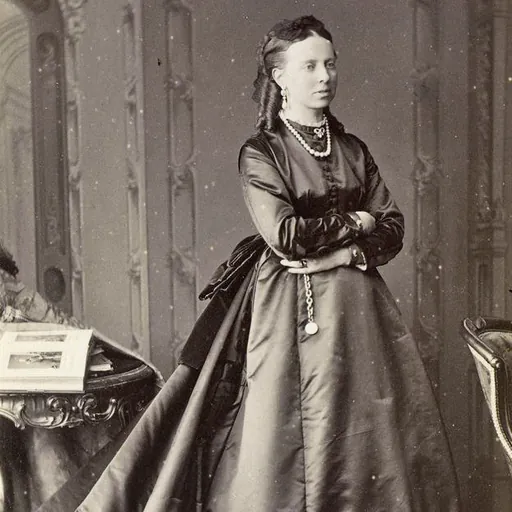
About Duchess Alexandra of Oldenburg
Lived 1838 – 1900 (aged 61). Duchess Alexandra of Oldenburg was a Russian nun.
Grand Duchess Alexandra Petrovna of Russia (; born Duchess Alexandra Frederica Wilhelmina of Oldenburg, ; 2 June 1838 – 25 April 1900) was a great-granddaughter of Emperor Paul I of Russia and the wife of Grand Duke Nicholas Nikolaevich of Russia, the elder.
She was the eldest daughter of Duke Peter of Oldenburg and his wife Princess Therese of Nassau-Weilburg. She grew up in Russia in close proximity to the Romanovs as her father was a nephew of Tsar Nicholas I of Russia. Alexandra's parents were artistically gifted and passionate philanthropists. They provided a good education for her and inspired in Alexandra a life of service to those in need.
Alexandra married in 1856, Grand Duke Nicholas Nikolaevich of Russia, the third son of Tsar Nicholas I and her first cousin once removed. Alexandra, who had been raised in the Lutheran church, converted to the Orthodox faith, and took the name Grand Duchess Alexandra Petrovna of Russia. The couple had two children: Grand Duke Nicholas Nikolaevich of Russia (1856–1929), the younger, and Grand Duke Peter Nikolaevich of Russia (1864–1931). The marriage, arranged by the Russian Imperial family in an attempt to control the Grand Duke's excesses, was unhappy. She was plain, serious and liked simplicity. Deeply religious and very involved in charity work, Alexandra founded a training institute for nurses in St Petersburg in 1865. The same year, her husband began an affair with a ballerina, forming a second family with his mistress.
After the collapse of her marriage, Alexandra lived separated from her husband who expelled her from their household in 1879. A carriage accident left her almost completely paralyzed and, in November 1880, Alexandra went abroad to improve her health, compelled by her brother-in-law Tsar Alexander II. The following year, she asked her nephew, Tsar Alexander III, to allow her to return to Russia and she settled in Kiev. She recovered her mobility and, in 1889, she founded the Pokrovsky Nunnery, Kiev, a convent of nursing nuns with its own hospital, to provide free treatment for the poor. She dedicated the rest of her life to the work at the hospital. In 1889, she became an Orthodox nun under the name Anastasia, but kept this secret until her death. She died at the convent in 1900.
Early life Alexandra Frederica Wilhelmina was born at her parents' palace at Embarkment, 2 in St. Petersburg on , as a Duchess of Oldenburg. She was the eldest of the eight children of Duke Peter of Oldenburg and his wife Princess Therese of Nassau-Weilburg, half-sister of Sofia of Nassau, queen consort of Oscar II of Sweden. where her family was closely related to the Romanov dynasty.
Duke Peter, Alexandra's father, was the only surviving son of Grand Duchess Catherine Pavlovna, the fourth daughter of Tsar Paul I of Russia. Peter of Oldenburg followed a military career in the Imperial Russian Army and was also a scholar, a music composer and philanthropist. Alexandra's mother, Princess Therese of Nassau-Weilburg, was interested in painting and like her husband was deeply involved in charity work, so much so that she was considered an eccentric.
The family spent the winter months in Peterhof and moved for the summer to their other residence Kamenoi-Ostroff. There, Alexandra and her siblings had a children's farm where they grew vegetables and tended farm animals under the supervision of their Russian governess. The Russian Imperial family, in an attempt to control the Grand Duke's excesses, had propelled Nicholas to marry Alexandra, hoping that she would have a good influence on him.
Alexandra was described by Anna Tyutcheva (1829-1889), a lady in waiting to Empress Maria Alexandrovna, as: "... a sweet and docile creature... Although not beautiful, she is captivating with the freshness of her seventeen years of age, and also with the sincerity and kindness that shines on her face". There, in their apartments on the ground floor, nine months after their wedding, Alexandra gave birth to their first child on 18 November 1856, Grand Duke Nicholas Nikolaevich of Russia the Younger.
Charity work Grand Duke Nicholas Nikolaevich his wife Grand Duchess Alexandra Petrovna of Russia and their two sons.1864. Alexandra loved her husband and her son deeply but she felt it was also her duty to help those in need. However, at the Russian court, Alexandra Petrovna's involvement in philanthropy was considered excessive and she was regarded as a holy fool.
In December 1861, the couple moved to their newly built Nicholas Palace on Annunciation Square. Even in the country, Alexandra continued her charity work. However, no sound information has surfaced to corroborate these claims. The story of the illegitimate child seems unlikely.
Alexandra Petrovna was deeply upset by her husband's infidelity. Grand Duchess Alexandra, leaving behind her jewelry, clothes and possessions, had to move to her parents' house. In January 1881, her estranged husband, Grand Duke Nicholas, arrived unexpectedly and took both their sons with him. According to Alexandra: he "made me experience things I wouldn't wish on my worst enemy". She completely relied on religion for solace and comfort.
In Kiev, Alexandra's health did not improve for years.
Alexandra became a nun, as Sister Anastasia, taking Holy Orders on 3 November 1889 in Kiev, while her husband was still alive. For the rest of her life, she worked at the hospital performing nursing duties, helping contagious patents and cleaning infected wounds. She often assisted in surgeries.
Last years
Catherine Chislova died in 1889, and Grand Duke Nicholas survived his lover by only two years. When he died in the Crimea in 1891, Alexandra Petrovna did not attend the funeral. She also refused to pay homage to her dead husband when the funeral catafalque, taking his body for burial in the St Peter and St Paul Cathedral in St Petersburg, came by train via Kiev on its route from the south. She was buried within the monastery graveyard in a plain white coffin, wearing her monastic habit. On the day of her burial, Emperor Nicholas II and Empress Alexandra Feodorovna attended a memorial service held in the Moscow Kremlin palace church.
In the 1950s, Alexandra's remains were moved to the Lukianovskoe Cemetery. She was reburied in the garden at the St. Nicholas Cathedral of the Pokrov Monastery on 2 November 2009. Grand Duchess Alexandra Petrovna was canonized by the Holy Synod of the Ukrainian Orthodox Church on 24 November 2009 as the locally venerated Reverend Grand Duchess Anastasia of Kiev, patron saint of all divorced men and women. Today her grave in the convent garden is again tended by nuns and her works continues.
Ancestry
Don’t just read it —
keep it.
Full-length biographies made to live with: read them, listen on the way to work, watch them tonight.
- E-book
- Audio
- Video
Instant download · yours to keep · every purchase keeps this site free
Important facts
Family & relationships
People in Duchess Alexandra of Oldenburg's life
Named in this biography and alive at the same time


Related people
Same field, nearest in time


Contemporaries
People whose lives overlapped Duchess Alexandra of Oldenburg's
Frequently asked questions
Who was Duchess Alexandra of Oldenburg?
Grand Duchess of Russia (1838–1900)
When was Duchess Alexandra of Oldenburg born?
Duchess Alexandra of Oldenburg was born on 2 May 1838 in Saint Petersburg.
When did Duchess Alexandra of Oldenburg die?
Duchess Alexandra of Oldenburg died on 13 April 1900 in Pokrovsky Monastery.
What was Duchess Alexandra of Oldenburg's occupation?
Duchess Alexandra of Oldenburg was a nun.
What nationality was Duchess Alexandra of Oldenburg?
Duchess Alexandra of Oldenburg was Russian.
Sources & further reading
· Wikipedia: Duchess Alexandra of Oldenburg
· DBpedia: Duchess Alexandra of Oldenburg
Cite this page
APA: Biography.guide. (2026). Duchess Alexandra of Oldenburg. https://biography.guide/duchess-alexandra-of-oldenburg/
MLA: "Duchess Alexandra of Oldenburg." Biography.guide, https://biography.guide/duchess-alexandra-of-oldenburg/.
Chicago: "Duchess Alexandra of Oldenburg." Biography.guide. https://biography.guide/duchess-alexandra-of-oldenburg/.
Data last updated: 2026-09-23 · Spot an error? Report a correction.
Portrait: Wikimedia Commons · author & licence
Page generated 2026-09-27 05:05 UTC