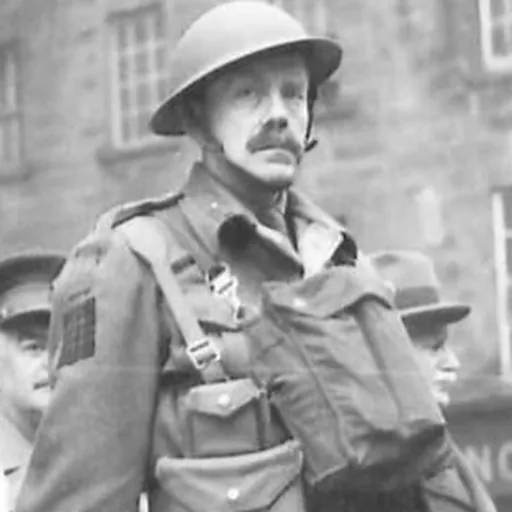
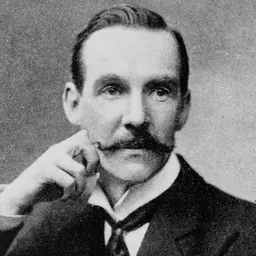
Douglas Wimberley
British general
About Douglas Wimberley
Lived 1896 – 1983 (aged 87). Douglas Wimberley was a British military personnel, gentleman Usher of the Scarlet Rod and university of Dundee.
Major-General Douglas Neil Wimberley, (15 August 1896 – 26 August 1983) was a British Army officer who, during the Second World War, commanded the 51st (Highland) Division for two years, from 1941 to 1943, notably at the Second Battle of El Alamein, before leading it across North Africa and in the Allied campaign in Sicily.
Early life and First World War Douglas Neil Wimberley was born on 15 August 1896 at 8 Ardross Terrace, Inverness, Scotland, the son of Surgeon-Captain Charles Neil Campbell Wimberley, and Minnie Lesmoir Gordon, daughter of R. J. Wimberley.
Wimberley was educated at Alton Burn, Nairn, Wellington College, followed by Cambridge University. In December 1914, four months after the outbreak of the First World War, he entered the Royal Military College, Sandhurst and, on 11 May 1915, he was commissioned as a second lieutenant, into his grandfather's regiment, the Queen's Own Cameron Highlanders. His first posting was with the 3rd (Militia) Battalion of his regiment at Invergordon before his eventual posting, in September, to the 1st Battalion on the Western Front. The battalion, a Regular Army unit, formed part of the 1st Brigade of the 1st Division. In October, Wimberley, now aged 19 and the machine gun officer of his battalion, fought in the Battle of Loos. and, in October, was sent to England, where he attended the Machine Gun Training Centre at Grantham, Lincolnshire and, returning to the Western Front, was promoted to the acting rank of captain on 12 February 1917, and assumed command of the 232nd Machine Gun Company, which in July became part of the 51st (Highland) Division, a Territorial Force (TF) formation. The German Army launched its Spring Offensive in late March and Wimberley was again wounded and, evacuated to England, was passed fit for service in June and attended a machine gun refresher course at Grantham the following month, but was not to see any further action during the war. He was soon afterwards posted as a company commander in the 9th Reserve Battalion, Machine Gun Corps, a training unit. In October/November he attended a Royal Air Force (RAF) cooperation course, with the intention of training infantry officers to be air observers. He was there by the time of the Armistice with Germany in November, which brought the war to an end. Wimberley's battalion, a Regular Army unit, was regarded by Bernard Montgomery, the brigade major of the parent Cork Brigade, to be the best troops available to act as a "flying column" to round up rebels. 1922 saw Wimberley made the adjutant of the 2nd Battalion, Camerons. Two years later he gained distinction in promotion examinations and was allowed to spend a year at Emmanuel College, Cambridge. the same year that he won the Army Quarterly military prize for an essay on recent military campaigns.
Wimberley then served as a General Staff Officer Grade 2 (GSO2) at the War Office for four years, during which time he received a promotion on 3 January 1934 to major, and brevet lieutenant-colonel on 1 January 1936, before returning to an active command when he was promoted to the rank of lieutenant-colonel on 19 December 1938 and succeeded Lieutenant-Colonel James Gammell as Commanding Officer (CO) of the 1st Battalion, Cameron Highlanders, then stationed in England, which he commanded until the outbreak of war nine months later. There was no immediate action, however, and in late December Wimberley was sent to England and made GSO1 and Chief Instructor at the Senior Officers' School, Sheerness, so missing the hostilities in France which commenced in May 1940.
On 21 May 1941 Wimberley was promoted to the acting rank of major-general and became GOC of the 46th Infantry Division, succeeding Major-General Charles Hudson, who had been one of Wimberley's fellow students at the Staff College, Camberley in the late 1920s. The division was a second-line Territorial Army (TA) formation that had fought with the BEF the year before and, like the 5th Division, had suffered heavy losses but was now reformed. He was to remain with the division for just three weeks as, in mid-June, after handing over the 46th to Major-General Miles Dempsey, he returned to the 51st (Highland) Division, this time as its GOC. He was made GOC at the specific request of his predecessor, Ritchie, who was then being posted to the Middle East. and, towards the end of June, the 51st Division left the United Kingdom, destined for North Africa. He often paused to assist troops carrying out work or briefed individual private soldiers, so as to make them better understand the part which they were to play. Therefore, the casualties suffered by the Eighth Army, amounting to nearly a quarter of the infantry force, caused Wimberley to comment "never again". Having observed in the closing stages of the battle an assault by his Highlanders which had gone in without an artillery barrage, he wrote:
Known, trusted and respected by Montgomery, Wimberley led the 51st Division across North Africa and almost continuously throughout the Tunisian Campaign, fighting at Mareth, Medinine, Akarit and Enfidaville, and Adrano. On 29 December 1942 Wimberley was awarded the Distinguished Service Order (DSO) for "gallant and distinguished services" so far in the campaign.
The pace of the pursuit of Rommel – the fear of another battle of attrition like Alamein – began to tell. In his unpublished memoirs, Wimberley wrote of the Battle of El Agheila:
To Wimberley was entrusted the task of taking Buerat and opening the way to Tripoli, before supplies ran out over a tenuous chain of communication, so fast had the Eighth Army advanced. Having opened the way to the city – the first major Axis prize to fall in the whole of the war so far – Wimberley's achievement went virtually unrecognised by Montgomery, who accused him of "dilatoriness". Wimberley forgave all during the Battle of Medenine, however, when he wrote, "I felt grateful, and thought, again, what a wonderful little commander I was serving under, in Monty."
Shortly after the capture of Tripoli, Wimberley's division was visited by Winston Churchill, the British Prime Minister, and General Alan Brooke, now the Chief of the Imperial General Staff (CIGS), who, like Montgomery, had formerly been one of Wimberley's Staff College instructors. On 4 February 1943, when Churchill and Brooke arrived, Wimberley ordered a composite brigade of the 51st Division, all of whom were wearing kilts and were led by the massed pipers, to march past the Prime Minister and CIGS. Both men were moved to tears by the encounter. Brooke wrote in his diary later that night about the encounter:
The campaign in Tunisia came to an end on 13 May 1943, with the Allies capturing nearly 250,000 Axis soldiers, although Wimberley and the 51st Division was, by this time, in Algeria resting after six months of combat, absorbing reinforcements, and, later, training in combined operations in preparation for the Allied invasion of Sicily. On 24 June 1943 Wimberley was mentioned in despatches for his services in North Africa.
Sicily In July 1943 Wimberley led the 51st Division, again serving under Leese's XXX Corps, during the Allied invasion of Sicily (codenamed Operation Husky). At this time, all three of Wimberley's brigades were commanded by future general officers, the 152nd by Gordon MacMillan, the 153rd by Horatius Murray and the 154th by Tom Rennie. The division was involved in heavy fighting until gradually being relieved in August by the 78th Infantry Division. This he did, and Wimberley was replaced by Major-General Charles Bullen-Smith, of the King's Own Scottish Borderers, who had been GOC of the 15th (Scottish) Infantry Division, another TA formation. In the event, Bullen-Smith was himself replaced by Major-General Tom Rennie, a Highlander, in July 1944, when the division was fighting in Normandy after being brought back to the United Kingdom by Montgomery (upon his promotion to command the 21st Army Group) to spearhead the Allied invasion of Normandy (codenamed Operation Overlord).
Whilst Montgomery judged "Tartan Tam" Wimberley as unsuitable for corps command, he recommended him to his mentor and friend, General Alan Brooke, the CIGS, for the position of Commandant at the Staff College, Camberley, a recommendation which was accepted. He assumed command in September, after a long leave, returning to the college nearly twenty years after he had attended it as a student, in turn succeeding Major-General Alan Cunningham. By now the course at the Staff College had been considerably reduced in length (down from just over two years in peacetime to a mere five months), due mainly to the needs of the wartime army, with its role being now to produce large numbers of competent staff officers in the shortest time possible, although the appointment itself was still seen as a very prestigious posting. in mid-December, Wimberley relinquished this appointment and, after handing over to Major-General Philip Gregson-Ellis, was appointed Director of Infantry at the War Office, his last appointment in the army, for which he was responsible for infantry training, although his assignment came at a difficult time, with the British Army then suffering from a severe manpower crisis, and the infantry having been forced to accept the worst recruits throughout the war. He held this post until his resignation from the army on 8 October 1946, after a 31-year military career, when it became clear that, with Montgomery having now become CIGS, in succession to Brooke, he would progress no higher in the army.
Without much academic power, Wimberley sought to give the college the same esprit de corps with which he had invigorated the 51st (Highland) Division. He worked as closely with the staff and students of the college as he had with the officers and men of his division.
In 1947 he wrote the "Wimberley Memo", which set the scene for the parting of ways between the University of St Andrews, and the former University College, Dundee. In honour of this event, the University of Dundee awards annually the Wimberley Award to the student who has contributed most to university life.
In his role as Principal of University College, Dundee Wimberley helped to found the Abertay Historical Society in 1947, along with the History lecturer Dr. Wainwright. The society, which is still active, was formed to encourage the study of the history of the Abertay area (Dundee, Angus, Perthshire and northern Fife). According to University of Dundee historian Kenneth Baxter, Wimberley set up the Society as part of a process of developing 'town and gown links' in Dundee.
In 1954, University College was replaced by Queen's College Dundee. The post of Principal of University College was replaced by the new role of Master of Queen's College. Wimberley was not considered for this new position and left the University. Having retired, he took up genealogy and lived with his wife in the town of Coupar Angus, Perthshire. From 2 September 1951 until 1961 he was colonel of the Queen's Own Cameron Highlanders. In 1973, Wimberley collated his papers and diaries into a five-volume autobiography called Scottish Soldier. This unpublished memoir was deposited by the general in the National Library of Scotland.
He died at Foxhall, Coupar Angus, on 26 August 1983, shortly after turning 87. He was survived by his son Neil Wimberley (b. 1927), who lives with his wife in Foxhall, and daughter Lesmoir Edington (1926-2019) living in Haddington, Scotland.
His name lives on in Dundee with the Wimberley Houses, Dundee University student accommodation by Ninewells Hospital. The University of Dundee Archive Services also holds his papers relating to his time as Principal of University College.
Don’t just read it —
keep it.
Full-length biographies made to live with: read them, listen on the way to work, watch them tonight.
- E-book
- Audio
- Video
Instant download · yours to keep · every purchase keeps this site free
Important facts
People in Douglas Wimberley's life
Named in this biography and alive at the same time


Related people
Same field, nearest in time





Contemporaries
People whose lives overlapped Douglas Wimberley's


Frequently asked questions
Who was Douglas Wimberley?
British general (1896–1983)
When was Douglas Wimberley born?
Douglas Wimberley was born on 15 August 1896 in Inverness.
When did Douglas Wimberley die?
Douglas Wimberley died on 26 August 1983 in Coupar Angus.
What was Douglas Wimberley's occupation?
Douglas Wimberley was a military personnel, gentleman Usher of the Scarlet Rod and university of Dundee.
What nationality was Douglas Wimberley?
Douglas Wimberley was British.
Sources & further reading
· Wikipedia: Douglas Wimberley
Cite this page
APA: Biography.guide. (2026). Douglas Wimberley. https://biography.guide/douglas-wimberley/
MLA: "Douglas Wimberley." Biography.guide, https://biography.guide/douglas-wimberley/.
Chicago: "Douglas Wimberley." Biography.guide. https://biography.guide/douglas-wimberley/.
Data last updated: 2026-09-24 · Spot an error? Report a correction.
Portrait: Wikimedia Commons · author & licence
Page generated 2026-09-27 05:09 UTC