
About Douglas Davis
Lived 1933 – 2014 (aged 80). Douglas Davis was an American art critic, television producer, video artist, artist and art theorist.
Douglas Matthew Davis, Jr. (April 11, 1933 – January 16, 2014) was an American artist, critic, teacher, and writer for among other publications Newsweek.
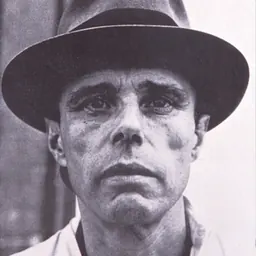
Artistic career In 1977, at the opening of documenta 6, alongside Nam June Paik and Joseph Beuys, Douglas Davis took part in one of the first international satellite telecasts with his live performance The Last Nine Minutes. Davis received grants for his work by the Rockefeller Foundation, the National Endowment for the Arts & the Trust for Mutual Understanding, among other institutions.
Early internet works His exploration of interactivity involving various media continued throughout the 1980s and 1990s. He is the author of one of the earliest art pieces on the World Wide Web, The World's First Collaborative Sentence (1994). His early work is featured on his website, The World's First Collaborative Sentence (1994), with elements from his exhibition InterActions 1967-1981. They include critical essays by Susan Hoeltzel, Michael Govan, David Ross, and Nam June Paik. Commissioned by the Lehman College Art Gallery, the Sentence was given by its collectors, Barbara and Eugene M. Schwartz, to the Whitney Museum of American Art. In 1997, P.S.1/The Institute of Contemporary Art joined with several other museums to host MetaBody (The World's First Collaborative Visions of the Beautiful), commissioned by George Waterman III. In 1997, Davis launched Terrible Beauty, an evolving global multi-media theater piece. Its "chapters" have been performed before audiences in New York, Dublin, San Francisco, and Berlin.
Teaching and writing
Davis taught advanced media at more than 25 universities and art colleges and served as consultant in this field for several corporations & foundations. Davis published the book Art and the Future in several countries in 1973. ArtCulture: Essays on the Post-Modern (1977), is a book of theoretical essays. The Five Myths of TV Power (or, Why the Medium is Not the Message), 1993, focuses on the crucial importance of the viewer, the "human" element in media theory.
Personal life Davis lived and worked in New York City until his death on January 16, 2014. He is survived by three daughters, and three granddaughters. His wife of over 30 years, Jane Bell Davis, died in 2005.
Exhibitions The Anagrammatic Body, Neue Galerie, Graz, Austria, 1999 The Net. Condition, Center for Art and Media, Karlsruhe, Germany, 1999 The American Century, Part II, Whitney Museum, 1999 Governor's Conference on the Arts and Technology, Information Technology Center, New York (installation), 1998 P.S. 1/Institute of Contemporary Art, New York (website), 1997 WithDrawing, Ronald Feldman Fine Arts, New York, 1996 X-Art Foundation, New York, 1996 Kwangju Biennale, Korea, 1995 Museum Sztuki, Lodz, Poland, 1995 (retrospective) InterActions (1967–1981), Art Gallery, Lehman College, New York City, 1994 Discours Amoureux, Galerie St. Gervais, Geneva, 1994 TranceSex, Amanda Obering Gallery, Los Angeles, 1993 Ronald Feldman Fine Arts (one-man), 1992, 1985, 1984, 1981, 1980, 1977 Centro de Arte y Communicacion—Harrod's en Arte, Buenos Aires, 1991 Kunstverein, Cologne, Germany, 1989 Solomon R. Guggenheim Museum, 1986, 1988 Whitney Museum of American Art, (Biennial 1985), 1981, 1977, 1972 Venice Biennale, 1976, 1978, 1986 The New Museum, New York City, 1983, 1984 The Museum of Modern Art, 1983, The Hirshhorn Museum & Sculpture Garden, 1983, 1984 Metropolitan Museum of Art, 1982 (traveling exhibition) Wadsworth Atheneum, 1982–1983 Centre Pompidou, Paris, 1981
Publications Essays on the Post-Modern. New York: Harper & Row, 1977. The Museum Transformed: Design and Culture in the Post-Pompidou Age. New York: Abbeville Press Publishers, 1990. The Five Myths of Television Power, Or, Why the Medium is Not the Message. Riverside, New Jersey, U.S.A.: Simon & Schuster, 1993.
Don’t just read it —
keep it.
Full-length biographies made to live with: read them, listen on the way to work, watch them tonight.
- E-book
- Audio
- Video
Instant download · yours to keep · every purchase keeps this site free
Important facts
People in Douglas Davis's life
Named in this biography and alive at the same time




Related people
Same field, nearest in time

Contemporaries
People whose lives overlapped Douglas Davis's




Frequently asked questions
Who was Douglas Davis?
American artist (1933–2014)
When was Douglas Davis born?
Douglas Davis was born on 11 April 1933 in Washington, D.C..
When did Douglas Davis die?
Douglas Davis died on 16 January 2014 in Queens.
What was Douglas Davis's occupation?
Douglas Davis was an art critic, television producer, video artist, artist and art theorist.
What nationality was Douglas Davis?
Douglas Davis was American.
Sources & further reading
· DBpedia: Douglas Davis (artist)
Cite this page
APA: Biography.guide. (2026). Douglas Davis. https://biography.guide/douglas-davis/
MLA: "Douglas Davis." Biography.guide, https://biography.guide/douglas-davis/.
Chicago: "Douglas Davis." Biography.guide. https://biography.guide/douglas-davis/.
Data last updated: 2026-09-20 · Spot an error? Report a correction.
Page generated 2026-09-27 05:11 UTC