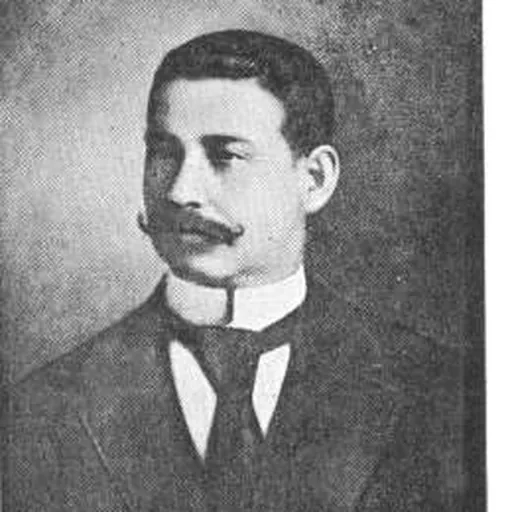
About Domingo Méndez Capote
Lived 1863 – 1934 (aged 70–71). Domingo Méndez Capote was a Cuban politician and military personnel.
Executive government of the Cuban Republic in Arms. Ernesto Fons Sterling, Secretary of the Treasury; Vice-President Mendez Capote; Andrés Moreno de la Torre, Secretary of Foreign Affairs; President Bartolomé Masó; José B. Aleman, Secretary of War; Manuel Ramon Silva, Secretary of the Interior. Domingo Méndez Capote was a Cuban lawyer, military officer, and politician who played a significant role in the Cuban War of Independence and the early years of the Republic of Cuba. He was the 2nd-serving Vice President of Cuba. Other roles he held over the years include; President of the Constituent Convention, Vice President of the Cuban Republic in Arms, President of the Senate of Cuba, Professor of the University of Havana faculty of Law, Dean of the Havana Bar Association, in three terms, Secretary of the Government for the military government of Cuba, and representative of several foreign houses.
Early life and legal career Domingo Méndez Capote was born on the San Francisco estate, in the flourishing town of Lagunillas, located nine kilometers south of Cárdenas, in the Matanzas Province. This town, which today has a population of approximately 600, was renamed Méndez Capote in 1899, in his honor. (Coordinates: ) Méndez Capote came from the wealthy Spanish family
In February 1896, Méndez Capote enlisted in the Cuban Liberation Army at the Matilde sugar mill near Camajuaní, in the province of Las Villas. His enlistment was under the command of Leoncio Vidal, who granted him the rank of captain due to his university education. and later briefly as Vice President from 1905 to 1906. He supported Estrada Palma’s policies, including the controversial 35-million-peso loan intended to pay the Liberation Army in 1903. Allegations of corruption surrounding this loan were never substantiated. The Estrada Palma administration prioritized education and healthcare, increasing the number of teachers to 3,500 by 1905—surpassing the number of soldiers in the regular army. The crisis stemmed from widespread accusations of electoral fraud in his 1905 re-election, where he allegedly manipulated the vote to secure a second term against José Miguel Gómez. Machado's campaign, however, allegedly used fraudulent methods to come to power.
Méndez Capote was appointed president and general delegate of the revolutionary junta, which unified various opposition groups, including nationalists, intellectuals, university faculty, and student organizations. The New York-based faction, formally named the Republican Delegation of Cuba, was led by Méndez Capote as president, with Dr. Fernando Ortiz as vice president and his son, Dr. Francisco M. Capote, as secretary. This delegation was granted full authority to represent the Cuban revolutionary junta in its dealings abroad.
The junta in Cuba, alongside Méndez Capote, included prominent figures such as Colonel Carlos Mendieta, Dr. Roberto Méndez Peñate, General Mario García Menocal, and Dr. Miguel Mariano Gómez. Their stated mission was to overthrow Machado’s dictatorship and restore constitutional governance. Méndez Capote issued a statement affirming that the junta would appoint a provisional government to reestablish Cuba’s constitutional order.
On August 10, back in Cuba, Carlos Mendieta and Mario García Menocal landed forces at Rio Verde in an attempt to overthrow Gerardo Machado. They were defeated by 14 August in military operations that include the first use of military aviation in Cuba. These events are collectively known as the failed Cuban Revolution of 1931.
Despite the junta’s efforts, the rebellion against Machado faced significant challenges. Meanwhile, U.S. authorities detained suspected Cuban insurgents off the coast of Montauk Point but ultimately released them due to lack of evidence. The Cuban exiles, including former government officials and military figures, denied involvement in revolutionary activities, maintaining that they were engaged in swordfishing when apprehended.
While the immediate rebellion struggled, the movement Méndez Capote helped lead contributed to the eventual fall of Machado in 1933. His involvement in the revolutionary junta solidified his legacy as a steadfast opponent of dictatorship and an advocate for constitutional governance in Cuba.
Return to Cuba and death After the Cuban General Strike of 1933 ensured the fall of the Machado government, forcing the President into exile in The Bahamas, Méndez Capote returned to Cuba, residing in his home in Vedado.
He died shortly afterwards, on June 16, 1934. His children, Eugenio, Sarah, and Reneé Méndez Capote, were raised in the same residence, where Reneé later documented historical accounts of Vedado and its early residents.
Don’t just read it —
keep it.
Full-length biographies made to live with: read them, listen on the way to work, watch them tonight.
- E-book
- Audio
- Video
Instant download · yours to keep · every purchase keeps this site free
Important facts
People in Domingo Méndez Capote's life
Named in this biography and alive at the same time




Related people
Same field, nearest in time





Contemporaries
People whose lives overlapped Domingo Méndez Capote's



Frequently asked questions
Who was Domingo Méndez Capote?
Cuban military and politician (1863-1934)
When was Domingo Méndez Capote born?
Domingo Méndez Capote was born in 1863 in Cárdenas.
When did Domingo Méndez Capote die?
Domingo Méndez Capote died in 1934 in Havana.
What was Domingo Méndez Capote's occupation?
Domingo Méndez Capote was a politician and military personnel.
What nationality was Domingo Méndez Capote?
Domingo Méndez Capote was Cuban.
Sources & further reading
· Wikipedia: Domingo Méndez Capote
· DBpedia: Domingo Méndez Capote
Cite this page
APA: Biography.guide. (2026). Domingo Méndez Capote. https://biography.guide/domingo-mendez-capote/
MLA: "Domingo Méndez Capote." Biography.guide, https://biography.guide/domingo-mendez-capote/.
Chicago: "Domingo Méndez Capote." Biography.guide. https://biography.guide/domingo-mendez-capote/.
Data last updated: 2026-09-21 · Spot an error? Report a correction.
Portrait: Wikimedia Commons · author & licence
Page generated 2026-09-27 05:00 UTC