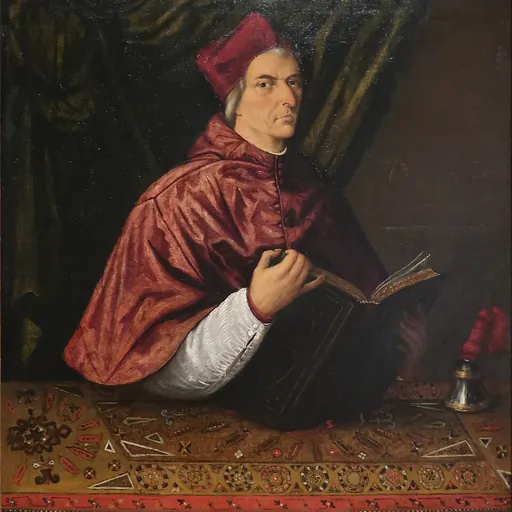
About Domenico Grimani
Lived 1461 – 1523 (aged 62). Domenico Grimani was an Italian catholic priest.
Domenico Grimani (22 February 1461 – 27 August 1523) was an Italian nobleman, theologian and cardinal. Like most noble churchmen of his era, Grimani was an ecclesiastical pluralist, holding numerous posts and benefices.
Biography Born in Venice, he was the eldest of five sons of Antonio Grimani, Doge of Venice from 1521 to 1523, and his wife Catarina Loredan.
He exhibited an early predilection for humanist studies, which was encouraged by teachers in his native Venice. Subsequently, in the ambit of the Medicean academy in Florence, he moved in the circle of Lorenzo de' Medici, among scholars like Pico della Mirandola and Poliziano. He obtained a doctorate in canon law at the University of Padua on 23 October 1487, and was elected a Senator of Venice that same year. Grimani was ordained a priest in 1498. In 1503, he became Cardinal priest of San Marco Evangelista al Campidoglio, Rome.
After a period as apostolic administrator in Nicosia, starting from 1497 he was Patriarch of Aquileia, a position he abandoned in favour of his nephew Marino (later also cardinal) in 1517. In 1508 he was named cardinal bishop of Albano, and was also the administrator of the diocese of Urbino (from 1514) and bishop of Ceneda (1517-1520). Grimani was already ill in the 1521 conclave, and died a year and a half later; he was buried in the church of Santi Giovanni e Paolo, Rome, but later his remains were moved to San Francesco della Vigna.
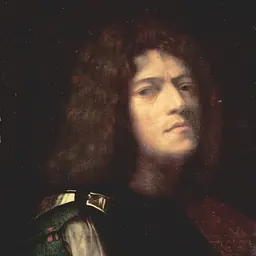
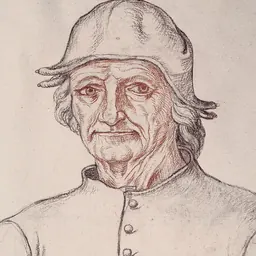
Legacy Grimani was a noted art collector, owning works by artists such as Leonardo da Vinci, Giorgione, Titian, Hans Memling, Hieronymus Bosch, Raphael and others: his collection now forms part of the Museo d'Antichità in the Doge's Palace in Venice, while several of his codexes are in the Archbishop's Library at Udine. The Grimani Breviary, now in the Biblioteca Marciana of Venice, is a key work in the late history of Flemish illuminated manuscripts. It was produced in Ghent and Bruges ca 1515-1520 and by 1520 owned, though possibly not originally commissioned, by Domenico Grimani. Several leading artists, including Simon Bening and Gerard David contributed some of their finest work to it.
The cardinal left his collection of Hebrew, Greek, and Latin manuscripts to the religious community at S. Antonio di Castello. Many ancient sculptures were found on land the family had purchased on the Quirinal Hill, once site of an ancient Roman bath and garden.
Grimani also wrote several theological treatises, and translated John Chrysostom's homilies.
Don’t just read it —
keep it.
Full-length biographies made to live with: read them, listen on the way to work, watch them tonight.
- E-book
- Audio
- Video
Instant download · yours to keep · every purchase keeps this site free
Important facts
People in Domenico Grimani's life
Named in this biography and alive at the same time



Related people
Same field, nearest in time



Contemporaries
People whose lives overlapped Domenico Grimani's



Frequently asked questions
Who was Domenico Grimani?
Catholic cardinal
When was Domenico Grimani born?
Domenico Grimani was born on 19 February 1461 in Venice.
When did Domenico Grimani die?
Domenico Grimani died on 27 August 1523 in Rome.
What was Domenico Grimani's occupation?
Domenico Grimani was a catholic priest.
What nationality was Domenico Grimani?
Domenico Grimani was Italian.
Sources & further reading
Cite this page
APA: Biography.guide. (2026). Domenico Grimani. https://biography.guide/domenico-grimani/
MLA: "Domenico Grimani." Biography.guide, https://biography.guide/domenico-grimani/.
Chicago: "Domenico Grimani." Biography.guide. https://biography.guide/domenico-grimani/.
Data last updated: 2026-09-20 · Spot an error? Report a correction.
Portrait: Wikimedia Commons · author & licence
Page generated 2026-09-27 04:57 UTC