
About Ding Shiue-ju
Lived 1913 – 2002 (aged 89). Ding Shiue-ju was a Taiwanese painter and art educator.
Ding Shiue-ju (; 3 March 1913 — 5 March 2002) was a painter and art educator born in Guoyang County, Anhui, China, and who lived many years in Taitung City, Taiwan. He was part of the first generation of Western-style painters in Taiwan's post-war period and a victim of the White Terror. During his younger years in China, he was highly active in the modernist watercolor circle. After moving to Taiwan, he turned to ink wash painting and pastels, becoming an iconic modernist painter of eastern Taiwan.
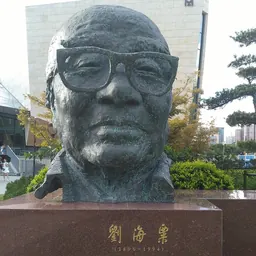
Life Early life Ding Shiue-ju was born in Guoyang County, Anhui, China. His education in art began at the age of nine. In 1932, he went to study at Shanghai School of Fine Arts (上海美術專科學校; today's Shanghai University Fine Arts College), where he learned watercolor painting and received guidance from college president Liu Haisu, watercolor instructor Wang Jiyuan, and drawing instructor Gong Bizheng (龔必正), all of whom were of the modernist school.
With the outbreak of the Battle of Shanghai in 1937 at the start of the Second Sino-Japanese War, Shanghai became embroiled in fighting, so Ding was forced to quit his studies, becoming relegated to Kuomintang-controlled areas and making a living by teaching. In 1940, he began studying at the Wuchang College of Art (武昌藝術專科學校; today's Hubei Institute of Fine Arts) in Chongqing, Sichuan, under the guidance of instructors Zhang Zhaoming (張肇銘) and Tang Yihe (唐一禾), where he studied ink wash painting, bamboo and wood sculpture, and music.
After graduating from the Wuchang Art School in 1941, he taught at Tongliang Middle School for Girls (銅梁女中) and Sichuan Leshan Normal School (四川樂山師範), during which time he frequently visited Mount Emei to paint scenery, and he also held exhibitions. Aesthetician Zhu Guangqian wrote a piece of calligraphy in praise of Ding's 1944 exhibition in Leshan. He also exhibit in the 3rd National Art Exhibition of Republic of China this year. In 1946, he traveled east along the Yangtze, painting the scenery of Tongliang, Rongchang, Leshan, and Chongqing while passing through. Upon arrival in Nanjing, he held a solo exhibition. The journey became a very important influence on his creativity. That same year, he returned to his home province of Anhui to teach, his pupils including accomplished Chinese-painting artist Wu Guoting (吳國亭). After being released, he began to teach at Li-Hsing Middle School (勵行中學), his notable pupils including well-known athlete Chi Cheng. During this time, he became close friends with painters Liu Chi-wei (劉其偉) and Read Lee. Since Ding was not a member of any art societies or organizations, these two friends became his main points of connection with the painting circle after he left Taipei. Ding retired from Tung Hai Junior High in 1980.
In 1984, at the recommendation of Liu Chi-wei and Read Lee, Ding was awarded the Art Society of China (中華民國畫學會)'s Golden Goblet Award (金爵獎). In 1986, one of his students gave him a box of pastels, giving Ding the opportunity to start using this medium to sketch scenery on site in Taitung. This led to him creating a great number of pastel sketches of Taitung's landscape.
In 1998, his son applied for compensation from the government for Ding's wrongful political imprisonment, and in 2001, the Taiwanese government awarded him NT$2 million based on the Compensation Act for Wrongful Trials on Charges of Sedition and Espionage during the Martial Law Period.
In 2001, he held a solo exhibition at the National Sun Yat-sen Memorial Hall. He died at the age of 90 in his home in March the following year. Watercolors make up the bulk of his early work, though he occasionally did ink wash paintings too. In his later years, health problems made watercolor painting difficult, so he shifted to ink wash paintings and pastels. Many of his watercolors were done while he was in China, most being of places along the Yangtze and Sichuan. The style and color are celebrated for their fullness, much like that of fauvism.
Ink wash Ding highly respected the "bone method" (one of Xie He's "Six Principles of Chinese Painting," which emphasizes that when lines comply with the regularity of nature, they create a vivid sense). Many of his later ink wash paintings consisted merely of lines and few details. Influenced by his teacher Liu Haisu, Ding used color in place of black or gray washes in his landscapes and imitated Western painting by adding any text (including his signature) in deep red in a way that incorporates them into the painting. He excelled at using Western composition techniques in his landscapes to create the effect of viewing the subject from overhead. In negative spaces, he would write short passages, expressions of his feelings. Liu Haisu wrote this on a piece of calligraphy entitled Spiritual Resonance and Vitality, which he gave to Ding as a gift: "In the style and composition of the watercolors of my student Ding Shiue-ju, there are neither too many nor too few lines. The style is full of inflections, subtle, beautiful, and one-of-a-kind, which is why his work is unparalleled by anyone else's."
Awards 1985 Golden Goblet Award for watercolor from the Art Society of China 1998 Bronze Arts and Business Award from the Council for Cultural Affairs
Don’t just read it —
keep it.
Full-length biographies made to live with: read them, listen on the way to work, watch them tonight.
- E-book
- Audio
- Video
Instant download · yours to keep · every purchase keeps this site free
Important facts
People in Ding Shiue-ju's life
Named in this biography and alive at the same time







Related people
Same field, nearest in time

Contemporaries
People whose lives overlapped Ding Shiue-ju's



Frequently asked questions
Who was Ding Shiue-ju?
Taiwanese artist
When was Ding Shiue-ju born?
Ding Shiue-ju was born on 3 March 1913 in Guoyang County.
When did Ding Shiue-ju die?
Ding Shiue-ju died on 5 March 2002.
What was Ding Shiue-ju's occupation?
Ding Shiue-ju was a painter and art educator.
What nationality was Ding Shiue-ju?
Ding Shiue-ju was Taiwanese.
Sources & further reading
Cite this page
APA: Biography.guide. (2026). Ding Shiue-ju. https://biography.guide/ding-shiue-ju/
MLA: "Ding Shiue-ju." Biography.guide, https://biography.guide/ding-shiue-ju/.
Chicago: "Ding Shiue-ju." Biography.guide. https://biography.guide/ding-shiue-ju/.
Data last updated: 2026-09-20 · Spot an error? Report a correction.
Page generated 2026-09-27 05:05 UTC