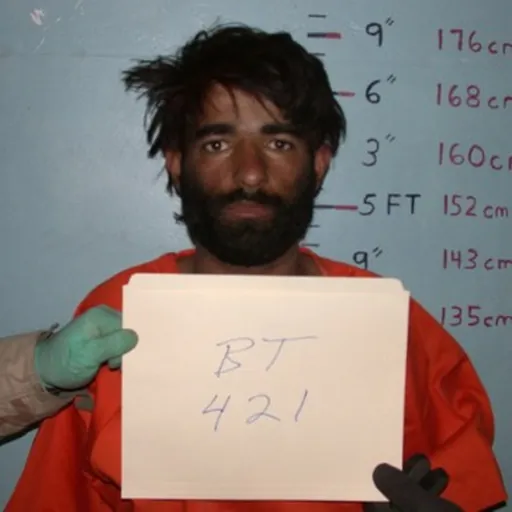
Dilawar
Afghan torture victim
About Dilawar
Lived 1979 – 2002 (aged 22). Dilawar was an Afghan chauffeur.
Dilawar (; born – 10 December 2002), also known as Dilawar of Yakubi, was an Afghan farmer and taxi driver who was tortured to death by US Army soldiers at the Parwan Detention Facility, which was at the time a US military detention center referred to as the “Parwan Collection Point,” in Afghanistan.
He arrived at the prison on 5 December 2002, and was declared dead five days later. His death was declared a homicide and was the subject of a major investigation by the US Army of abuses at the prison. It was prosecuted in the Bagram torture and prisoner abuse trials and no one was found guilty. The Academy award-winning documentary Taxi to the Dark Side (2007) focuses on the killing of Dilawar.
Background Dilawar was born to a Pashtun family native to Yakubi in the Khost Province of Afghanistan. Dilawar and his nine siblings were born in nearby Pakistan, where his parents had fled due to the Soviet–Afghan War. They earned a living through manual labor, with Dilawar's eldest brother Shapoor sending back money he earned as a migrant worker in Dubai's taxi and hotel industry. The family returned to Khost in 1996 following the establishment of the first Islamic Emirate of Afghanistan, purchasing a plot of land in Yakubi to grow corn, grain and peanuts. At age 17, Dilawar married in Khost and had a daughter. He subsequently worked as a goat shepherd for the livestock trading business of his brother Shapoor during the day and during the evenings, he collected rock from the nearby mountains to sell as building material.
Standing at and weighing , Dilawar was noted as having a weak physical constitution and did not leave the vicinity of his home since he was unable to grow a full beard in accordance with Taliban rules. In late 2002, Dilawar received a Toyota Corolla as a belated wedding gift from his brother Shapoor, who hoped that this would help Dilawar pursue less strenuous work. Dilawar had been a taxi driver for only a few weeks before his death.
Arrest On 1 December 2002, on Eid al-Fitr, Dilawar set off from Yakubi in his taxi. His mother had asked Dilawar to bring his three sisters back for a family dinner from their husbands' homes in nearby villages. As the car did not have enough fuel, Dilawar first set out for Khost city to earn a taxi fare to refill his gas tank. In Khost, Dilawar picked up three passengers: laborer Parkhudin, farmer Zakim Khan and baker Abdul Rahim, who were headed for Yakubi to join their families for Eid al-Fitr. The various accounts of torture Dilawar suffered have been detailed as follows: A black hood pulled over his head limiting his ability to breathe Knee strikes to the abdomen Over 100 peroneal strikes (a nerve behind the kneecap) Shoved against a wall Pulled by his beard His bare feet stepped on Kicks to the groin Chained to the ceiling for extended hours, depriving him of sleep Slammed his chest into a table front On his first day at Bagram, Dilawar was awoken by being splashed with cold water, with the ventilation turned on to let frigid air in from outside to induce a stronger freezing sensation. He and other prisoners were then chained to the ceiling of his cell, and suspended by his wrists, and only periodically released from this position for interrogation. His arms became dislocated from their sockets, and flapped around limply whenever guards lowered him from the ceiling.
In March 2004, Dilawar's passengers, Parkhudin, Zakim Khan and Abdul Rahim, who had all experienced similar mistreatment, were flown to the Guantanamo Bay detention camps at the US base in Cuba.
Leaked internal United States Army documentation in the form of a death certificate dated 12 December 2002, ruled that his death was due to a direct result of assaults and attacks he sustained at the hands of interrogators of the 519th Military Intelligence Battalion during his stay at Bagram. The document was signed by Lt. Col. Elizabeth A. Rouse of the U.S. Air Force, a pathologist with the Armed Forces Institute of Pathology in Washington DC, and listed as its finding that the "mode of death" was "homicide," and not "natural," "accident" or "suicide" and that the cause of death was "blunt-force injuries to lower extremities complicating coronary artery disease".
A subsequent autopsy revealed that his legs had been "pulpified," and that even if Dilawar had survived, it would have been necessary to amputate his legs.
According to the death certificate shown in the documentary Taxi to the Dark Side, the box marked homicide had been checked as the ultimate cause of death. However, the military had so far publicly claimed that Dilawar had died from natural causes. It was only by accident that the death certificate was leaked when New York Times reporter Carlotta Gall managed to track down Dilawar's family in Yakubi. Dilawar's body was only repatriated to Yakubi after a government worker made contact with his uncles and arranged for return.
Culpability
In August 2005, lead interrogator Specialist Glendale C. Walls of the U.S. Army pleaded guilty at a military court to pushing Dilawar against a wall and doing nothing to prevent other soldiers from abusing him. Walls was subsequently sentenced to two months in a military prison. Two other soldiers convicted in connection with the case escaped custodial sentences. The sentences were criticized by Human Rights Watch.
In March 2006, the CBS News program, "60 Minutes" investigated the deaths of two Afghan prisoners, including Dilawar, revealing that authorization for the abuse came from the "very top of the United States government". 60 Minutes correspondent Scott Pelley interviewed retired Army Colonel Lawrence Wilkerson, who was appointed chief of staff by Secretary of State Colin Powell in 2002, during George W. Bush's first administration. Willie V. Brand, one of the soldiers convicted of assault and maiming in the deaths of the two prisoners, and Brand's commanding officer, Capt. Christopher Beiring, were also featured in the program. Wilkerson told "60 Minutes" that he could "smell" a cover-up and was asked by Powell to investigate how American soldiers had come to use torture and stated; "I was developing the picture as to how this all got started in the first place, and that alarmed me as much as the abuse itself because it looked like authorization for the abuse went to the very top of the United States government". Brand and Beiring confirmed that several of their leaders had witnessed and knew about the abuse and torture of the prisoners.
Beiring and Brand showed no remorse when recounting the torture. Beiring was charged with dereliction of duty, a charge that was later dropped. Brand was convicted at his court martial, but rather than the 16 years in prison he was facing from the charges brought against him, he was given a reduction in rank.
2007 inquiry in civil court
In July 2007, a federal grand jury opened a civil inquiry into the Bagram abuse. Alicia A. Caldwell, writing in the Huffington Post, quoted a former military defense lawyer, named Michael Waddington, who said:
Duane M. Grubb, Darin Broady, Christopher Greatorex and Christopher Beiring, four of the soldiers who served at the center at the time of the deaths, acknowledge that they had been called before the grand jury. They were reported to have waived immunity.
Don’t just read it —
keep it.
Full-length biographies made to live with: read them, listen on the way to work, watch them tonight.
- E-book
- Audio
- Video
Instant download · yours to keep · every purchase keeps this site free
Important facts
People in Dilawar's life
Named in this biography and alive at the same time






Related people
Same field, nearest in time





Contemporaries
People whose lives overlapped Dilawar's


Frequently asked questions
Who was Dilawar?
Afghan torture victim (1979-2002)
When was Dilawar born?
Dilawar was born on 11 December 1979 in Khost Province.
When did Dilawar die?
Dilawar died on 10 December 2002 in Parwan Detention Facility.
What was Dilawar's occupation?
Dilawar was a chauffeur.
What nationality was Dilawar?
Dilawar was Afghan.
Sources & further reading
Cite this page
APA: Biography.guide. (2026). Dilawar. https://biography.guide/dilawar/
MLA: "Dilawar." Biography.guide, https://biography.guide/dilawar/.
Chicago: "Dilawar." Biography.guide. https://biography.guide/dilawar/.
Data last updated: 2026-09-20 · Spot an error? Report a correction.
Portrait: Wikimedia Commons · author & licence
Page generated 2026-09-27 04:57 UTC