
About Digby Tatham-Warter
Lived 1917 – 1993 (aged 75). Digby Tatham-Warter was a British military personnel.
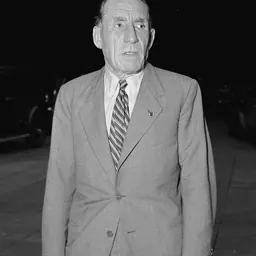
Major Allison Digby Tatham-Warter, (21 May 1917 – 21 March 1993), also known as Digby Tatham-Warter or just Digby, was a British Army officer who fought in the Second World War and was famed for wearing a bowler hat and carrying an umbrella into battle.
Early life Digby was born in Atcham, Shropshire, on 21 May 1917. He was the second son of Henry de Grey Tatham-Warter, a landowner with several estates in the southwest of England. Digby's father fought in the First World War with the Artists Rifles; he was gassed in the trenches, and later died when Digby was 11. Digby was educated at Wellington College, Berkshire.
Early military career In 1935 he was accepted into the Royal Military College, Sandhurst. Digby passed out of Sandhurst on 21 January 1937 and was commissioned as a second lieutenant into the Unattached List for the British Indian Army with a view to joining the Indian Army due to his family connections. He was attached to the 2nd Battalion, Oxfordshire and Buckinghamshire Light Infantry, then serving in India, from 13 March 1937, and subsequently transferred to that regiment 27 April 1938 (never joining the Indian Army) so that he would be able to continue his hobbies of tiger hunting and pig sticking.
Second World War When the Second World War broke out, Digby was not initially sent to fight in Europe. His sister Kit served in the Western Desert Campaign and was awarded the French Croix de guerre while serving with the Hadfield-Spears Unit. Upon hearing of his brother John's death at the Second Battle of El Alamein in late 1942 with the 2nd Dragoon Guards, The Queen's Bays, Digby volunteered for the airborne forces and transferred to the Parachute Regiment. He was appointed as the company commander of A Company of the 2nd Parachute Battalion, part of the 1st Parachute Brigade of the 1st Airborne Division. He was stationed in Grantham, Lincolnshire, during training. His tiger hunting exploits were well known, and his reputation was enhanced as he was able to obtain the use of an American Dakota aeroplane in which he flew all the company officers in the camp to London for a party at the Ritz.
A Company was dropped away from the target of Arnhem Bridge and had to go through Arnhem, where the streets were blocked by German forces. Digby led his men through the back gardens of nearby houses instead of attempting to advance through the streets and thus avoided the Germans. Digby was later injured by shrapnel, which also cut open the rear of his trousers, but continued to fight until A Company had run out of ammunition. Despite the radios being unreliable as Digby had predicted and the bugle calls being used most in the battle, the message "out of ammo, God save The King" was radioed out before Digby was captured.
Because of his injury, Digby was sent to St Elizabeth's Hospital but escaped out of a window with his second-in-command, Captain Tony Frank, when the German nurses left them alone. After creating an escape compass from buttons on his uniform, Digby and Frank headed towards Mariendaal. Upon arriving, they were hidden by a Dutch woman who spoke no English, before being put in contact with her neighbour. He disguised them as painters and moved them to Derk Wildeboer's house. Wildeboer was a local leader of the Dutch Resistance in Ede. They then met Menno de Nooy of the Dutch Resistance, who gave them a bicycle. Wildeboer had a fake Dutch identity card made for Digby to allow him to pose as Peter Jansen, the deaf-mute son of a lawyer.
Later life After the war ended, Digby served in British-controlled Mandatory Palestine before being appointed to the 5th King's African Rifles in British Kenya in 1946, where he also bought two estates in Eburru and Nanyuki. and granddaughter of Arthur George Egerton, 5th Earl of Wilton, and they had three daughters and several grandchildren. Their daughter Belinda Rose Tatham-Warter (born 1954) married in Nanyuki German aristocrat Friedrich von Oldenburg, great-grandson of Frederick Augustus II, last ruling Grand Duke of Oldenburg. Digby died in Nanyuki on 21 March 1993.
Don’t just read it —
keep it.
Full-length biographies made to live with: read them, listen on the way to work, watch them tonight.
- E-book
- Audio
- Video
Instant download · yours to keep · every purchase keeps this site free
Important facts
People in Digby Tatham-Warter's life
Named in this biography and alive at the same time





Related people
Same field, nearest in time



Contemporaries
People whose lives overlapped Digby Tatham-Warter's


Frequently asked questions
Who was Digby Tatham-Warter?
British military personnel
When was Digby Tatham-Warter born?
Digby Tatham-Warter was born on 21 May 1917 in Atcham.
When did Digby Tatham-Warter die?
Digby Tatham-Warter died on 21 March 1993 in Nanyuki.
What was Digby Tatham-Warter's occupation?
Digby Tatham-Warter was a military personnel.
What nationality was Digby Tatham-Warter?
Digby Tatham-Warter was British.
Sources & further reading
· Wikipedia: Digby Tatham-Warter
· DBpedia: Digby Tatham-Warter
Cite this page
APA: Biography.guide. (2026). Digby Tatham-Warter. https://biography.guide/digby-tatham-warter/
MLA: "Digby Tatham-Warter." Biography.guide, https://biography.guide/digby-tatham-warter/.
Chicago: "Digby Tatham-Warter." Biography.guide. https://biography.guide/digby-tatham-warter/.
Data last updated: 2026-09-20 · Spot an error? Report a correction.
Page generated 2026-09-27 05:23 UTC