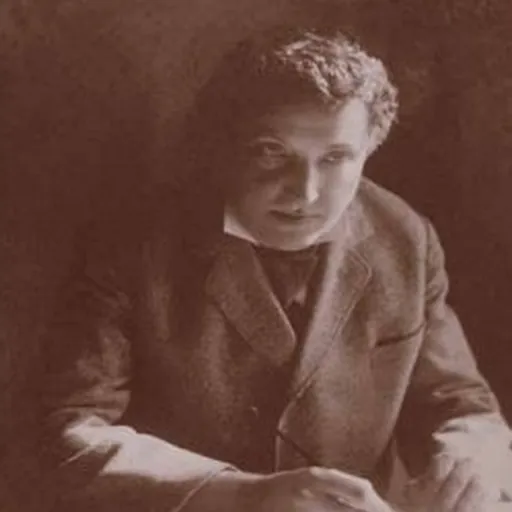
About Dezső Szabó
Lived 1879 – 1945 (aged 65). Dezső Szabó was a Hungarian writer, journalist and opinion journalist.
Dezső Szabó (June 10, 1879, in Kolozsvár, Austria-Hungary (present-day Cluj-Napoca, Romania) – January 5, 1945, in Budapest) was a Hungarian linguist, writer, noted mainly for his three-volume novel "Az elsodort falu" ("The Eroded Village") and his pamphlets. Szabó's oeuvre is contradictory, some consider it as the peak of Hungarian expressionist prose, others call it one of the first "pioneers of Magyar populist literature". He was a Nobel Prize nominee in 1935. He is also known for his antisemitic views.
Szabó came to live in Budapest in 1918 and started publishing short essays in the literary revue Nyugat which was the leading newspaper of Hungary's intellectuals. He had a great success with his pamphlet criticizing István Tisza, the liberal-conservative prime minister of Hungary. Due to this writing he became one of the leading figures of Hungarian progressive intellectuals.
Initially he supported the Hungarian Revolution of 1918. Arthur Koestler, at the time a high school pupil in Budapest, recalls Szabó as one of the new teachers brought to his school by the revolutionary regime – "A shy, soft spoken, somewhat absent-minded man, he told us of a subject more faraway than the Moon: the daily life of hired agricultural workers in the countryside"
Support for the revolution was, however, a brief interlude in Szabó's life, and he soon developed into an outspoken and vehement opponent of the short-lived Hungarian Soviet Republic proclaimed by Béla Kun. He proclaimed to attack not the revolution itself, which was according to him unnecessary, but the "corruption of the revolution".
He was quick to become a well-known and highly influential and energetic writer, gaining fame for his 1919 "Az elsodort falu" ("The Eroded Village"), an expressionist work espousing the idea that hope for a Hungarian renaissance lay in the peasant class, as opposed to the middle class which Szabó believed was "corrupted by the mentalities of the assimilated Germans and Jews". Though he published many later books, this was considered as the peak of his literary achievements. Although the views of the novel is considered later unrealistic, stylistically it is still remarkable.
Historian Joseph Varga wrote: "Szabo passionately represented the idea that the unique characteristics of the Magyar race and its national uniqueness could only be ensured through the Magyar peasantry. To him, the people were the peasants, its best characteristics and virtues were embodied in the peasantry, a significant improvement in the financial and cultural status of the Magyar peasantry was an historical necessity, in the interest of the entire nation [since] the peasantry was the sole social segment that remained true to Hungary’s Christian and national traditions through the revolutions of 1918 and 1919".
Szabó has been considered the first "intellectual anti-Semite among Hungarian writers", Apologists for the writer note that in "The Eroded Village" Miklós (a key figure of this main work) says to an old Jewish friend: "If you should know that all my anger comes out from that I know that we depend on each other, because I love you". In an other book he also wrote "I consider the honest Hungarian-Jew cooperation as a must for the two races and the foundation of a more human future".
At the same time Szabó was also vehemently anti-German, embarking in 1923 on a "Campaign to eradicate German influence in Hungary". After 1932 he was also outspokenly opposed to the Arrow Cross Party, the Hungarists—without abandoning his antisemitic views. This combination of views was due to his own specific brand of racism, which Szabó termed "The Apotheosis of the Hungarian Race".
Szabó died in January 1945, during the siege of Budapest by the Soviet Army.
Works Az Elsodort Falu (1918) Csodálatos élet (1920) Jaj! (1925) Feltámadás Makucskán´ (1925) Karácsony Kolozsvárt (1931)
Don’t just read it —
keep it.
Full-length biographies made to live with: read them, listen on the way to work, watch them tonight.
- E-book
- Audio
- Video
Instant download · yours to keep · every purchase keeps this site free
Important facts
People in Dezső Szabó's life
Named in this biography and alive at the same time



Related people
Same field, nearest in time



Contemporaries
People whose lives overlapped Dezső Szabó's





Frequently asked questions
Who was Dezső Szabó?
Hungarian writer (1879–1945)
When was Dezső Szabó born?
Dezső Szabó was born on 10 June 1879 in Cluj-Napoca.
When did Dezső Szabó die?
Dezső Szabó died on 13 January 1945 in Budapest.
What was Dezső Szabó's occupation?
Dezső Szabó was a writer, journalist and opinion journalist.
What nationality was Dezső Szabó?
Dezső Szabó was Hungarian.
Sources & further reading
· DBpedia: Dezső Szabó (writer)
Cite this page
APA: Biography.guide. (2026). Dezső Szabó. https://biography.guide/dezso-szabo-writer/
MLA: "Dezső Szabó." Biography.guide, https://biography.guide/dezso-szabo-writer/.
Chicago: "Dezső Szabó." Biography.guide. https://biography.guide/dezso-szabo-writer/.
Data last updated: 2026-09-23 · Spot an error? Report a correction.
Portrait: Wikimedia Commons · author & licence
Page generated 2026-09-27 05:06 UTC