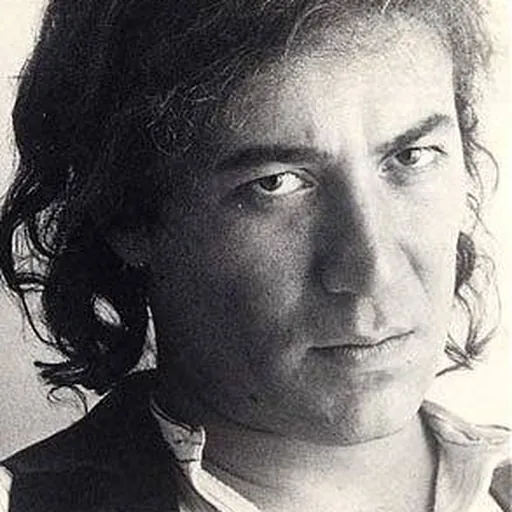
About Demetrio Stratos
Lived 1945 – 1979 (aged 34). Demetrio Stratos was an Egyptian and Italian singer, musicologist, composer, ethnomusicologist, jazz musician and songwriter.
Efstratios Dimitriou (; 22 April 1945 – 13 June 1979), known professionally as Demetrio Stratos, was a Greek-Italian vocalist, songwriter, multi-instrumentalist and music researcher, best known as the co-founder, frontman and lead singer of the Italian progressive rock band Area – International POPular Group.
Born and raised in Alexandria, Egypt, of Greek parents, he studied piano and accordion at the "National Conservatoire". In 1957 he was sent to Nicosia, Cyprus, and, at the age of 17, moved to Milan, Italy, to attend the Politecnico di Milano University at the Architecture Faculty, where he formed his first musical group. In 1967, Demetrio Stratos joined the Italian beat band I Ribelli, and in 1972, founded Area.
Stratos recorded many records, and toured festivals in Italy, France, Portugal, Switzerland, Netherlands, Cuba, and the United States with Area, as well as a solo artist and in collaboration with other artists. He worked with Mogol, Lucio Battisti, Gianni Sassi, Gianni Emilio Simonetti, Juan Hidalgo, Walter Marchetti, John Cage, Tran Quang Hai, Merce Cunningham, Jasper Johns, Andy Warhol, Grete Sultan, Paul Zukofsky, Nanni Balestrini, Claude Royet-Journoud, and Antonio Porta.
Stratos studied ethnomusicology, vocal extensions, Asian music chant, compared musicology, the problem of ethnic vocality, psychoanalysis, the relationship between spoken language and the psyche, the limits of the spoken language. He was able to reach 7,000 Hz, and to perform diplophony, triplophony, and also quadrophony. Daniel Charles has described him as the person who decimated monody by the demultiplication of the acoustic spectrum. His vocal abilities were explored and documented.
Stratos died in New York City Memorial Hospital on 13 June 1979 at the age of 34. His self-proclaimed mission was to free vocal expression from what he considered to be the slavery of language and classical lyrical melody. He considered the exploration of vocal potential as a tool of psychological and political liberation. His studies and recognition of the voice as musical instrument carried this ethos to the edge of human vocal ability. His work is considered by many critics and vocalists as important in the progression of experimental and novel vocal techniques.
Biography
The early years, 1945–1971 Demetrio Stratos was born as Efstratios Demetriou in Alexandria, Egypt, on 22 April 1945 to Greek parents Janis Demetriou and Athanassia Archondoyorghi. He spent his first 13 years in Alexandria where he studied piano and accordion at the prestigious Conservatoire National d'Athènes ("National Conservatoire of Athens"),
In 1962, he and his family moved to Milan, Italy where he attended the Politecnico di Milano University at the Architecture Faculty. In 1963 he formed his first musical group and performed live at the "Casa dello studente" ("Student's House") Festival in Milan, then in some of the local pubs such as the Santa Tecla and the Intra's al Corso. Fortuitously, the original singer of the group was unable to sing one night due to a minor car accident, so Stratos stepped in to replace him, which began his venture into singing. In 1969, the band released their self-titled studio album, I Ribelli. His interest in this research started when he observed his daughter, Anastassia (who was born in 1970), during her "babbling" phase, when a child is not yet able to speak correctly. Stratos noticed by watching his daughter that a child initially "plays" and "experiments" with her or his own voice, but then the richness of the vocal sound gets lost in the acquisition of verbal language. "The child loses the sound in order to organize the words". This observation by Stratos was fundamental for his poetry. This language-voice connection and his experimentation with it was the hallmark of his entire artistic career.
Area, 1972–1978
In 1972, Demetrio Stratos and drummer Giulio Capiozzo founded Area, an Italian progressive rock, jazz fusion band. The original line-up included Eddie Busnello (saxophone), Patrick Djivas (bass), Leandro Gaetano (piano) and Johnny Lambizzi (lead guitar). Soon after, Busnello and Djivas left the group, and Patrizio Fariselli and Paolo Tofani joined the group. Djivas joined Premiata Forneria Marconi (PFM), and he was replaced by Ares Tavolazzi. Stratos recorded many records with Area, as well as in collaboration with Gianni Sassi, the owner of Cramps Records, on solo artist albums.
In 1973, Stratos took part in the eighth Biennale de Paris, and Area released their first studio album, Arbeit macht frei ("Work Brings Freedom"), taken from the inscription that was on the gate at the entrance of Auschwitz Nazi concentration camp. founders of the group Zaj (an experimental music and performance art group formed in 1959), in the context of the Fluxus experience (an international network of artists, composers and designers noted for blending different artistic media and disciplines), and he then became involved with John Cage's music when he recorded Cage's "Sixty-Two Mesostics Re Merce Cunningham" in a version for a solo voice and microphone,
In 1976, Stratos released his first studio album as a solo artist, Metrodora, which was the result of his vocal studies and research. Its title and the single lyric that was included were inspired by Metrodora, a Byzantine woman physician of the 6th century. ("Institute of Glottology and Phonetics") at the University of Padua, in Italy, formulating his own and true "pedagogy of the voice". In Padua, he worked together with Ferrero and Lucio Croatto from the Centro Medico di Foniatria ("Medical Centre of Phoniatrics"), on research related to language and vocal techniques. Stratos underlined the link between language and the psyche, and he highlighted the connection between them with the sounds made by his own vocal cords, which he considered to be a musical instrument. a study that produced two scientific publications. He also found the time to do some live performances at the "Arsenale" Theater and at the Marconi's Gallery in Milan.
Albert Hera asked Tran Quang Hai in an interview, "What do you think about Demetrio Stratos?" Tran Quang Hai answered:
Area live in Castelmassa (Rovigo), Italy, August 1978 In 1978, Area left Cramps Records and moved to Ascolto, a record label owned by CGD. For Ascolto, they released their sixth studio album, 1978 Gli dei se ne vanno, gli arrabbiati restano!, the last one that included Demetrio Stratos. In the meantime, Stratos continued with Cramps and Gianni Sassi as a solo artist, releasing Cantare la Voce.
On 2 June, Stratos was in Bologna for the second International Week of the Performance. On 4 July, he was on stage with Grete Sultan and Paul Zukofsky for a John Cage concert at the Margherita theatre in Genoa. In February, he was in Paris to perform the Antonin Artaud character in a theatrical review organized by France Culture. is at the Cemetery of Scipione Castello , a little village that is a fraction of Salsomaggiore Terme, a town in northern Italy, which is located in the province of Parma, in the Emilia-Romagna region. Every year since 2000, Scipione Castello organizes a musical festival in memory of Demetrio Stratos.
In 2002, the Italian progressive rock band Picchio dal Pozzo discovered the tape recordings made in 1979 by the band with Stratos performing at the IPPAI Theatre (Institute for Youth's Protection and Assistance) in Genoa, Italy. Stratos' performances were featured on Picchio dal Pozzo's 2004 album, Pic_nic @ Valdapozzo, whose songs are built around Stratos' voice. The effect is particularly striking on the song "Epitaffio", in which Stratos creates a sweet melody with his "Flautofonie" technique, while a subtle beat, harmony and night sounds are provided very gently as not to shadow the voice.
The "Demetrio Stratos" International Prize for experimental music, established in 2005 and promoted by his wife Daniela Ronconi Demetriou, Area's member Patrizio Fariselli, Claudio Chianura, Walter Prati and Gerd Rische, awards emerging musicians and new projects for music experimentation, and career achievements in experimental music. The award for the emerging artist best project has been assigned to Romina Daniele in 2005. The Career Awards have been received by Diamanda Galás in 2005, Meredith Monk in 2007, Fred Frith in 2008, Fátima Miranda in 2009, and Joan La Barbara in 2011.
La voce Stratos ("The Voice Stratos") is a book and a documentary on the life and career of Demetrio Stratos released in 2009 and directed by Luciano D'Onofrio and Monica Affatato, and with the collaboration of Stratos' wife Daniela Ronconi Demetriou. It includes over thirty interviews with Stratos' collaborators, musicians, artists and phonetics researchers, as well as photos, videos, and previously unseen footage. The second edition of Suonare la voce: tributo a Demetrio Stratos ("Playing the Voice: Tribute to Demetrio Stratos") was held in Genoa in the same year. The two days of seminars and concerts culminated with a performance by Spanish artist Fátima Miranda.
On 25 August 2009 in Siena, the remaining Area members, Patrizio Fariselli, Ares Tavolazzi, and Paolo Tofani together with Capiozzo's son, Christian on drums, and Mauro Pagani on vocals and violin reunited for the first time in over a decade during the ninth edition of the festival La Città Aromatica ("The Aromaric City"), dedicated to Demetrio Stratos thirty years after his death. On 29 and 30 January 2010, there was another tribute to Stratos and another reunion of Area with UT Gandhi (Umberto Trombetta) on drums. They played at the San Lazzaro di Savena (Bologna) theatre as part of StratosFerico: Omaggio a Demetrio Stratos ("StratosPheric: Tribute to Demetrio Stratos").
Demetrio Stratos' life perfectly incarnates the spirit of the '70s. He, literally, wanted individuals and social groups to find their own voice.
Besides the official Area discography, for which Stratos is remembered, it is important to remember his solo works, a massive set of productions full of experimentation and vocal research. His study of the voice used as a musical instrument carried him to reach for the limits of human capabilities. Stratos was able to reach 7,000 Hz, when a tenor normally reaches 523 Hz and a woman soprano 1,046 Hz (C6). He would hold notes for long periods of time, modulate them vibrato-like, and leap and dive from low to high and back again, with pinpoint accuracy. Using various overtone singing and other extended techniques, he was able to perform diplophony, triplophony, and also quadrophony, the ability to produce two, three, and even four sounds simultaneously (multiphonic) using only the human voice as the musical instrument. In collaboration with the CNR of Padua, he has released many studies in ethnomusicology, vocal extensions and Asian music chant. the voice tends to be declined plurally, it whispers, it moans, it imitates, it becomes diplophonia and triplophonia. It is a polyphonic vocalism without a subject, androgynous, where both genders, masculine and feminine, coexist.
Stratos sings the voice, mere appearance, pharmakon, poisonous, and curative, without anything else except the voice, a pure ludic act, only voice as voice itself. "By this way the subversive sovereignty of the voice as an event, pharmakon communication challenge leaves the subject somewhere between unconditioned enjoyment and consumption."
The praise of the voice signifier supports an epistemology of the perception, it states "the error of Descartes" who reduced reason to conceptual word. It's in line with the "Praktognosia" (practical knowledge) of Maurice Merleau-Ponty, which sets the starting pointing the sensible perceptions of our bodies. there are two not harmonic voices that cause to the listener a state of trance, similar to the trance during the religious rites, and a sense of estrange. So, the Stratos' voice-music is a sort of lay rite that produces to the listeners the ability to reach their primordial origin.
"The Stratos' flute-voice plays a circular theme, a modal inspiration that brings us filler to an experience of communion, ritual interaction and sacrifices. That repetition suggests something of hypnotic that should be propitious to the trance state. Stratos seems to wish a participated, spontaneous and also generous listening. Through these, always different, repetitions, he aimed to abolish, to dissolute, to dissolve the "ego", as the basic element for the sacrifice. In this dissolution of the identity we (the group of listeners) are in communion with gods (divinities), Earth and life." — Janete El Haouli (translated from Spanish to Italian to English)
In the years of the desecration and secularization of the Christianity, Stratos proposed a new lay sacredness, in the name of the ancient Greeks, a return to the true rituality. The binomial voice-music had forgotten that rituality because in today's world it is only used to propose human's thoughts, ideas, and ideologies rather than the sacred experiences of the intimate communion between humans and the nature that surrounds us.
The search of the triplophonies and quadriphonies is used by Tibetan's monks and some knights of Mongolia. "It is a ritual use of the voice", wrote Stratos, and this purpose is maintained in his works. There are four ritual elements: the repetition, the escape from the ordinary, the loss of the ego, and the communitarian dimension. Perhaps, reading Gilles Deleuze, Stratos had been convinced that the repetition was not the ill-famed co-action to repeat the obsessive neurosis, but it should become a technique to escape from the ordinary, from the temporary flux, to access to another order of truth. Therefore, the trance with the abolition of the ego and the known world increased the horizon on other worlds. The result was a collective scene, an estranging and mystic performance at the same time.
In Stratos' works, we can find the standard-bearer of the lay rituals in the rock mega-concerts, where the audience is not exhausted by the spectacular of the mimetic model of the super star, but in the nearly to religious fruition of the voice-music that allows to feel us in the scene the ice cold shiver chilling of our belongings to life.
Albums YearAlbumAdditional information1968 I RibelliAlbum by I Ribelli.1972RadiusAlbum by Alberto Radius. Demetrio Stratos features on track A2. "To the Moon I'm Going" – 7:28.1974Nova Musicha N. 1Album by John Cage. Demetrio Stratos features on track B3. "Demetrio Stratos – Sixty–Two Mesostics Re Merce Cunningham (Frammenti)" – 9:00. Originally released in vinyl LP format and published in Italy by Cramps, CRSLP 6101; re–released in 2007 in CD Sized Album Replica, Gatefold, Limited Edition format and published in Japan by Strange Days, POCE–1205.1976MetrodoraOriginally released in vinyl LP format and published in Italy by Cramps, CRSLP 6205; re-released in 2007 in CD Sized Album Replica, Limited Edition format and published in Japan by Strange Days, POCE-1197.
Track listing
Side one "Segmenti Uno" – 3:36 "Segmenti Due" – 4:04 "Segmenti Tre" – 4:01 "Segmenti Quattro" – 4:31
Side two "Mirologhi 1 (Lamento d'Epiro)" – 4:23 "Metrodora" – 8:55 "Mirologhi 2 (Lamento d'Epiro)" – 4:101976Cantata Rossa per Taal al ZaatarAlbum by Gaetano Liguori, Giulio Stocchi and Demetrio Stratos, featuring Concetta Busacca, Pasquale Liguori and Roberto Del Piano. Originally released in vinyl LP format.1978Futura: Poesia SonoraAntologia storico critica della poesia sonora ("Critical-historical anthology of sound poetry"). Sound poems, many of them performed by their authors. Edited by Arrigo Lora-Totino; introduction by Renato Barilli. Demetrio Stratos features on disc 7, track A2. "O Tzitziras o Mitziras" – 4:01 Originally released in vinyl LP format and published in Italy by Cramps, 5204-001; re–released in 1989 in CD format and published in Italy by Cramps, CRSCD 091-095.1978Cantare la voceOriginally released in vinyl LP format and published in Italy by Cramps, 520.6119.
Track listing
Side one "Investigazioni (Diplofonie e Triplofonie)" – 14:41 "Passaggi 1,2" – 5:16
Side two "Criptomelodie Infantili" – 6:23 "Flautofonie ed Altro" – 6:17 "Le Sirene" – 6:191978Mauro PaganiAscolto. "L'albero di canto" "L'albero di canto II"1979Le MilleunaText written by Nanni Balestrini. Originally released in vinyl LP format and published in Italy by Cramps, 7243 8 57442 2 8; re-released in 1990 in CD format and published in Italy by Cramps, CRSCD 034; re-released in 2007 in CD Sized Album Replica, Limited Edition format and published in Japan by Strange Days, POCE-1170.
Track listing "Le Milleuna" – 63:131979CarnascialiaPolygram. "Canzone numero uno (c'è chi batte i denti, chi prende il ritmo e ci balla sopra)" (Pasquale Minieri, Piero Brega) "Fiocchi di neve e bruscolini" (Antonio Vivaldi, Demetrio Stratos) "Almeisan" (Minieri) "Kaitain (22 ottobre 1962)" (Vivaldi, Minieri, Stratos, Maurizio Giammarco) "Cruzeiro Do' Sul" (Giammarco) "Gamela" (Minieri, Brega)
Compilations and lives YearAlbumAdditional information1979Rock'n roll exhibitionLive in 1978 with Paolo Tofani, Mauro Pagani, Walter Calloni, Stefano Cerri and Paolo Donnarumma. Cramps.
Track listing
Side one "Mean Woman Blues" – 4:27 "Hound Dog" – 3:55 "Blueberry Hill / I Can't Stop Loving You" – 4:50 "Long Tall Sally" – 3:35
Side two "Boom Boom" – 10:00 "Barefootin'" – 5:32 "25 Miles From Nowhere" – 11:301980RecitarcantandoLive album recorded in Cremona, Italy on 21 September 1978, with Demetrio Stratos on vocals and Lucio Fabbri on violin Originally released in vinyl LP format and published in Italy by Cramps, 520.6501; re-released in 2007 in CD Sized Album Replica, Gatefold, Limited Edition format and published in Japan by Strange Days, POCE-1171.
Track listing
Side one "Flautofonie ed altro" – 4:45 "Passaggi" – 2:05 "Cometa Rossa" – 9:19 "Le sirene" – 5:02
Side two "Flautofonie ed altro" – 8:10 "Investigazioni (diplofonie triplofonie)" – 7:05 "Mirologhi 1" – 5:30
Singles YearSingleAdditional information1966"Come Adriano / Enchinza Bubu"Single by I Ribelli.1966"Per Una Lira / Ehi... Voi!"Single by I Ribelli. Two issues.1967"Chi Mi Aiuterà / Un Giorno Se Ne Va"Single by I Ribelli.1967"La Follia / Pugni Chiusi"Single by I Ribelli.1969"Goodbye / Josephine"Single by I Ribelli.1969"Obladì Obladà / Lei m'ama"Single by I Ribelli.1969"Oh Darling / Il vento non sa leggere"Single by I Ribelli.1972"Daddy's dream / Since you've been gone"7" vinyl published in Italy by Numero Uno, ZN 50142.1978O Tzitziras o MitzirasCramps Records.
Videos
Track listing "Investigazioni (diplofonie e trifonie)" "Passaggi 1, 2" "Criptomelodie infantili" "Flautonie ed altro" "Le sirene" "Sixty two Mesostics Re Merce Cunningham" "Cometa rossa" "Luglio, agosto, settembre (nero)" "Mean Woman Blues" "Hound Dog" "Long Tall Sally" "Metrodora"2009La voce Stratos
Don’t just read it —
keep it.
Full-length biographies made to live with: read them, listen on the way to work, watch them tonight.
- E-book
- Audio
- Video
Instant download · yours to keep · every purchase keeps this site free
Important facts
People in Demetrio Stratos's life
Named in this biography and alive at the same time





Related people
Same field, nearest in time





Contemporaries
People whose lives overlapped Demetrio Stratos's



Frequently asked questions
Who was Demetrio Stratos?
Greek musician and lyricist (1945–1979)
When was Demetrio Stratos born?
Demetrio Stratos was born on 22 April 1945 in Alexandria.
When did Demetrio Stratos die?
Demetrio Stratos died on 13 June 1979 in New York City.
What was Demetrio Stratos's occupation?
Demetrio Stratos was a singer, musicologist, composer, ethnomusicologist, jazz musician and songwriter.
What nationality was Demetrio Stratos?
Demetrio Stratos was Egyptian and Italian.
Sources & further reading
Cite this page
APA: Biography.guide. (2026). Demetrio Stratos. https://biography.guide/demetrio-stratos/
MLA: "Demetrio Stratos." Biography.guide, https://biography.guide/demetrio-stratos/.
Chicago: "Demetrio Stratos." Biography.guide. https://biography.guide/demetrio-stratos/.
Data last updated: 2026-09-24 · Spot an error? Report a correction.
Portrait: Wikimedia Commons · author & licence
Page generated 2026-09-27 05:08 UTC