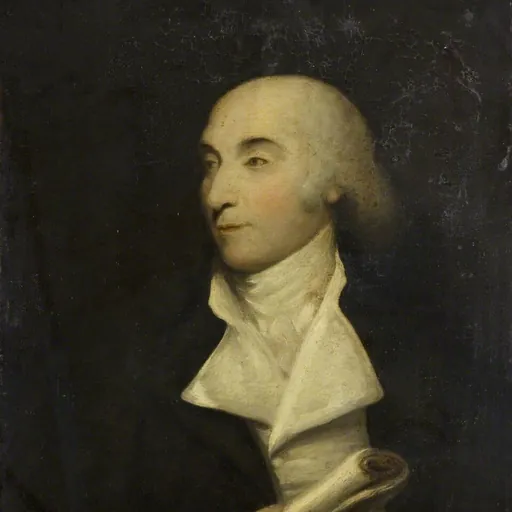
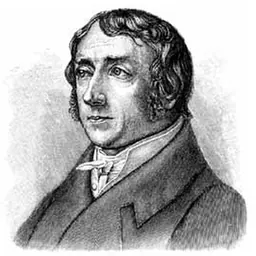
David Williams
Welsh philosopher of the Enlightenment period
About David Williams
Lived 1738 – 1816 (aged 77). David Williams was a British historian, philosopher, patron of the arts, opinion journalist, teacher and theologian.
David Williams (1738 – 29 June 1816) was a Welsh philosopher of the Enlightenment period. He was an ordained minister, theologian and political polemicist, and was the founder in 1788 of the Royal Literary Fund, of which he had been a proponent since 1773.
Upbringing Williams was born in a house called Waun Waelod in Watford near Caerphilly. His early education was partly under John Smith, vicar of Eglwysilan, and he went on to a local school run by his namesake, David Williams. His father, William David, was converted to Methodism by Howell Harris; it was at his request that David Williams entered the ministry. Rev. David, an unfortunate speculator in mines and miners' tools, died in 1752; the family consisted of one surviving son and two daughters.
His father on his deathbed made David promise to enter Carmarthen Academy to qualify as a dissenting minister. He studied there, with an exhibition from the London presbyterian board (1753 to Christmas 1757), under Evan Davies, a pupil of John Eames. The academy, hitherto Calvinist, had begun to acquire a heterodox repute. From February 1755 the London congregational board sent no students, owing to the alleged Arianism of Davies's assistant, Samuel Thomas. Davies himself resigned his chair in 1759 under suspicion of Arminianism. Williams' views were unconventional, largely thanks to his four years study at Carmarthen Academy, and he was regarded as a Deist.
Ordination Williams was ordained in 1758 to the charge of the dissenting congregation at Frome, Somerset, on a stipend of £45. This was the congregation from which Thomas Morgan, the deist, had been dismissed in 1720. Williams's theological views did not prove satisfactory. In 1761 he moved to the Mint meeting, Exeter, founded by James Peirce. Here he was reordained. He prepared A Liturgy on the Principles of the Christian Religion, which is said to have been adopted by his congregation. He soon quarrelled with 'elder members' who objected to his opinions. He retorted by finding fault with their morals. By way of an 'accommodation' he left Exeter about 1769 to take charge of a waning congregation in Southwood Lane, Highgate. To this congregation the father of John Wilkes used to drive in a coach-and-six. In this charge he appears to have remained till 1773. His withdrawal was ascribed by himself to 'the intrigues of a lady', and to no rejection of revelation, 'which he had taken for granted'. His successor, in 1774, was Joseph Towers. His first publication, The Philosopher, in Three Conversations, 1771, (dedicated to Lord Mansfield and Bishop Warburton), containing a project of church reform, drew the attention of John Jebb. With the co-operation of John Lee, a proposal was set on foot for opening a chapel in London with an expurgated prayer-book. Williams was to draw attention to the plan through the public papers. His communications to the Public Advertiser republished as Essays on Public Worship, Patriotism, and Projects of Reformation, 1773, were so deistic in tone as to put an end to the scheme.
Letter to David Garrick A taste for the drama led to his acquaintance with David Garrick whom he met at the house of a hostess of 'the wits of the time.' With this lady he visited Henry Mossop, the actor, who attributed his misfortunes to Garrick's neglect. Williams wrote to the papers embodying Mossop's view, but the communication was not printed. Three months later he published his keen but truculent Letter to David Garrick, 1772. According to a note by John Philip Kemble in the British Museum copy there was a second edition; Williams, in an advertisement at the end of his Lectures, 1779, vol. i., claims the authorship of the Letter, and affirms that there was 'a surreptitious edition'. Morris, who reprints the Letter with a wrong date (1770), says it was withdrawn from sale. In the Private Correspondence of David Garrick, 1831, is a letter (2 October 1772), signed D. Ws hinting that the published 'Letter' was by 'a young man who is making himself known us a first-rate genius.... His name is Williams. He is intimate at Captain Pye's. Goldsmith knows him, and I have seen him go into Johnson's'. James Boaden, the editor of the 'Correspondence' calls the writer (evidently Williams himself) an 'arrogant boy '. On Mossop's death (18 November 1773) Williams wrote to Garrick, and received a touching reply.
School and churches In 1773 Williams took a house in Lawrence Street, Chelsea, married Mary Emilia, a woman without a fortune, and set up a school. As the fruit of his ministry he published a volume of Sermons, chiefly upon Religious Hypocrisy (1774). His educational ideas, founded on those of John Amos Comenius, he embodied in his Treatise on Education (1774). Book-learning he subordinated to scientific training based on a first-hand knowledge of facts. He made a novel application of the drunken helot plan, obtaining from a workhouse a 'lying boy' as an object lesson. His school 'prospered beyond his expectations', but the death of his wife (in 1774) He was invited to take up his abode in the house of the Literary Fund, 36 Gerrard Street, Soho, and there he remained till his death, regularly attending the society's meetings. At a special meeting of the general committee, held without Williams's knowledge on 25 July 1815, it was resolved to offer him £50 every six months, as evidence of the committee's 'attachment to the first principles of their society'. Only one instalment was paid before his death on 29 June 1816. A second instalment was handed to his niece and housekeeper, Mary Watkins. On 6 July he was buried in St Anne's Church, Soho, where there is a brief inscription to his memory.
His will, dated 16 July 1814, left his papers to his executors, Richard Yates and Thomas Wittingham; his other property went to his niece and housekeeper, Mary Watkins (died 5 February 1845), who moved from Gerrard Street to Lower Sloane Street, and afterwards to King's Road, Chelsea.
A memorial to Williams was erected in 1911 in the park adjoining Caerphilly Castle, now named David Williams Park. It was listed Grade II in 1999.
Works Treatise on Education (1774) A Liturgy on the Universal Principles of Religion and Morality (1776) Letters on Political Liberty (1782) History of Monmouthshire (1796)
Don’t just read it —
keep it.
Full-length biographies made to live with: read them, listen on the way to work, watch them tonight.
- E-book
- Audio
- Video
Instant download · yours to keep · every purchase keeps this site free
Important facts
People in David Williams's life
Named in this biography and alive at the same time

Related people
Same field, nearest in time


Contemporaries
People whose lives overlapped David Williams's






Frequently asked questions
Who was David Williams?
Welsh philosopher of the Enlightenment period (1738–1816)
When was David Williams born?
David Williams was born on 1 December 1738 in Caerphilly County Borough.
When did David Williams die?
David Williams died on 29 June 1816.
What was David Williams's occupation?
David Williams was a historian, philosopher, patron of the arts, opinion journalist, teacher and theologian.
What nationality was David Williams?
David Williams was British.
Sources & further reading
· DBpedia: David Williams (philosopher)
Cite this page
APA: Biography.guide. (2026). David Williams. https://biography.guide/david-williams-historian-1738/
MLA: "David Williams." Biography.guide, https://biography.guide/david-williams-historian-1738/.
Chicago: "David Williams." Biography.guide. https://biography.guide/david-williams-historian-1738/.
Data last updated: 2026-09-22 · Spot an error? Report a correction.
Portrait: Wikimedia Commons · author & licence
Page generated 2026-09-27 05:03 UTC